
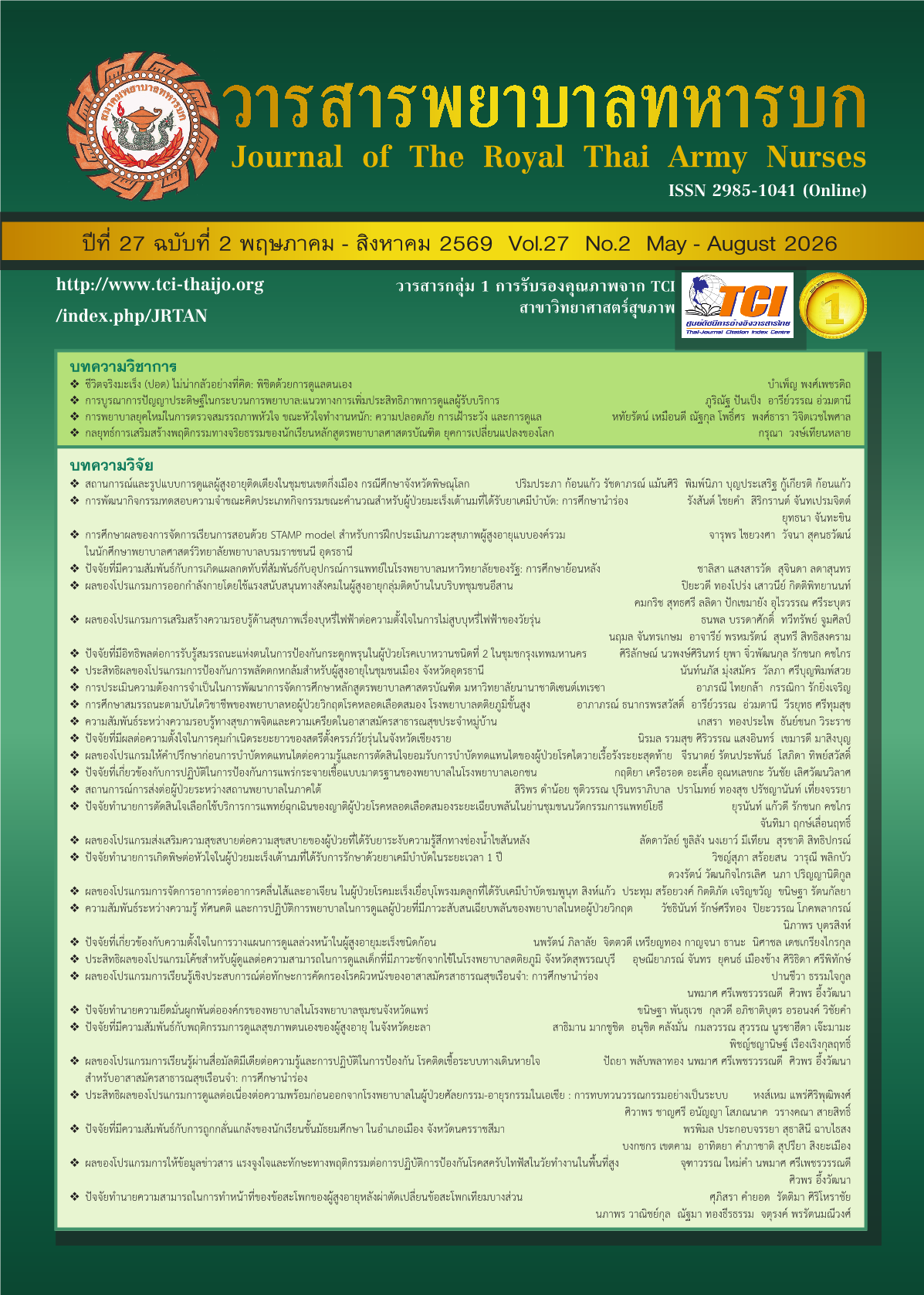
การบูรณาการปัญญาประดิษฐ์ในกระบวนการพยาบาล: แนวทางการเพิ่มประสิทธิภาพการดูแลผู้รับบริการ
คำสำคัญ:
ปัญญาประดิษฐ์, กระบวนการพยาบาล, ประสิทธิภาพการดูแลผู้รับบริการบทคัดย่อ
ในศตวรรษที่ 21 เทคโนโลยีปัญญาประดิษฐ์ (Artificial Intelligence: AI) ได้เข้ามามีบทบาทสำคัญต่อระบบบริการ สุขภาพและการพยาบาล เนื่องจากความสามารถในการประมวลผลและวิเคราะห์ข้อมูลจำนวนมากได้อย่างรวดเร็ว ทำให้ปัญญาประดิษฐ์กลายเป็นเครื่องมือที่ช่วยยกระดับคุณภาพการดูแลผู้รับบริการและช่วยเพิ่มประสิทธิภาพการทำงานของบุคลากรทาง การพยาบาล อย่างไรก็ตามการนำปัญญาประดิษฐ์มาใช้ในกระบวนการพยาบาลจำเป็นต้องมีแนวทางที่ชัดเจนและสอดคล้องกับหลัก จริยธรรม โดยให้ความสำคัญกับความปลอดภัยของผู้รับบริการ ความเป็นส่วนตัวของข้อมูลและความเสมอภาคในการเข้าถึงบริการ เพื่อสร้างความมั่นใจทั้งต่อผู้รับบริการและผู้ให้การพยาบาล บทความนี้มีวัตถุประสงค์เพื่อเสนอแนวทางการบูรณาการปัญญาประดิษฐ์เข้ากับกระบวนการพยาบาลทั้ง 5 ขั้นตอน พร้อมทั้งวิเคราะห์ปัจจัยสนับสนุนและปัจจัยอุปสรรคในการใช้ปัญญาประดิษฐ์ ในการให้บริการพยาบาล
Downloads
เอกสารอ้างอิง
Polevikov S. Advancing AI in healthcare: A comprehensive review of best practices. Clinica Chimica Acta. 2023; 548:1-9.
Rajpurkar P, Chen E, Banerjee O, & Topol EJ. AI in health and medicine. Nature Medicine. 2022;28(1):31–8.
Alowais SA, Alghamdi SS, Alsuhebany N, Alqahtani T, Alshaya AI, Almohareb SN, et al. Revolutionizing healthcare: the role of artificial intelligence in clinical practice. BMC Medical Education. 2023; 23:1-15.
Cary MP, Bessias S, McCall J, Pencina MJ, Grady SD, Lytle K, et al. Empowering nurses to champion Health equity & BE FAIR: Bias elimination for fair and responsible AI in healthcare. Journal of Nursing Scholarship. 2025;57(1):130–9.
Wieben AM, Walden RL, Alreshidi BG, Brown SF, Cato K, Coviak CP, et al. Data Science Implementation Trends in Nursing Practice: A Review of the 2021 Literature. Applied Clinical Informatics. 2023;14(3):585–93.
Lee D & Yoon SN. Application of Artificial Intelligence-Based Technologies in the Healthcare Industry: Opportunities and Challenges. International Journal Environment Research and Public Health. 2021;18(1):271-89.
Montejo L, Fenton A, & Davis G. Artificial intelligence (AI) applications in healthcare and considerations for nursing education. Nurse Education in Practice. 2024; 80:1-6.
Aung YYM, Wong DCS, & Ting DSW. The promise of artificial intelligence: a review of the opportunities and challenges of artificial intelligence in healthcare. British Medical Bulletin. 2021;139(1):4–15.
Al Khatib I & Ndiaye M. Examining the Role of AI in Changing the Role of Nurses in Patient Care: Systematic Review. Journal of Medical Internet Research Nursing. 2025; 8:1–19.
Jo HK. Why nursing cannot be replaced with artificial intelligence. Womens Health Nursing. 2024;30(4):340–4.
Vetter N. The promise of artificial intelligence: a review of the opportunities and challenges of artificial intelligence in healthcare and clinical trials in skeletal dysplasia: a paradigm for treating rare diseases. British Medical Bulletin. 202;139(1):1–3.
Ahmed MI, Spooner B, Isherwood J, Lane M, Orrock E, & Dennison A. A Systematic Review of the Barriers to the Implementation of Artificial Intelligence in Healthcare. Cureus. 2023;15(10):1-14.
Ranjbari D & Abbasgholizadeh Rahimi S. Implications of conscious AI in primary healthcare. Family Medicine and Community Health. 2024;12(Suppl 1):1-5.
Colomer-Lahiguera S, Gentizon J, Christofis M, Darnac C, Serena A & Eicher M. Achieving Comprehensive, Patient-Centered Cancer Services: Optimizing the Role of Advanced Practice Nurses at the Core of Precision Health. Seminars in Oncology Nursing. 2024;40(3):1-9.
Wipada K. Artificial Intelligence and Nursing Profession: Driving Sustainable Healthcare in the Digital 5.0 Era. The Journal of Chulabhorn Royal Academy.2025;7(4):446–55. (in Thai)
Kimura R, Noitasaeng P, & Vichitvejpaisal P. Artificial Intelligence - An Innovation in Nursing Care. Journal of The Royal Thai Army Nurses. 2023;24(3):15–22. (in Thai)
Younis HA, Eisa TAE, Nasser M, Sahib TM, Noor AA, Alyasiri OM, et al. A Systematic Review and Meta-Analysis of Artificial Intelligence Tools in Medicine and Healthcare: Applications, Considerations, Limitations, Motivation and Challenges. Diagnostics (Basel). 2024;14(1): 109-47.
Davenport T & Kalakota R. The potential for artificial intelligence in healthcare. Future Healthcare Journal. 2019;6(2):94–8.
Von Gerich H, Moen H, Block LJ, Chu CH, DeForest H, Hobensack M, et al. Artificial Intelligence -based technologies in nursing: A scoping literature review of the evidence. International Journal of Nursing Studies. 2022; 127:1-20.
Manickam P, Mariappan SA, Murugesan SM, Hansda S, Kaushik A, Shinde R, et al. Artificial Intelligence (AI) and Internet of Medical Things (IoMT) Assisted Biomedical Systems for Intelligent Healthcare. Biosensors (Basel). 2022;12(8):1-29.
Lynn LA. Artificial intelligence systems for complex decision-making in acute care medicine: a review. Patient Safety in Surgery. 2019; 13:6-14.
Shorey S, Mattar C, Pereira TLB, & Choolani M. A scoping review of ChatGPT’s role in healthcare education and research. Nurse Education Today. 2024; 135:1-11.
ดาวน์โหลด
เผยแพร่แล้ว
รูปแบบการอ้างอิง
ฉบับ
ประเภทบทความ
สัญญาอนุญาต
ลิขสิทธิ์ (c) 2026 วารสารพยาบาลทหารบก

อนุญาตภายใต้เงื่อนไข Creative Commons Attribution-NonCommercial-NoDerivatives 4.0 International License.
บทความหรือข้อคิดเห็นใดใดที่ปรากฏในวารสารพยาบาลทหารบกเป็นวรรณกรรมของผู้เขียน ซึ่งบรรณาธิการหรือสมาคมพยาบาลทหารบก ไม่จำเป็นต้องเห็นด้วย
บทความที่ได้รับการตีพิมพ์เป็นลิขสิทธิ์ของวารสารพยาบาลทหารบก
The ideas and opinions expressed in the Journal of The Royal Thai Army Nurses are those of the authors and not necessarily those
of the editor or Royal Thai Army Nurses Association.