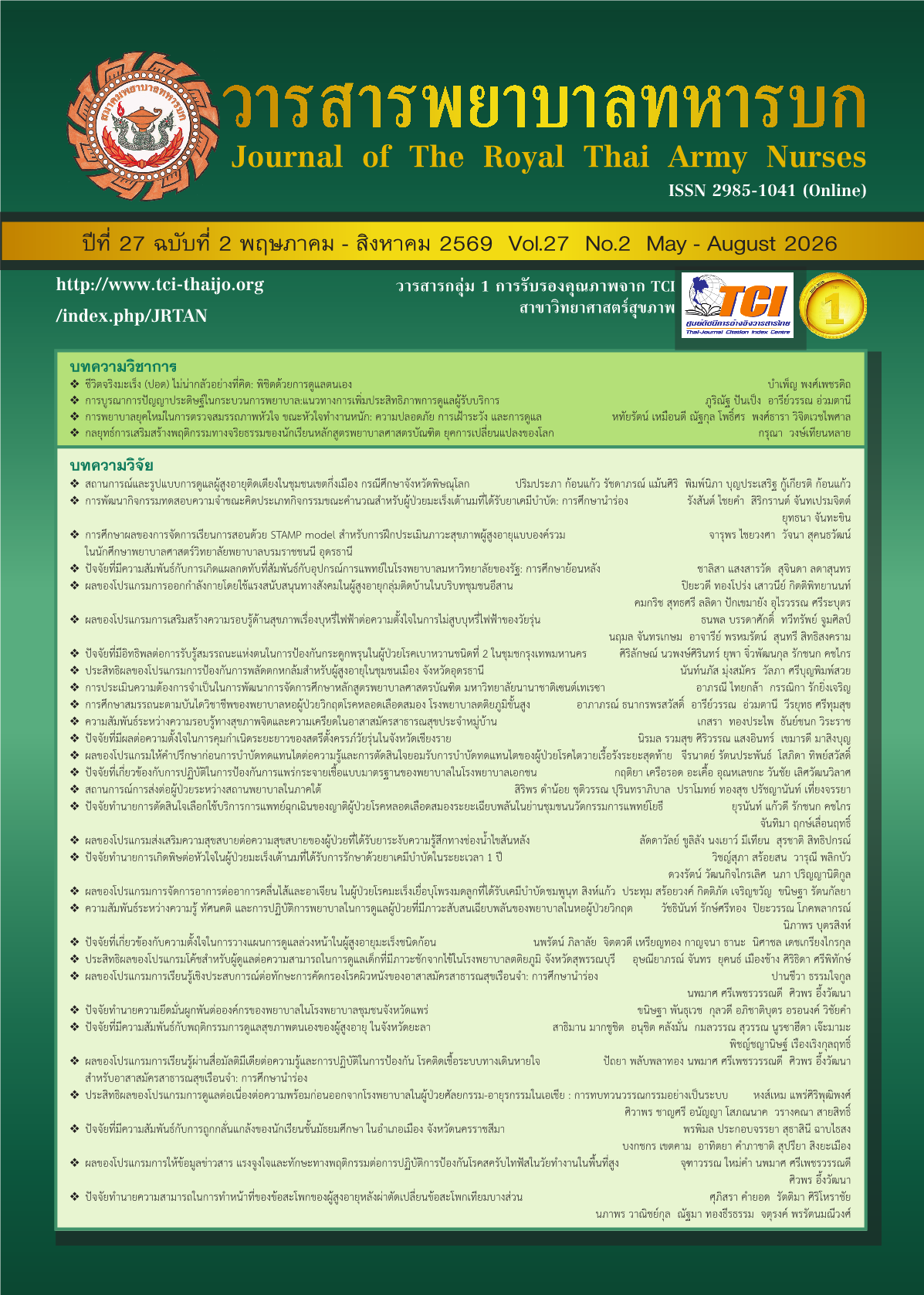
ปัจจัยที่เกี่ยวข้องกับความตั้งใจในการวางแผนการดูแลล่วงหน้าในผู้สูงอายุมะเร็งชนิดก้อน
คำสำคัญ:
การวางแผนการดูแลล่วงหน้า, ผู้สูงอายุ, มะเร็งก้อนบทคัดย่อ
การวางแผนการดูแลล่วงหน้าเป็นสิ่งสำคัญในกลุ่มผู้สูงอายุมะเร็งชนิดก้อน โดยส่วนใหญ่ไม่มีการวางแผนการดูแลล่วงหน้า ทำให้ได้รับการรักษาที่ไม่จำเป็นและไม่เกิดประโยชน์ การวิจัยนี้มีวัตถุประสงค์เพื่อศึกษาระดับความตั้งใจในการวางแผนการดูแลล่วงหน้าและปัจจัยที่เกี่ยวข้อง โดยเป็นการศึกษาเชิงพรรณนาหาความสัมพันธ์ เลือกกลุ่มตัวอย่างแบบเฉพาะเจาะจงตามคุณสมบัติที่กำหนด จำนวน 84 คน เครื่องมือที่ใช้ในการเก็บรวบรวมข้อมูลได้แก่ 1) แบบสอบถามข้อมูลส่วนบุคคล 2) แบบสอบถามความตั้งใจในการวางแผนการดูแลล่วงหน้า 3) แบบสอบถามทัศนคติต่อความตาย 4) แบบวัดการสนับสนุนทางสังคม และ 5) แบบสอบถามความรู้เกี่ยวกับการวางแผนการดูแลล่วงหน้า วิเคราะห์ข้อมูลโดยใช้สถิติเชิงพรรณนา สถิติสัมประสิทธิ์สหสัมพันธ์พอยท์ไบซีเรียล และสถิติสัมประสิทธิ์สหสัมพันธ์สเปียร์แมน ผลการศึกษาพบว่า ความตั้งใจในการวางแผนการดูแลล่วงหน้าอยู่ในระดับสูง ความตั้งใจในการวางแผนการดูแลล่วงหน้ามีความสัมพันธ์ทางบวกในระดับต่ำกับระดับการศึกษาอย่างมีนัยสำคัญทางสถิติ (rpb = .220, p <.05) ความตั้งใจในการวางแผนการดูแลล่วงหน้ามีความสัมพันธ์ทางบวกในระดับปานกลางกับทัศนคติต่อความตาย และการสนับสนุนทางสังคมอย่างมีนัยสำคัญทางสถิติ (rs =.364 และ.538 ตามลำดับ, p <.01) ในขณะที่เพศ อายุ ศาสนา และความรู้เกี่ยวกับการวางแผนการดูแลล่วงหน้าไม่มีความสัมพันธ์กับความตั้งใจในการวางแผนการดูแลล่วงหน้า
Downloads
เอกสารอ้างอิง
Strategy and Planning Division. Public health statistics 2021. Nonthaburi: Strategy and Planning Division, Ministry of Public Health; 2021. (in Thai)
World Health Organization. International Agency for Research on Cancer: Global cancer observatory. Geneva: World Health Organization; 2022.
Burstein R, Aviv A, Even-Zohar NG, Nachmias B, Haran A, Braun M, et al. Comparing end-oflife care of hematologic malignancy versus solid tumor patients in a tertiary care center. European Journal Haematology. 2023; 111(4): 528-35.
Newcomb RA, Nipp RD, Waldman LP, Greer JA, Lage DE, Hochberg EP, et al. Symptom burden in patients with cancer who are experiencing unplanned hospitalization. Cancer. 2020; 126(12): 2924-33.
Utthiya P. Role of Home Care Nurses for Older Adults with End Stage Cancer. Journal of The Royal Thai Army Nurses. 2020; 21(1): 18-25. (in Thai)
Liao J, Wu B, Mao J, & Ni P. Preference for aggressive end-of-life care among advanced cancer patients in wuhan, china: a crosssectional study. International Journal of Environmental Research and Public Health. 2020; 17(18): 1-12.
Martínez-Arnau FM, Puchades-García A, & Pérez-Ros P. Accuracy of delirium screening tools in older people with cancer-A systematic review. Cancers (Basel). 2023; 15(10): 1-15.
National Health Commission Office of Thailand. Thai standards for advance care planning 2022. Nonthaburi: National Health Commission Office of Thailand; 2022. (in Thai)
Goswami P. Advance Care Planning and EndOf-Life Communications: Practical Tips for Oncology Advanced Practitioners. Journal of the Advanced Practitioner Oncology. 2021; 12(1): 89-95
Hu L, Chu Q, Fan Z, & Chen Y. Discussion of advance care planning on end-of-life decisions with lung cancer patients in Wuhan, China: attitude, timing and future directions. Internal Medicine Journal. 2021; 51(12): 2111–8.
Breslin L, Connolly E, Purcell R, Lavan A, Kenny RA, & Briggs R. What factors are associated with advance care planning in community dwelling older people? Data from TILDA. European Geriatric Medicine. 2022; 13(1): 285–9.
Hong M, & Kim K. Advance care planning among ethnic/racial minority older adults: Prevalence of and factors associated with informal talks, durable power of attorney for health care, and living will. Ethnicity Health. 2022; 27(2): 453–62.
Tsai WT, Chen CM, Chung MC, Tsai PY, Liu YT, Tang FC, et al. Important factors influencing willingness to participate in advance care planning among outpatients: A pilot study in central Taiwan. International Journal of Environmental Research and Public Health. 2022; 19(9): 1-9.
Yang Z, Hou B, Chen P, & Zhang H. Preference and influencing factors of advance care planning for Chinese elderly patients with chronic diseases: A mixed-methods approach. Journal of Hospice and Palliative Nursing. 2021; 23(2): 178–86.
Takeshita Y, Kaneko F, & Okamura H. Factors associated with facilitating advance care planning based on the theory of planned behaviour. Japanese Journal of Clinical Oncology. 2021; 51(6): 942-9.
Zheng X, Gao Y, Yan XX, Zhu X, & Wang C. Acceptance status and influencing factors of advance care planning among elderly patients with chronic disease. Medicine (Baltimore). 2024; 103(49): e40526.
Ke LS, Cheng HC, Ku YC, Lee MJ, Chang SY, Huang HY, et al. Older adults’ behavioral intentions toward advance care planning based on theory of reasoned action. Journal of Hospice and Palliative Nursing. 2022; 24(6): E294–300.
Zhang P, Sun F, & Hirsch J. Perceived barriers and social cultural factors associated with advance care planning conversations among Chinese American older adults. Journal of Applied Gerontology. 2023; 42(10): 2110-8.
Kelly EP, Henderson B, Hyer M, Pawlik TM. Intrapersonal factors impact advance care planning among cancer patients. American Journal of Hospice and Palliative Care. 2021; 38(8): 907–13.
Chiangmai Provincial public health Office. Health screening guide for the elderly health promotion. Chiang Mai: Chiangmai Provincial Public Health Office; 2018. (in Thai)
Nilchaikovit T, Lotrakul M, & Phisansuthideth U. Development of Thai version of hospital anxiety and depression scale in cancer patients. Journal of the Psychiatric Association of Thailand. 1996; 41(1): 18–30. (in Thai)
Cheng HC, Ke LS, Chang SY, Huang HY, Ku YC, & Lee MJ. Knowledge, attitudes, and behavioral intentions of elderly individuals regarding advance care planning: questionnaire development and testing. Public Library of Science One. 2022; 17(7): e0272351.
Sawasdipanich N, Thiansawad S. Translation of instruments for cross-cultural research: Techniques and considerations. Thai Journal of Nursing. 2011; 26(1): 19-28.
Kritsadee D, & Surinya T. Attitudes toward death, self-awareness, family support, and depression among the elderly in the elderly club, Sikhio district, Nakhon Ratchasima province. (thesis). Bangkok: Kasetsart University; 2008. (in Thai)
Pawapaiboon K. Mental health self-care behaviors, hope, and social support among the elderly in Ratchaburi Province. (thesis). Bangkok: Mahidol University; 2004. (in Thai)
Kanchanopas T, & Thanapreethiwong S. Advance care planning in the elderly. Ramathibodi Medical Journal. 2024; 47(4): 46–60. (in Thai)
Roulet C. Gender equality in politics. Organisation for Economic Co-Operation and Development (OECD); 2024
Gallagher J, Bolt T, & Tamiya N. Advance care planning in the community: factors of influence. British Medical Journal Supportive and Palliative Care. 2022; 12(3): e345–57.
Thapanakunlaks S. Advance care planning: Key issues in palliative care for the elderly. The Journal of Nursing Science and Health. 2020; 43(3): 12–23. (in Thai)
Sawa T. Review of Religious Variables in Advance Care Planning for End-of-Life Care: Consideration of Faith as a New Construct. The American Journal of Geriatric Psychiatry. 2022; 30(7): 747–58.
Yunus RM, Duivenbode R, & Padela AI. American Muslim engagement with advance care planning: Insights from a community survey. The American journal of hospice and palliative care. 2024; 41(4): 405-13.
Rahemi Z, & Adams SA. Advance care planning among diverse U.S. older adults with varied cognition levels. Alzheimer’s & Dementia. 2024; 20(Suppl. 7): 1-2
Park S-u, & Kang Y-S. The effect of cancer patients’ knowledge of advanced directives and perception of good death on attitude toward withdrawal of life-sustaining treatment. Journal of the Korea Academia Industrial Cooperation Society. 2021; 22: 539-47.
Wang K, De Fries C, To MN, Sun F, Wu B, & Levkoff S. Attitudes toward advance directives among older Southeast Asian American. Innovation in Aging. 2023; 7(Supplement_1): 220.
Ajzen I. From intentions to actions: A theory of planned behavior. Berlin: Springer-Verlag; 1985.
Li Z, McIlfatrick S, Hasson F, & Beck ER. Factors influencing knowledge, attitudes and behaviour towards engaging with advance care planning: A cross-sectional survey of Chinese diaspora. Journal of Palliative Care. 2025; 40(3): 233-43.
Chikada A, Arakawa Y, Takenouchi S, & Narita Y. Advance care planning in primary malignant brain tumors: Knowledge, experiences, and preferences of patients and caregivers. Neuro-Oncology Practice. 2025; 12(1): 1-11.
ดาวน์โหลด
เผยแพร่แล้ว
รูปแบบการอ้างอิง
ฉบับ
ประเภทบทความ
สัญญาอนุญาต
ลิขสิทธิ์ (c) 2026 วารสารพยาบาลทหารบก

อนุญาตภายใต้เงื่อนไข Creative Commons Attribution-NonCommercial-NoDerivatives 4.0 International License.
บทความหรือข้อคิดเห็นใดใดที่ปรากฏในวารสารพยาบาลทหารบกเป็นวรรณกรรมของผู้เขียน ซึ่งบรรณาธิการหรือสมาคมพยาบาลทหารบก ไม่จำเป็นต้องเห็นด้วย
บทความที่ได้รับการตีพิมพ์เป็นลิขสิทธิ์ของวารสารพยาบาลทหารบก
The ideas and opinions expressed in the Journal of The Royal Thai Army Nurses are those of the authors and not necessarily those
of the editor or Royal Thai Army Nurses Association.