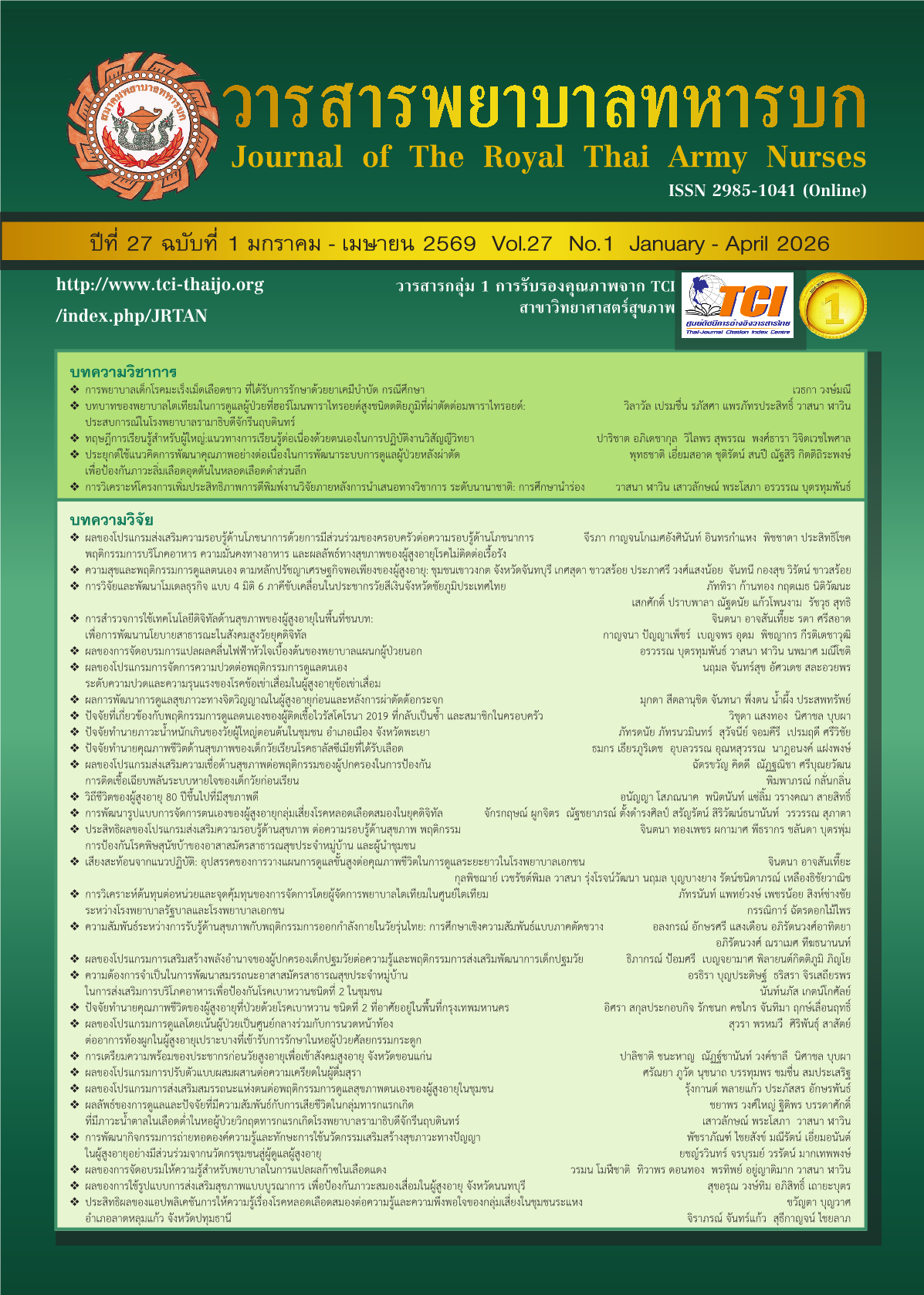
ความสัมพันธ์ระหว่างการรับรู้ด้านสุขภาพกับพฤติกรรมการออกกำลังกายในวัยรุ่นไทย: การศึกษาเชิงความสัมพันธ์แบบภาคตัดขวาง
คำสำคัญ:
การรับรู้ด้านสุขภาพ, พฤติกรรมการออกกำลังกาย, วัยรุ่น, การศึกษาเชิงความสัมพันธ์แบบภาคตัดขวางบทคัดย่อ
การศึกษามีวัตถุประสงค์เพื่อศึกษาความสัมพันธ์ระหว่างการรับรู้ด้านสุขภาพกับพฤติกรรมการออกกำลังกายในวัยรุ่นไทย โดยใช้ข้อมูลจากกลุ่มตัวอย่างนักเรียนระดับมัธยมศึกษาตอนปลาย โรงเรียนมัธยมสาธิตมหาวิทยาลัยนเรศวร จังหวัดพิษณุโลก
การศึกษาเป็นแบบภาคตัดขวาง กลุ่มตัวอย่างจำนวน 324 คน คัดเลือกโดยใช้การสุ่มอย่างง่าย เก็บข้อมูลโดยใช้แบบสอบถามเกี่ยวกับการรับรู้ด้านสุขภาพและพฤติกรรมการออกกำลังกาย การตรวจสอบคุณภาพด้านความตรงเชิงเนื้อหาและความเชื่อมั่นของเครื่องมือวัด วิเคราะห์ข้อมูลโดยใช้สถิติเชิงพรรณนา และการวิเคราะห์ค่าสัมประสิทธิ์สหสัมพันธ์ของเพียร์สัน
ผลการศึกษาพบว่า การรับรู้ประโยชน์ของการออกกำลังกายมีความสัมพันธ์เชิงบวกกับพฤติกรรมการออกกำลังกายในระดับปานกลาง อย่างมีนัยสำคัญทางสถิติ (r = .40, p < .05) การรับรู้อุปสรรคของการออกกำลังกายมีความสัมพันธ์เชิงลบกับพฤติกรรมการออกกำลังกายในระดับต่ำ (r = -.25, p < .05) การรับรู้โอกาสเสี่ยงของการไม่ออกกำลังกาย และการรับรู้ความรุนแรงของการไม่ออกกำลังกาย มีความสัมพันธ์เชิงบวกกับพฤติกรรมการออกกำลังกายในระดับต่ำถึงปานกลาง (r = .33, p < .05 และ r = .36, p < .05 ตามลำดับ) ดังนั้นการพัฒนาโปรแกรมการส่งเสริมสุขภาพควรมุ่งเน้นการเพิ่มการรับรู้ประโยชน์ของการออกกำลังกาย และลดอุปสรรคเพื่อสนับสนุนให้วัยรุ่นมีพฤติกรรมสุขภาพที่ดี
Downloads
เอกสารอ้างอิง
Lee EY, Shih AC, Collins M, Kim YB, Nader PA, Bhawra J, et al. Report card grades on physical activity for children and adolescents from 18 Asian countries: Patterns, trends, gaps, and future recommendations. Journal of Exercise Science and Fitness. 2023;21(1):34–44.
Sritart H, Taertulakarn S, & Miyazaki H. Disparities in childhood obesity prevalence and spatial clustering related to socioeconomic factors in Isaan, Thailand. International Journal of Environmental Research and Public Health. 2023;20(1):1-18.
Thai Ministry of Public Health. Prevalence of childhood overweight and obesity. Nonthaburi: Thai Ministry of Public Health. 2023. (in Thai)
Widyastari DA, Saonuam P, Pongpradit K, Wongsingha N, Choolers P, Kesaro S, et al. Results from the Thailand 2022 report card on physical activity for children and youth. Journal of Exercise Science and Fitness. 2022;20(4):276–82.
National Physical Activity Promotion Master Plan Committee. National Master Plan for Physical Activity Promotion: 2018–2030. Bangkok: National Health Security Office. 2017. (in Thai)
Topothai T, Liangruenrom N, Topothai C, Suriyawongpaisan W, Limwattananon S, Limwattananon C, et al. How much energy do Thai people expend in physical activity and sedentary behavior? Data from the 2015 National Health and Welfare Survey. Journal of Health Systems Research. 2017;11(3): 327–44. (in Thai)
Katewongsa P, Pongpradit K, & Widyastari DA. Physical activity level of Thai children and youth: Evidence from Thailand’s 2018 report card on physical activity for children and youth. Journal of Exercise Science and Fitness. 2021;19(2):71–4. (in Thai)
Widyastari DA, Saonuam P, Rasri N, Pongpradit K, & Katewongsa P. Prevalence and trends of physical activity in Thai children and young people: Pooled panel data analysis from Thailand’s surveillance on physical activity 2012–2020. International Journal of Environmental Research and Public Health. 2021;18(19):1-14.
Amornsriwatanakul A, Lester L, Bull FC, & Rosenberg M. Ecological correlates of sport and exercise participation among Thai adolescents: A hierarchical examination of a cross-sectional population survey. Journal of Sport and Health Science. 2023;12(5):592–605. (in Thai)
Bussamongkhon P, & Thonglong T. The effects of applied Thai dance aerobic exercise program on the health-related physical fitness of female students among upper elementary school. Journal of The Royal Thai Army Nurses. 2024;25(1):449–57. (in Thai)
Piboon K, Methaphat C, Ouppawongsapat D, Chaiklongkit K, Arunrat P, & Sukthong N. Predicting factors of physical activity among university students, Thailand. Bangkok Medical Journal. 2020;16(1):33. (in Thai)
Tongwat P, & Kitreerawutiwong N. Factors predicting physical activity behaviors among grade 4–6 students in Nongkula Sub-district, Bang Rakam District, Phitsanulok Province. Nursing Journal of the Ministry of Public Health. 2019;29(2):24–36. (in Thai)
Manokha S, Theerawiwat M, & Imamee N. Factors associated with health-promoting behaviors among university students in Bangkok. Journal of Health Education. 2019; 42(1):146–56. (in Thai)
Becker MH. The health belief model and personl health behavior. Health Education Monographs. 1974;2(4):324-473.
Al-Khudairy L, Loveman E, Colquitt JL, Mead E, Johnson RE, Fraser H, et al. Diet, physical activity and behavioral interventions for the treatment of overweight or obese adolescents aged 12 to 17 years. Cochrane Database of Systematic Review. 2017;6(6):1-341.
Wannalai U. Factors influencing health management for obesity prevention among adolescents in Lampang Province. Journal of Health Science of Thailand. 2021;30(Suppl 3): S441–53. (in Thai)
Uthaithum N, Pithoonsap C, Chimpalee B, & Jaree S. Factors related to exercise behavior of nursing students, Prachomklao College of Nursing, Phetchaburi Province. Journal of Prachomklao College of Nursing, Phetchaburi Province. 2020;3(1):62–72. (in Thai)
Sopha C, Meedech N, Khattipan N, Lim N, Wongkhomlue C, Khamkrueang N, et al. Factors associated with exercise behavior among undergraduate students during the COVID-19 pandemic: A cross-sectional correlation study. Nursing Science Journal of Thailand. 2022;40(4):65–76. (in Thai)
Polit DF, & Beck CT. Nursing research: Generating and assessing evidence for nursing practice. 9thed. Philadelphia: Lippincott Williams & Wilkins; 2012.
Hu D, Zhou S, Crowley-McHattan ZJ, & Liu Z. Factors that influence participation in physical activity in school-aged children and adolescents: A systematic review from the social ecological model perspective. International Journal of Environmental Research and Public Health. 2021;18(6):1-22.
Sheng J, Gong L, & Zhou J. Exercise health belief model mediates the relationship between physical activity and peer support among Chinese college students: A cross-sectional survey. Frontiers in Psychology. 2023;14(1):1-9.
Damayanti I, Rahayu NI, & Hadi A. Relationship between students perceived exercise benefit and physical activity level during COVID-19 pandemic in Indonesia. Malaysian Journal of Medicine and Health Sciences. 2021;17(Suppl 14):105–9.
ดาวน์โหลด
เผยแพร่แล้ว
รูปแบบการอ้างอิง
ฉบับ
ประเภทบทความ
สัญญาอนุญาต
ลิขสิทธิ์ (c) 2026 วารสารพยาบาลทหารบก

อนุญาตภายใต้เงื่อนไข Creative Commons Attribution-NonCommercial-NoDerivatives 4.0 International License.
บทความหรือข้อคิดเห็นใดใดที่ปรากฏในวารสารพยาบาลทหารบกเป็นวรรณกรรมของผู้เขียน ซึ่งบรรณาธิการหรือสมาคมพยาบาลทหารบก ไม่จำเป็นต้องเห็นด้วย
บทความที่ได้รับการตีพิมพ์เป็นลิขสิทธิ์ของวารสารพยาบาลทหารบก
The ideas and opinions expressed in the Journal of The Royal Thai Army Nurses are those of the authors and not necessarily those
of the editor or Royal Thai Army Nurses Association.