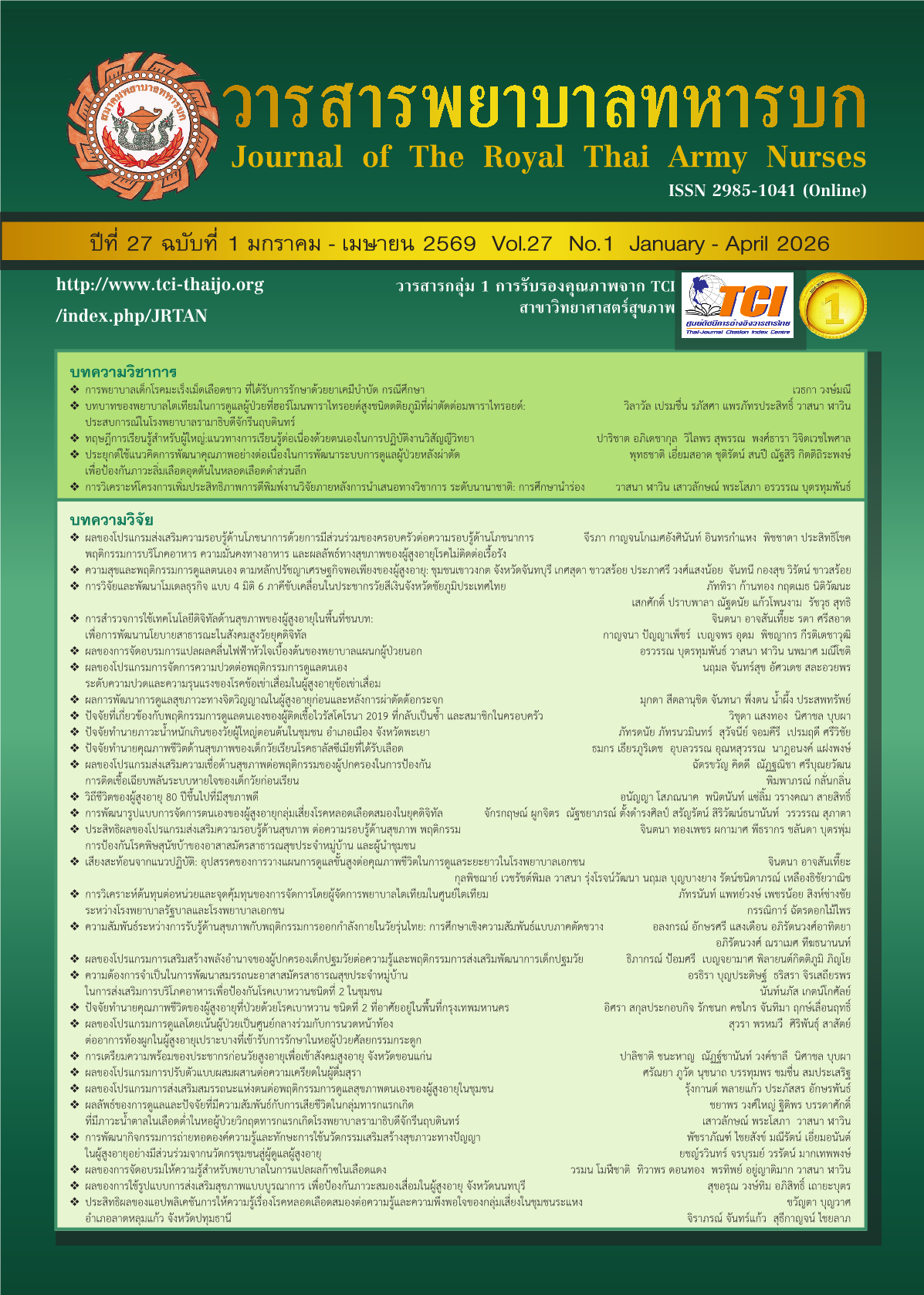
ผลของโปรแกรมส่งเสริมความรอบรู้ด้านโภชนาการ ด้วยการมีส่วนร่วมของครอบครัวต่อความรอบรู้ด้านโภชนาการ พฤติกรรมการบริโภคอาหาร ความมั่นคงทางอาหาร และผลลัพธ์ทางสุขภาพของผู้สูงอายุโรคไม่ติดต่อเรื้อรัง
คำสำคัญ:
ความรอบรู้ด้านโภชนาการ, การมีส่วนร่วมของครอบครัว, พฤติกรรมการบริโภคอาหาร, ความมั่นคงทางอาหาร, ผลลัพธ์ทางสุขภาพบทคัดย่อ
การวิจัยกึ่งทดลองนี้ มีวัตถุประสงค์เพื่อศึกษาผลของโปรแกรมส่งเสริมความรอบรู้ด้านโภชนาการด้วยการมีส่วนร่วมของครอบครัวต่อความรอบรู้ด้านโภชนาการ พฤติกรรมการบริโภคอาหาร ความมั่นคงทางอาหาร และผลลัพธ์ทางสุขภาพของผู้สูงอายุโรคไม่ติดต่อเรื้อรังจำนวน 68 คน โดยการสุ่มอย่างง่ายเข้ากลุ่มทดลองและกลุ่มควบคุมกลุ่มละ 34 คน เครื่องมือที่ใช้ได้แก่ แบบสอบถามความรอบรู้ด้านโภชนาการ แบบสอบถามพฤติกรรมการบริโภคอาหาร และแบบสอบถามความมั่นคงทางอาหาร โดยมีค่าความเชื่อมั่นเท่ากับ .98 .71 และ.72 ตามลำดับ รวมทั้งแบบบันทึกผลลัพธ์ทางสุขภาพได้แก่ ดัชนีมวลกาย เส้นรอบเอว ความดันโลหิต และน้ำตาลในเลือด วิเคราะห์ข้อมูลด้วยสถิติ MANOVA และ Repeated MANOVA
ผลการศึกษาพบว่า ความรอบรู้ด้านโภชนาการ พฤติกรรมการบริโภคอาหาร และผลลัพธ์ทางสุขภาพ ได้แก่ ดัชนีมวลกาย และเส้นรอบเอวของกลุ่มทดลอง ระยะหลังการทดลองและติดตามผลดีกว่ากลุ่มควบคุมอย่างมีนัยสำคัญทางสถิติ (p<.05) และความรอบรู้ด้านโภชนาการ พฤติกรรมการบริโภคอาหาร ความมั่นคงทางอาหาร และผลลัพธ์ทางสุขภาพคือ ดัชนีมวลกายและเส้นรอบเอวของกลุ่มทดลอง ระยะหลังการทดลองและติดตามผลดีกว่าระยะก่อนการทดลองอย่างมีนัยสำคัญทางสถิติ (p<.05) ดังนั้น ควรนำโปรแกรมนี้ไปพัฒนาพฤติกรรมการบริโภคอาหาร ความมั่นคงทางอาหาร และผลลัพธ์ทางสุขภาพเพื่อลดภาวะแทรกซ้อนโรคไม่ติดต่อเรื้อรังในผู้สูงอายุได้
Downloads
เอกสารอ้างอิง
Sapkota BP, Baral KP, Rehfuess EA, Parhofer KG, & Berger U. Effects of age on non-communicable disease risk factors among Nepalese adults. PLoS One. 2023;18(6):1-15.
Krause C, Sommerhalder K, Beer-Borst S, & Abel T. Just a subtle difference? Findings from a systematic review on definitions of nutrition literacy and food literacy. Health Promotion International. 2018;33(3):378-89.
Vettori V, Lorini C, Milani C, & Bonaccorsi G. Towards the Implementation of a Conceptual Framework of Food and Nutrition Literacy: Providing Healthy Eating for the Population. International Journal of Environmental Research and Public Health. 2019;16(24):1-21.
Sebern M. Shared Care, elder and family member skills used to manage burden. The Journal of Advanced Nursing. 2005;52(2):170-9.
Monteiro M, Fontes T, & Ferreira-Pêgo C. Nutrition Literacy of Portuguese Adults-A Pilot Study. International Journal of Environmental Research and Public Health. 2021;18(6):7-9.
Xie H, Qiao LH, Zhao Y, Yan Z, Bai H, Wang Y, et al. Nutrition education with or without oral nutrition supplements has contrasting effects on nutrition status in older adults: A randomized controlled study. Nutrition and Clinical Practice. 2023;38(1):138-47.
Parekh N, Khalife G, Hellmers N, & D’Eramo Melkus G. The Healthy Eating and Living Against Noncommunicable Diseases Study: An Innovative Family-Based Intervention. The Diabetes Educator. 2020;46(6):569-79.
Abdelwahed AY, Algameel MMM, & Tayel DI. Effect of a Nutritional Education Program on Nutritional Status of Elderly in Rural Areas of Damanhur City, Egypt. International Journal of Nursing Science. 2018;8(5):83-92.
Mezirow J. Transformative Learning as Discourse. Journal of Transformative Education. 2003; 1(1):58-63.
Intarakamhang U. 3-Self behavior modification programs base on the PROMISE Model for clients at metabolic risk. Global Journal of Health Sciences. 2011;4(1):204-10.
Singtong T, Ivanovitch K, & Boonshuyar C. Effects of a Nutrition Literacy Promotion Program on Eating Behavior of Secondary School Students. Thai Journal of Public Health. 2020; 50(2): 149-59. (in Thai)
Gibbs HD, Ellerbeck EF, Gajewski B, Zhang C, & Sullivan DK. The Nutrition Literacy Assessment Instrument is a Valid and Reliable Measure of Nutrition Literacy in Adults with Chronic Disease. Journal of Nutrition Education and Behavior. 2018;50(3):247-57.
Peng W, & Berry EM. The Concept of Food Security. In: Ferranti P, Berry EM, & Anderson JR, editors. Encyclopedia of Food Security and Sustainability. Oxford; Elsevier. 2019.
Santiparp P. The results of health literate promot ing program using based on transformative learning via social medias for hypertensive/diabetes mellitus patients. Santapol College Academic Journal. 2019; 6(1):9-18. (in Thai)
Smith ML, Lee S, Towne SD, Jr., Han G, Quinn C, Peña-Purcell NC, et al. Impact of a Behavioral Intervention on Diet, Eating Patterns, SelfEfficacy, and Social Support. Journal of Nutrition Education and Behavior. 2020; 52(2):180-6.
West EG, Lindberg R, Ball K, & McNaughton SA. The Role of a Food Literacy Intervention in Promoting Food Security and Food LiteracyOz Harvest’s NEST Program. Nutrients. 2020;12(8): 1-24.
Ng AH, ElGhattis Y, Biesiekierski JR, & Moschonis G. Assessing the effectiveness of a 4-week online intervention on food literacy and fruit and vegetable consumption in Australian adults: The online MedDiet challenge. Health and Social Care in the Community. 2022;30(6): e4975-81.
Duncan S, Goodyear-Smith F, McPhee J, Zinn C, Grøntved A, & Schofield G. Family-centered brief intervention for reducing obesity and cardiovascular disease risk: A randomized controlled trial. Obesity (Silver Spring). 2016; 24(11):2311-8.
Rimpeekool S, & Seubsman S. Effects of Nutrition Education Program with Applied Social Support Theory on Food Knowledge and Consumption Behavior among In-patientswith Acute Coronary Syndrome of Naresuan University Hospital. Journal of The Royal Thai Army Nurses. 2022;23(3):363-71. (in Thai)
Chongmontri K. Food literacy program in elderly retirement teachers. (thesis). Bangkok: Srinakharinwirot University; 2019. (in Thai)
ดาวน์โหลด
เผยแพร่แล้ว
รูปแบบการอ้างอิง
ฉบับ
ประเภทบทความ
สัญญาอนุญาต
ลิขสิทธิ์ (c) 2026 วารสารพยาบาลทหารบก

อนุญาตภายใต้เงื่อนไข Creative Commons Attribution-NonCommercial-NoDerivatives 4.0 International License.
บทความหรือข้อคิดเห็นใดใดที่ปรากฏในวารสารพยาบาลทหารบกเป็นวรรณกรรมของผู้เขียน ซึ่งบรรณาธิการหรือสมาคมพยาบาลทหารบก ไม่จำเป็นต้องเห็นด้วย
บทความที่ได้รับการตีพิมพ์เป็นลิขสิทธิ์ของวารสารพยาบาลทหารบก
The ideas and opinions expressed in the Journal of The Royal Thai Army Nurses are those of the authors and not necessarily those
of the editor or Royal Thai Army Nurses Association.