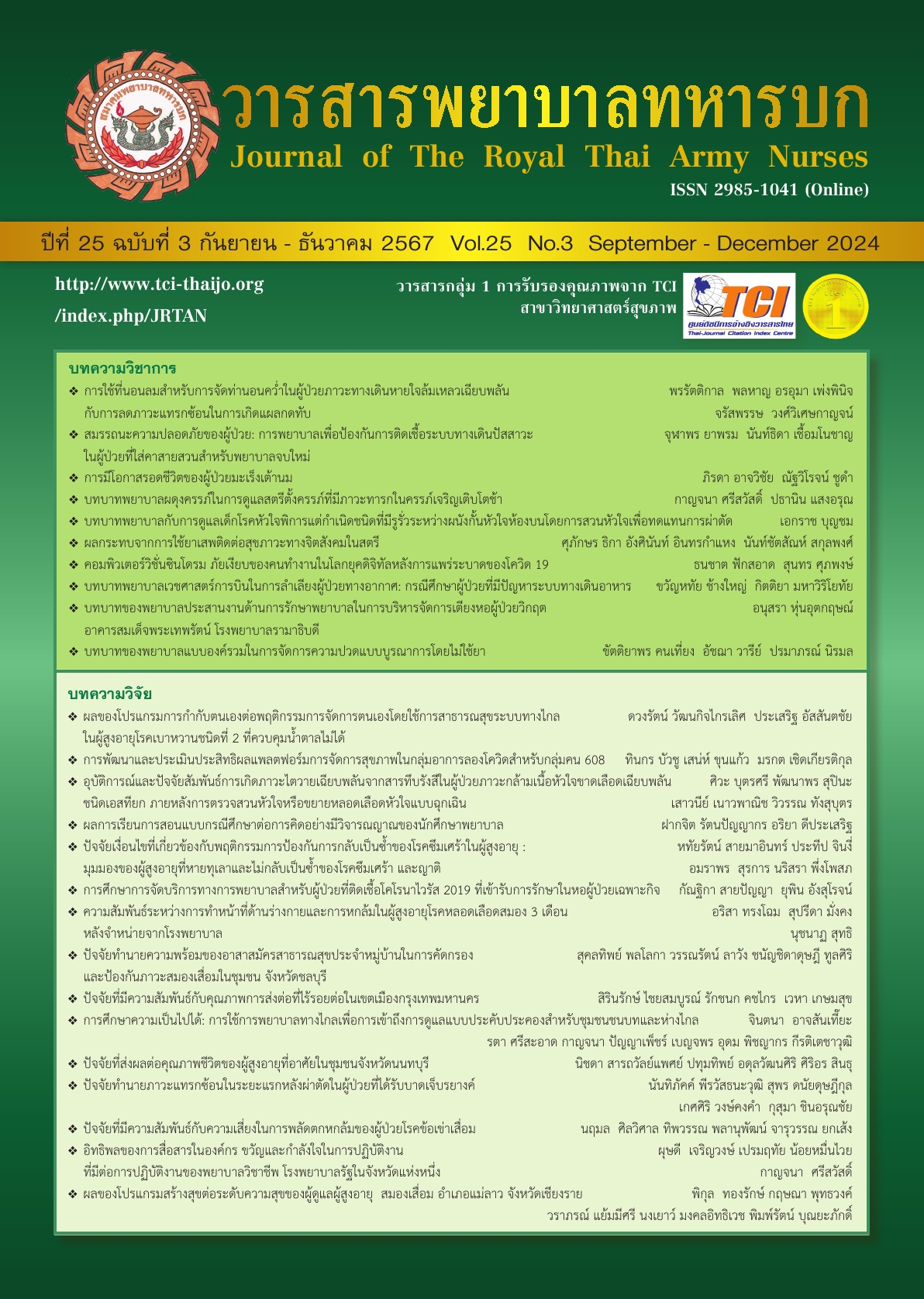
ปัจจัยทำนายคุณภาพชีวิตของผู้สูงอายุที่อาศัยในชุมชนจังหวัดนนทบุรี
คำสำคัญ:
คุณภาพชีวิต, ผู้สูงอายุบทคัดย่อ
การวิจัยนี้มีวัตถุประสงค์เพื่อวิเคราะห์ปัจจัยที่ส่งผลต่อคุณภาพชีวิตของผู้สูงอายุที่อาศัยอยู่ในชุมชนจังหวัดนนทบุรี กลุ่ม ตัวอย่าง คือ ผู้ที่มีอายุตั้งแต่ 60 ปีขึ้นไป จำนวน 116 คน เครื่องมือเก็บรวบรวมข้อมูลเป็นแบบสอบถามประกอบด้วย 4 ส่วน 1) ข้อมูลส่วนบุคคลและการเข้าถึงบริการสุขภาพ 2) ความรอบรู้ด้านสุขภาพ 3) ภาวะเปราะบาง 4) คุณภาพชีวิต ค่าสัมประสิทธิ์ความ เที่ยงแบบสอบถามส่วนที่ 2 และ 4 เท่ากับ 0.84 และ 0.98 แบบสอบถามภาวะเปราะบาง หาค่า KR-20 เท่ากับ 0.95 วิเคราะห์ ข้อมูลโดยใช้สถิติเชิงพรรณนา และการถดถอยพหุคูณแบบขั้นตอน กำหนดค่านัยสำคัญทางสถิติที่ระดับ .05
ผลการวิจัย พบว่า ผู้สูงอายุมีคุณภาพชีวิตอยู่ในระดับปานกลาง ร้อยละ 60.34 (mean ± SD = 40.16 ± 10.46) ความ เพียงพอของรายได้ ( = 0.49, p = 0.000) ความสามารถในการปฏิบัติกิจวัตรประจำวัน (
= 0.19, p = 0.003) ความรอบรู้ด้าน สุขภาพ (
= 0.17, p = 0.042) และจำนวนครั้งที่พยาบาลเยี่ยมบ้านต่อปี (
= 0.16, p = 0.028) สามารถร่วมกันทำนายคุณภาพ ชีวิตได้ร้อยละ 57.6 (R2 = 0.576) ดังนั้น ผู้กำหนดนโยบายควรส่งเสริมสังคมสูงวัยเชิงรุกและการสร้างรายได้ให้ผู้สูงอายุอย่างเพียง พอต่อการดูแลจัดการปัญหาสุขภาพ ลดภาวะพึ่งพิง การเยี่ยมบ้านโดยพยาบาลมีความสำคัญในการส่งเสริมให้ผู้สูงอายุมีคุณภาพ ชีวิตที่ดี
Downloads
เอกสารอ้างอิง
Department of Older Persons. Situation of the thai older person 2022. 1st ed. BKK: Amarin Corporations Public Company Limited.; 2023.
National Statistical Office. The 2021 Survey of The Older Persons in Thailand. 1sted. BKK: Statistical Forecasting Division.; 2022.
Tupanich W, Chaiyalap S, & Chaiyalap K. Problems and needs of older adults living in urban area, Bangkok Metropolitan. Vajira Medical Journal : Journal of Urban Medicine. 2019; 63(Suppl):S83-92. (in Thai)
Teoli D, & Bhardwaj A. Quality of life. StatPearls. Treasure Island (FL): StatPearls Publishing; 2024.
Joowong S, Junsirimongkol B, Khaektao P, Doungyota T, & Paomee K. A cross-sectional study of factors associated with life satisfaction in Thai elderly. European Psychiatry. 2022; 65(Suppl 1):S91-2.
Waelveerakup W, Suwannasarn K, & Pasuwan D. Quality of life of older persons during the second wave of the COVID-19 pandemic in Thailand. Journal of The Royal Thai Army Nurses. 2023;24(2):76-87. (in Thai)
Medhi GK, Sarma J, Bhattacharyya H, Pala S, Visi V, & Bora PJ. Sociodemographic variations in health-related quality of life (HRQOL) among elderly individuals in an urban locality in India. Journal of Family Medicine and Primary Care. 2019;8(7):2473-7.
Lim SC, Chan YM, & Gan WY. Social and health determinants of quality of life of community-dwelling older adults in Malaysia. International Journal of Environmental Research and Public Health. 2023;20(5): 3977-92.
Molina-Mula J, Miguélez-Chamorro A, TaltavullAparicio JM, Miralles-Xamena J, & Ortego-Mate MD. Quality of life and dependence degree of chronic patients in a chronicity care model. Healthcare (Basel, Switzerland). 2020;8(3): 293-309.
Setiati S, Soejono CH, Harimurti K, Dwimartutie N, & Aryana IGPS, Sunarti S, et al. Frailty state among Indonesian elderly: prevalence, associated factors, and frailty state transition. BioMed Central Geriatrics. 2019;19(1):182-92.
Sørensen K, Van den Broucke S, Pelikan JM, et al. Measuring health literacy in populations: illuminating the design and development process of the European health literacy survey questionnaire (HLS-EU-Q). BioMed Central Public Health. 2013;13(1):948-58.
Mekhail KT, Burstrom B, Marttila A, Wangdahl J, & Lindberg L. Psychometric qualities of the HLS-EU-Q16 instrument for parental health literacy in Swedish multicultural settings. BioMed Central Public Health. 2022;22(1): 293-305.
Gobbens RJ, van Assen MA, Luijkx KG, Wijnen-Sponselee MT, & Schols JM. The Tilburg Frailty Indicator: psychometric properties. Journal of the American Medical Directors Association. 2010;11(5):344-55.
Caballero FF, Miret M, Power M, Chatterji S, Tobiasz-Adamczyk B, Koskinen S, et al. Validation of an instrument to evaluate quality of life in the aging population: WHOQOL-AGE. Health and Quality of Life Outcomes. 2013;11(1):177-89.
La Fauci V, Venuto R, Genovese C, et al. Study-related stress, perceived stress and quality of life among healthcare university students. Clinical Therapeutics. 2023;174(5): 412-9.
World Health Organization. Process of translation and adaptation of instruments 2009.
Buasri S, & Supata W. Factors associated with quality of life among dependent older people in Muang district. Journal of Nursing and Health Research. 2024;25(2):19-35. (in Thai)
Rent PD, Kumar S, Dmello MK, & Purushotham J. Psychosoc ial status and economic dependence for healthcare and nonhealthcare among elderly population in rural Coastal Karnataka. Journal of mid-life health. 2017; 8(4):174-8.
Ausín B, Zamorano A, & Muñoz M. Relationship between quality of life and sociodemographic, physical and mental health variables in people over 65 in the community of Madrid. International Journal of Environmental Research and Public Health. 2020;17(22): 8528-39.
Gu J, Chao J, Chen W, Xu H, Zhang R, He T, et al. Multimorbidity and health-related quality of life among the community-dwelling elderly: A longitudinal study. Archives of Gerontology and Geriatrics. 2018;74(6):133-40.
Cano-Vindel A, Muñoz-Navarro R, Wood CM, Limonero JT, Medrano LA, Ruiz-Rodríguez P, et al. Transdiagnostic cognitive behavioral therapy versus treatment as usual in adult patients with emotional disorders in the primary care setting (PsicAP Study): Protocol for a randomized controlled trial. Journal of Medical Internet Research Protocols. 2016; 5(4):246-62.
Panagioti M, Skevington SM, Hann M, et al. Effect of health literacy on the quality of life of older patients with long-term conditions: a large cohort study in UK general practice. Quality of Life Research. 2018;27(5):1257-68.
ดาวน์โหลด
เผยแพร่แล้ว
รูปแบบการอ้างอิง
ฉบับ
ประเภทบทความ
สัญญาอนุญาต
ลิขสิทธิ์ (c) 2024 วารสารพยาบาลทหารบก

อนุญาตภายใต้เงื่อนไข Creative Commons Attribution-NonCommercial-NoDerivatives 4.0 International License.
บทความหรือข้อคิดเห็นใดใดที่ปรากฏในวารสารพยาบาลทหารบกเป็นวรรณกรรมของผู้เขียน ซึ่งบรรณาธิการหรือสมาคมพยาบาลทหารบก ไม่จำเป็นต้องเห็นด้วย
บทความที่ได้รับการตีพิมพ์เป็นลิขสิทธิ์ของวารสารพยาบาลทหารบก
The ideas and opinions expressed in the Journal of The Royal Thai Army Nurses are those of the authors and not necessarily those
of the editor or Royal Thai Army Nurses Association.