
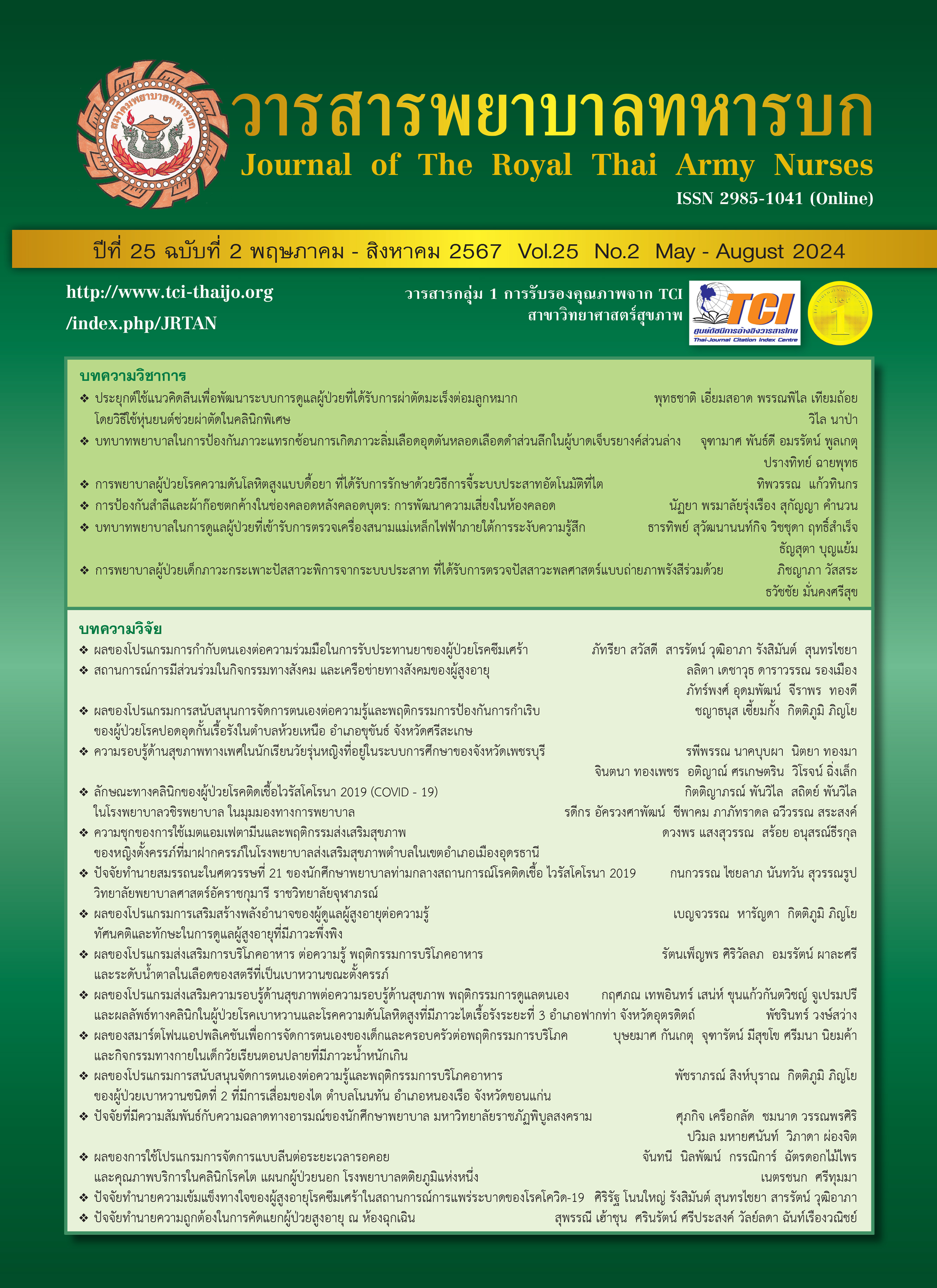
การพยาบาลผู้ป่วยเด็กภาวะกระเพาะปัสสาวะพิการจากระบบประสาท ที่ได้รับการตรวจปัสสาวะพลศาสตร์แบบถ่ายภาพรังสีร่วมด้วย
คำสำคัญ:
การพยาบาล, ผู้ป่วยเด็ก, ภาวะกระเพาะปัสสาวะพิการจากระบบประสาท, การตรวจปัสสาวะพลศาสตร์แบบถ่ายภาพรังสีร่วมด้วยบทคัดย่อ
กระเพาะปัสสาวะพิการจากระบบประสาทในเด็ก เกิดจากการมีรอยโรคที่สมอง ไขสันหลัง หรือเส้นประสาทส่วนปลาย ที่ไปเลี้ยงกระเพาะปัสสาวะและหรูดท่อปัสสาวะ ทำให้ไม่สามารถควบคุมการไหลของปัสสาวะได้ ส่งผลให้เกิดการติดเชื้อทางเดิน ปัสสาวะ เพิ่มความเสี่ยงต่อภาวะปีสสาวะไหลย้อนขึ้นท่อไต กรณีที่ได้รับการรักษาล่าช้าอาจส่งผลให้เกิดภาวะความตันโลหิลหิตสูง และ ภาวะไตวายเรื้อรัง การตรวจปัสสาวะพลศาสตร์แบบถ่ายภาพรังสีร่วมด้วยเป็นวิธีการตรวจวินิจฉัยตามมาตรฐานทำให้ได้ชัลที่ สำคัญ คือ ลักษณะทางกายภาพและการทำงทำงานของระบบบทางเดินปัสสาวะส่วนล่าง ซึ่งมีความจำเป็นสำหรับการกำหนดแนวทาง การรักษา อย่างไรก็ตามในผู้ป่วยเด็กรวมถึงผู้ปกครอง มักเกิดความวิตกกังวลเกี่ยวกับวิธีการตรวจ และภาวะแทรกซ้อนที่อาจเกิด ขึ้นหลังการตรวจ พยาบาลผู้ให้การดูแลจึงจำเป็นต้องมีความรู้เกี่ยวกับการตรวจปัสสาวะพลศาสตร์ เพื่อที่จะถ่ายทอดให้ป่วย และผู้ปกครองเข้าใจซึ่งช่วยคลายความวิตกกังวล และเป็นการเตรียมความพร้อมของผู้ป่วยก่อนตรวจ ส่งเสริมให้ผู้ป่วยร่วมมือ เข้ารับการตรวจ ให้การพยาบาลเพื่อป้องกันภาวะแทรกซ้อนที่อาจเกิดขึ้นในระยะตรวจและสามารถเฝ้าระวังอาการผิดปกติ รวมถึงสามารถจัดเตรียมอุปกรณ์ต่าง ๆ ในการตรวจใต้อย่างถูกต้อง เพื่อผลลัพธ์ทางการพยาบาล นั่นคือ ผู้ป่วยปลอดภัยและ ไม่เกิดภาวะแทรกช้อนในระยะหลังตรวจ
Downloads
เอกสารอ้างอิง
Sager C, Barroso JrU, Netto MB, Retamal G, Ormaechea E. Management of neurogenic bladder dysfunction in children update and recommendations on medical treatment. International Brazilian Journal of Urology. 2022; 48(1):31-51.
Stein R, Bogaert G, Dogan HS, Hoen L, Kocvara R, Nijman RJM, et al. EAU/ESPU guidelines on the management of neurogenic bladder in children and adolescent part I diagnostics and conservative treatment. Neurourology and Urodynamics. 2020;39(1):45-57.
Hobbs KT, Krischak M, Tejwani R, Purves JT, Wiener JS, Routh JC. The importance of early diagnosis and management of pediatric neurogenic bladder dysfunction. Research and Reports in Urology. 2021;13:647-57.
Sangsupawanich P, Ingviya T, Thinkhamrop B. Development of surveillance system for neural tube defects. Nonthaburi: Health Systems Research Institute; 2020. (in Thai)
Division of Medical Record. Statistical report 2021-2023. Bangkok: Faculty of Medicine Siriraj Hospital Mahidol University; 2024. (in Thai)
Izumi N, Kitta T, Mitsui T. Importance of regular examination and follow-up in pediatric patients with neurogenic bladder: 24-month follow-up study using a Japanese health insurance database. Advances in Therapy. 2023;40:5519-35.
Chua ME, Yadav P, Wang PZT, Mau EE, Keefe DT, Thomas J, et al. 2023 Canadian urological association/pediatric urologists of Canada guideline: pediatric patients with neurogenic lower urinary tract dysfunction. Canadian Urological Association Journal. 2023;17(10): 338-57.
Fairchild RJ, Aksenov LI, Hobbs KT, Krischa MK, Kaplan SJ, Purves JT, et al. Medical management of neurogenic bladder in patients with spina bifida: A scoping review. Journal of Pediatric Urology. 2023;19(1):55-63.
Ramart P. Urodynamics for clinical applications. Bangkok: Faculty of Medicine Siriraj Hospital, Mahidol University.; 2024. (in Thai)
Yerkes EB, Cheng EY, Wiener JS, Austin JC, Tu DD, Joseph DBea. Translating pediatric urodynamics from clinic into collaborative research: Lessons and recommendations from the UMPIRE study group. Journal of pediatric urology. 2021;17(5):716-25.
Jerez Molina C, Lahuerta Valls L, Fernandez Villegas V, Santos Ruiz S. Nursing evaluation of pediatric preoperative anxiety: a qualitative study. Revista Latino-Americana de Enfermagem. 2023;31:e3738.
Sangnimitchaikul W. Using play for stress adaptation in sick children. Thai Science and Technology Journal. 2012;20(5):449-56. (in Thai)
Hutchison D, Sobrado S, Corbett S, Leroy S, Morgan K, Daugherty R, et al. Parental perception of contrast enhanced voiding ultrasonography urodynamics vs fluoroscopic urodynamics. Journal of Pediatric Urology. 2023;19(6):783e1-5.
Kırlı EA, Türk Ş, Kırlı S. The burden of urinary incontinence on caregivers and evaluation of its impact on their emotional status. Alpha psychiatry. 2021;22(1):43-8.
Canon S, Shera A, Phan NMH, Lapicz L, Scheidweiler T, Batchelor L, et al. Autonomic dysreflexia during urodynamics in children and adolescents with spinal cord injury or severe neurologic disease. Journal of Pediatric Urology. 2015;11(1):32e1-4.
Takami N, Mukai S, Nomi M, Yanagiuchi A, Sengoku A, Maeda K, et al. Retrospective observational study of risk factors for febrile infectious complications after urodynamics studies in Patients with suspected neurogenic lower urinary tract disturbance. Urologia Internationalis. 2022;106(7):722-9.
Yadav P, Alsabban A, de Los Reyes T, Varghese A, Ming JM, Milford K, et al. A systematic review of paediatric neurogenic lower urinary tract dysfunction guidelines using the Appraisal of Guidelines and Research Evaluation (AGREE) II instrument. British Journal of Urology international. 2023;131(5):520-9.
Gammie A, Clarkson B, Constantinou C, Damaser M, Drinnan M, Geleijnse G, et al. International Continence Society guidelines on urodynamics equipment performance. Neurourology urodynamics. 2014;33(4):370-9.
Bauer SB, Nijman RJM, Drzewiecki BA, Sillen U, Hoebeke P. International Children’s Continence Society standardization report on urodynamics studies of the lower urinary tract in children. Neurourology and Urodynamics. 2015;34(7):640-7.
Demirkan H, Kuzdan MO. Comparison of the Urodynamics Patterns of the Disorders Frequently Encountered in the Field of Pediatric Urology. The Medical Bulletin of Haseki. 2022;60:20-5.
Cunha NS, Malvea A, Sadat S, Ibrahim GM, Fehlings MG. Pediatric spinal cord injury: a review. Children (Basel). 2023;10(9):1-30.
Mahawong P. Urodynamics in pediatric patients with neurogenic diseases. in Mahawong P, Viseshsindh W, Santi-ngamkun A, (editors). Basic Urodynamics and Clinical Applications. Bangkok: The Thai Urological Association under the Royal Patronage; 2019. (in Thai)
Perrin A, Corcos J. The utility of urodynamics studies in neuro-urological patients. Biomedicines. 2023;11(4):1-11.
Butsankot P, Kongklang J. Nursing care for prevention complications of patient with spine and spinal cord Injuries in rehabilitation phase. Srinagarind Medical Journal. 2021;36(5):639-48. (in Thai)
Ellison JS., Nicholls G., Woodward M. Urodynamics in children. Abrams’ Urodynamics; 2021.
Choodum N, Lohitthai S, ChuaChomket A. Competencies of Professional Nurses in the Hospital. Journal of The Royal Thai Army Nurses. 2023;24(3):31-8. (in Thai)
Jongwannasiri M, Viseshsindh W. Nursing care: patient with neurogenic lower urinary tract dysfunction from spinal cord injury for urodynamics study. Nursing Research and Innovation Journal. 2020;25(3):270-9. (in Thai)
Janpanich S. Caring for patients undergoing computed tomography and magnetic resonance imaging. Journal of Siriraj Radiology. 2016;3(2):149-58. (in Thai)
Nieuwhof-Leppink AJ, Hussong J, Chase J, Larsson J, Renson C, Hoebeke P, et al. Definitions, indications and practice of urotherapy in children and adolescents: A standardization document of the International Children’s Continence Society (ICCS). Journal of Pediatric Urology. 2021;17(2):172-81.
ดาวน์โหลด
เผยแพร่แล้ว
รูปแบบการอ้างอิง
ฉบับ
ประเภทบทความ
สัญญาอนุญาต
ลิขสิทธิ์ (c) 2024 วารสารพยาบาลทหารบก

อนุญาตภายใต้เงื่อนไข Creative Commons Attribution-NonCommercial-NoDerivatives 4.0 International License.
บทความหรือข้อคิดเห็นใดใดที่ปรากฏในวารสารพยาบาลทหารบกเป็นวรรณกรรมของผู้เขียน ซึ่งบรรณาธิการหรือสมาคมพยาบาลทหารบก ไม่จำเป็นต้องเห็นด้วย
บทความที่ได้รับการตีพิมพ์เป็นลิขสิทธิ์ของวารสารพยาบาลทหารบก
The ideas and opinions expressed in the Journal of The Royal Thai Army Nurses are those of the authors and not necessarily those
of the editor or Royal Thai Army Nurses Association.