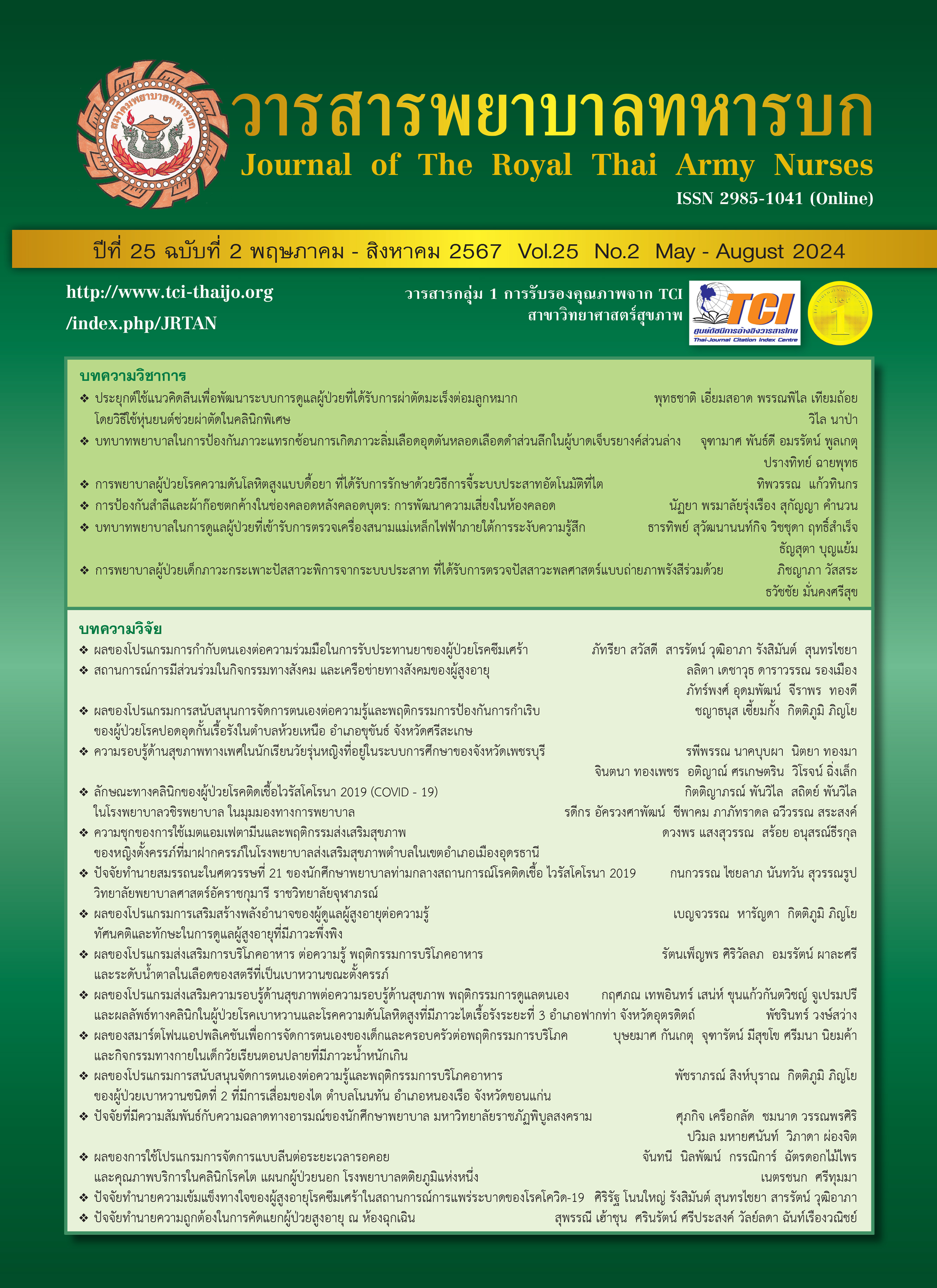
ปัจจัยที่มีความสัมพันธ์กับความฉลาดทางอารมณ์ ของนักศึกษาพยาบาล มหาวิทยาลัยราชภัฏพิบูลสงคราม
คำสำคัญ:
นักศึกษาพยาบาล, ความฉลาดทางอารมณ์, ความเครียดบทคัดย่อ
ความฉลาดทางอารมณ์มีความสำคัญมากสำหรับนักศึกษาพยาบาล เนื่องจากต้องเผชิญกับความเครียดการเรียนทั้ง ภาคทฤษฎีและปฏิบัติ และเมื่อสำเร็จการศึกษาไปแล้วจะเป็นทีมสุขภาพที่ดูแลผู้ป่วย จะต้องควบคุมอารมณ์ พร้อมจัดการกับ ความเครียดและปัญหาให้รอบคอบ การวิจัยครั้งนี้เป็นการวิจัยเชิงพรรณนาภาคตัดขวาง เพื่อศึกษาปัจจัยที่มีความสัมพันธ์กับ ความฉลาดทางอารมณ์ของนักศึกษาพยาบาล มหาวิทยาลัยราชภัฏพิบูลสงคราม กลุ่มตัวอย่างเป็นนักศึกษาพยาบาล คณะพยาบาลศาสตร์ชั้นปีที่ 1-4 มหาวิทยาลัยราชภัฏพิบูลสงคราม ปีการศึกษา 2565 จำนวน 145 คน คัดเลือกกลุ่มตัวอย่างโดย ใช้ความน่าจะเป็น (Probability sampling) แบบแบ่งชั้น (Stratified sampling) เครื่องมือการวิจัยเป็นแบบสอบถาม แบ่งออกเป็น 3 ส่วน ได้แก่ แบบสอบถามข้อมูลทั่วไป แบบประเมินความเครียดสวนปรุง (SPST-20) และแบบประเมินความฉลาดทางอารมณ์ ของกรมสุขภาพจิต หาคุณภาพโดยใช้ค่าสัมประสิทธิ์สหสัมพันธ์แอลฟาครอนบาคได้ค่าความเชื่อมั่นเท่ากับ .90 และ .95 ตามลำดับ วิเคราะห์ข้อมูลด้วยสถิติเชิงพรรณนา ได้แก่ ความถี่ ร้อยละ ค่าเฉลี่ย ส่วนเบี่ยงเบนมาตรฐาน และสถิติสหสัมพันธ์เพียร์สัน
ผลการศึกษาพบว่า 1) ระดับความฉลาดทางอารมณ์ของนักศึกษาพยาบาล มหาวิทยาลัยราชภัฏพิบูลสงครามอยู่ในเกณฑ์ ปกติ (x̅ = 162.04, S.D. = 18.80) และ 2) ความเครียดมีความสัมพันธ์ทางลบระดับปานกลางกับความฉลาดทางอารมณ์ของ นักศึกษาพยาบาล มหาวิทยาลัยราชภัฏพิบูลสงคราม อย่างมีนัยสำคัญทางสถิติที่ระดับ .05 (r = -.404, p<.05)
Downloads
เอกสารอ้างอิง
Panich. V. Creating learning for the 21st century. 2nd ed. Bangkok: Chulalongkorn; 2014. (in Thai)
Ministry of Education. The National education plan, B.E. 2017-2036. Bangkok: Office of the Education Council; 2017. (in Thai)
Rattanaraj P. Desirable Characteristics Among Graduate Nurses of Ubon Ratchathani Rajabhat University. Ubon Ratchathani Journal of Research and Evaluation. 2020; 9(1): 20-30. (in Thai)
Nussutam, W., Riangsanor, A, & Jeeraya S. The Development of Emotional Intelligence in Nursing Students. Nursing Journal. 2017; 44(2): 111-18. (In Thai)
Nuchsutham W. Emotional quotient of nursing students, Faculty of Nursing, Chiang Rai College. Community Health Development Quarterly Khon Kaen University. 2016; 4(4): 505-19. (in Thai)
Goleman, D. Emotion Intelligence. New York: Bantan Book; 1998.
Thailand Nursing and Midwifery Council. Nursing Council Announcement. Working hours policy for patient safety. Bangkok; 2017. (in Thai)
Nuchsutham W., Kaewkunta P., Somboon L., Boonthai C., & Muangmakham S. Effect of Emotional Quotient Promoting Program on Emotional Quotient among Nursing Students. Nursing Journal. 2018; 45(1): 110-21. (in Thai)
Sirichockwattana K. Super E.Q. Happiness & Success can be created by heart. 2nd ed. Bangkok: Rungsamg; 2018. (in Thai)
Department of mental health, Emotional Quotient. Nonthaburi: Bangkok; 2003. (in Thai)
Bormann VS. Emotional Intelligence and Readiness in Performing Professional Nursing Roles among Nursing Students. Journal of Health Science Research. 2010; 4(2): 47-57.
Ngamkham N., Chitraboon K., ChaichanaN., Kanyanthong P., Yurak P., & Nuchsiri P. Factors affecting emotional quotient of students in health science curriculums at Huachiew Chalermprakiet University. Huachiew Chalermprakiet University Journal of Health Science. 2016; 20(39): 45-56. (in Thai)
Thongeiad, K., & Chaiprom, D. Emotional Intelligence and Stress among Nursing Students of Faculty of Nursing of Suratthani Rajabhat University. Suratthani Rajabhat Journal. 2018; 5(2): 214-32. (in Thai)
Panjiang P. Factors Affecting Emotional Quotient and a model of Emotional Quotient Development of Students in Higher Education Institutions in Songkhla Province. 2015.
Leksungnoen S. Emotional intelligence of first year students Silpakorn University Sanam Chandra Palace. (thesis). Nakhon Pathom: Silpakorn University, Sanam Chandra Palace Campus; 2018. (in Thai)
Pongklum O., Klommake J., Pakluck P., Khuttamasoon T., Bunluesup W., & Hongthong M. The Emotional Quotient among Nursing Students in a Private University, Bangkok. The Journal of Faculty of Nursing Burapha University. 2017; 25(3): 9-19. (in Thai)
Thato R. Nursing research: concepts to application. 3rded. Bangkok: Chulalongkorn; 2018. (in Thai)
Ukkakimapan J., Tepvorachai U., Sompittayanurak N., & Tareepean N. The Emotional Quotientof Nursing Students Pathum Thani University. Journal of Nakhonratchasima College (Humanities and Social Sciences). 2021; 15(3): 122-33. (in Thai)
Sritawan K., Chinkhaokham D., & Kitnopkiat K. Factors Related to Emotional Intelligence among Nursing Students of Boromarajonani College of Nursing, Ratchaburi. Journal of The Royal Thai Army Nurses. 2023; 24(1): 109-15. (in Thai)
Jahan K. Emotional intelligence related to stress: a study on college students. The International Journal of Indian Psychology. 2020; 8(1): 495-500.
Stevens C., Schneider E., Miller BP., & Arcangelo K. Exploring The Relationship Between Emotional Intelligence And Academic Stress Among Students At A Small, Private College. Contemporary Issues in Education Research. 2019; 12(4): 93-102.
ดาวน์โหลด
เผยแพร่แล้ว
รูปแบบการอ้างอิง
ฉบับ
ประเภทบทความ
สัญญาอนุญาต
ลิขสิทธิ์ (c) 2024 วารสารพยาบาลทหารบก

อนุญาตภายใต้เงื่อนไข Creative Commons Attribution-NonCommercial-NoDerivatives 4.0 International License.
บทความหรือข้อคิดเห็นใดใดที่ปรากฏในวารสารพยาบาลทหารบกเป็นวรรณกรรมของผู้เขียน ซึ่งบรรณาธิการหรือสมาคมพยาบาลทหารบก ไม่จำเป็นต้องเห็นด้วย
บทความที่ได้รับการตีพิมพ์เป็นลิขสิทธิ์ของวารสารพยาบาลทหารบก
The ideas and opinions expressed in the Journal of The Royal Thai Army Nurses are those of the authors and not necessarily those
of the editor or Royal Thai Army Nurses Association.