
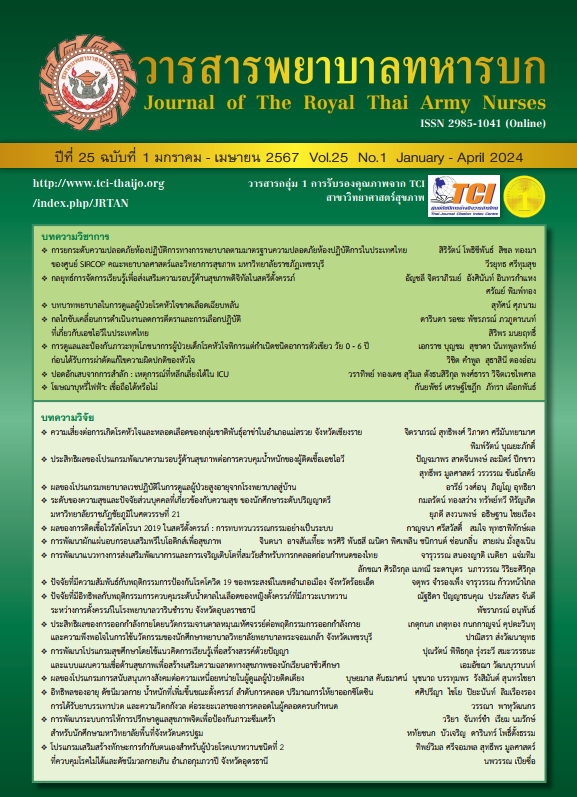
การใช้โปรแกรมภาษาประสาทสัมผัสเพื่อพัฒนาหน้าที่บริหารจัดการ ของสมองในเด็กปฐมวัย
คำสำคัญ:
โปรแกรมภาษาประสาทสัมผัส, หน้าที่บริหารจัดการของสมอง, เด็กปฐมวัยบทคัดย่อ
การวิจัยครั้งนี้มีวัตถุประสงค์เพื่อทดสอบประสิทธิผลของการใช้โปรแกรมภาษาประสาทสัมผัสเพื่อพัฒนาหน้าที่บริหาร จัดการของสมองสำหรับเด็กปฐมวัย กลุ่มตัวอย่างเป็นนักเรียนชั้นอนุบาลศึกษาปีที่ 3 สุ่มตัวอย่างแบบแบ่งกลุ่ม จำนวน 2 ห้องเรียน แบ่งเป็นห้องเรียนที่ได้รับโปรแกรมพัฒนาหน้าที่บริหารจัดการของสมองด้วยโปรแกรมภาษาประสาทสัมผัสสำหรับเด็กปฐมวัย 27 คน และห้องเรียนที่ได้รับการเรียนการสอนของโรงเรียน 22 คน รวม 49 คน เครื่องมือวิจัย ได้แก่ 1) โปรแกรมภาษาประสาท สัมผัสเพื่อพัฒนาหน้าที่บริหารจัดการของสมองสำหรับเด็กปฐมวัย จำนวน 8 ครั้ง ครั้งละ 30-50 นาที บูรณาการหลักการ ของโปรแกรมภาษาประสาทสัมผัส ได้แก่ การสร้างสัมพันธภาพ การตั้งเป้าหมาย ความฉับไวต่อการรับรู้ ความยืดหยุ่น และการสร้างสัญญาณพลัง 2) มาตรวัดหน้าที่บริหารจัดการของสมองโดยการตรวจเช็คพฤติกรรม 2 สำหรับคุณครู ใช้ประเมินพฤติกรรมที่แสดงถึงความบกพร่องของหน้าที่บริหารจัดการของสมอง 3 ระยะ คือ ก่อนการทดลอง หลังการทดลอง และระยะติดตามผล 2 สัปดาห์ วิเคราะห์ความแปรปรวนแบบวัดซ้ำ หนึ่งตัวแปรภายในกลุ่มและหนึ่งตัวแปรระหว่างกลุ่ม ทดสอบความแตกต่างรายคู่แบบ บอนเฟอโรนี่ผลการวิจัยพบว่ากลุ่มทดลองมีหน้าที่บริหารจัดการของสมองสูงกว่ากลุ่มควบคุมหลังการทดลองและระยะติดตามผล และมีหน้าที่บริหารจัดการของสมองหลังการทดลองและระยะติดตามผลสูงกว่าก่อนการทดลอง อย่างมีนัยสำคัญทางสถิติที่ .05
Downloads
เอกสารอ้างอิง
Gilbert SJ, Burgess PW. Executive function. Current Biology. 2008;18(3):R110-R114.
Casey BJ, Tottenham N, Liston C, Durston S. Imaging the developing brain: what have we learned about cognitive development?. Trends in cognitive sciences. 2005;9(3):104-10.
Miyake A, Friedman NP, Emerson MJ, Witzki AH, Howerter A, Wager TD. The unity and diversity of executive functions and their contributions to complex “Frontal Lobe” tasks: a latent variable analysis. Cognitive Psychology. 2000;41(1):49-100.
Diamond A, Ling DS. Conclusions about interventions, programs, and approaches for improving executive functions that appear justified and those that, despite much hype, do not. Developmental cognitive neuroscience. 2016;18(2016):34-48.
Diamond A. Executive functions. Annual Review of Psychology. 2013;64(2013):135-68.
Gioia GA, Isquith PK, Guy SC, Kenworthy L. BRIEF-2: Behavior rating inventory of executive function. Lutz, FL: Psychological Assessment Resources; 2015.
Chano J. Executive Functions and Early Childhood Development. Journal of Education, Mahasarakham University. 2019; 13(1):7-17. (in Thai)
Nopakhun J. The Development of Executive Function for 21st Century Preschool Children through Montessori Approach. Journal of education silpakorn University. 2018;16(1): 75-90. (in Thai)
Haenjohn, J. Neuro-linguistic programming [NLP]: application for counseling, learning, and Business: Chonburi, Get Good Creation; 2014. (in Thai)
Ahmad KZ. Improving emotional intelligence (EI) using neuro linguistic programming (NLP) techniques. InInternational Conference on Advances in Business and Law (ICABL). 2017;1(1):172-83.
Hejase HJ. Neuro-linguistic programming (NLP): Awareness and practice in UAE. European Journal of Business and Social Sciences. 2015;3(10):135-7.
Fabiańska M, Bosiacki M, Simińska D. The role of mirror neurons in cognitive and social functioning. Pomeranian Journal of Life Sciences. 2020;66(4):30-40.
Elston T, Spohrer K. Using NLP to enhance behaviour and learning: A handbook for teachers. Bloomsbury Publishing; 2009.
Skinner H, Croft R. Neuro‐linguistic programming techniques to improve the self‐efficacy of undergraduate dissertation students. Journal of Applied Research in Higher Education. 2009;1(1):30-8.
Javadi Y, Asl SA. Neuro-linguistic Programming, Teacher’s Identity, and Teachers’ Effectiveness. Journal of Language Teaching and Research. 2020;11(3):389-98.
Mukherjee S. Anchoring-An NLP Master Tool. Available at SSRN 2191435. 2012.
Patyencheun W, Haenjohn J, Sirithadakunlaphat S. Development of Program to Promote Attention Based on Neuro-Linguistic Programming in Primary School Students. Journal of The Royal Thai Army Nurses. 2019; 20(3):305-12. (in Thai)
Phetmrum C, Haenjohn J, Supwirapakorn W. The Development of Promote Inhibitory Control in School Age Children. Journal of The Royal Thai Army Nurses. 2022; 23(1):390-8. (in Thai)
Alghafri AS, Ismail HN. The effects of neuroscience-and non-neuroscience-based thinking strategies on primary school students’ thinking. Procedia-Social and Behavioral Sciences. 2011;15(2011):3291-8.
Zhang X, Davarpanah N, Izadpanah S. The effect of neurolinguistic programming on academic achievement, emotional intelligence, and critical thinking of EFL learners. Frontiers in Psychology. 2023;13(2022):1-11.
Lertladaluck K, Suppalarkbunlue W, Moriguchi Y, Chutabhakdikul N. School-based mindfulness intervention improves executive functions and self-regulation in preschoolers at risk. The Journal of Behavioral Science. 2021; 16(2):58-72.
Li Q, Song Y, Lian B, Feng T. Mindfulness training can improve 3-and 4-year-old children’s attention and executive function. Acta Psychologica Sinica. 2019;51(3):324-36.
Howard SJ, Powell T, Vasseleu E, Johnstone S, Melhuish E. Enhancing Preschoolers’ Executive Functions Through Embedding Cognitive Activities in Shared Book Reading. Educational Psychology Review. 2017;29(2017):153–74.
Pishghadam R, Shapoori M, Shayesteh S. NLP and its relationship with teacher success, gender, teaching experience, and degree: A comparative study. World journal of English language. 2011;1(2):2-8.
Lashkarian A, Sayadian S. The effect of Neuro Linguistic Programming (NLP) techniques on young Iranian EFL Learners’ motivation, learning improvement, and on teacher’s success. Procedia-Social and Behavioral Sciences. 2015;199(2015):510-6.
Bull L. Sunflower therapy for children with specific learning difficulties (dyslexia): a randomised, controlled trial. Complementary therapies in clinical practice. 2007;13(1):15-24.
Walk LM, Evers WF, Quante S, Hille K. Evaluation of a teacher training program to enhance executive functions in preschool children. PloS one. 2018;13(5):1-20. 28.Anderson PJ, Reidy N. Assessing executive function in preschoolers. Neuropsychology review. 2012;22(4):345-60.
ดาวน์โหลด
เผยแพร่แล้ว
รูปแบบการอ้างอิง
ฉบับ
ประเภทบทความ
สัญญาอนุญาต
ลิขสิทธิ์ (c) 2024 วารสารพยาบาลทหารบก

อนุญาตภายใต้เงื่อนไข Creative Commons Attribution-NonCommercial-NoDerivatives 4.0 International License.
บทความหรือข้อคิดเห็นใดใดที่ปรากฏในวารสารพยาบาลทหารบกเป็นวรรณกรรมของผู้เขียน ซึ่งบรรณาธิการหรือสมาคมพยาบาลทหารบก ไม่จำเป็นต้องเห็นด้วย
บทความที่ได้รับการตีพิมพ์เป็นลิขสิทธิ์ของวารสารพยาบาลทหารบก
The ideas and opinions expressed in the Journal of The Royal Thai Army Nurses are those of the authors and not necessarily those
of the editor or Royal Thai Army Nurses Association.