
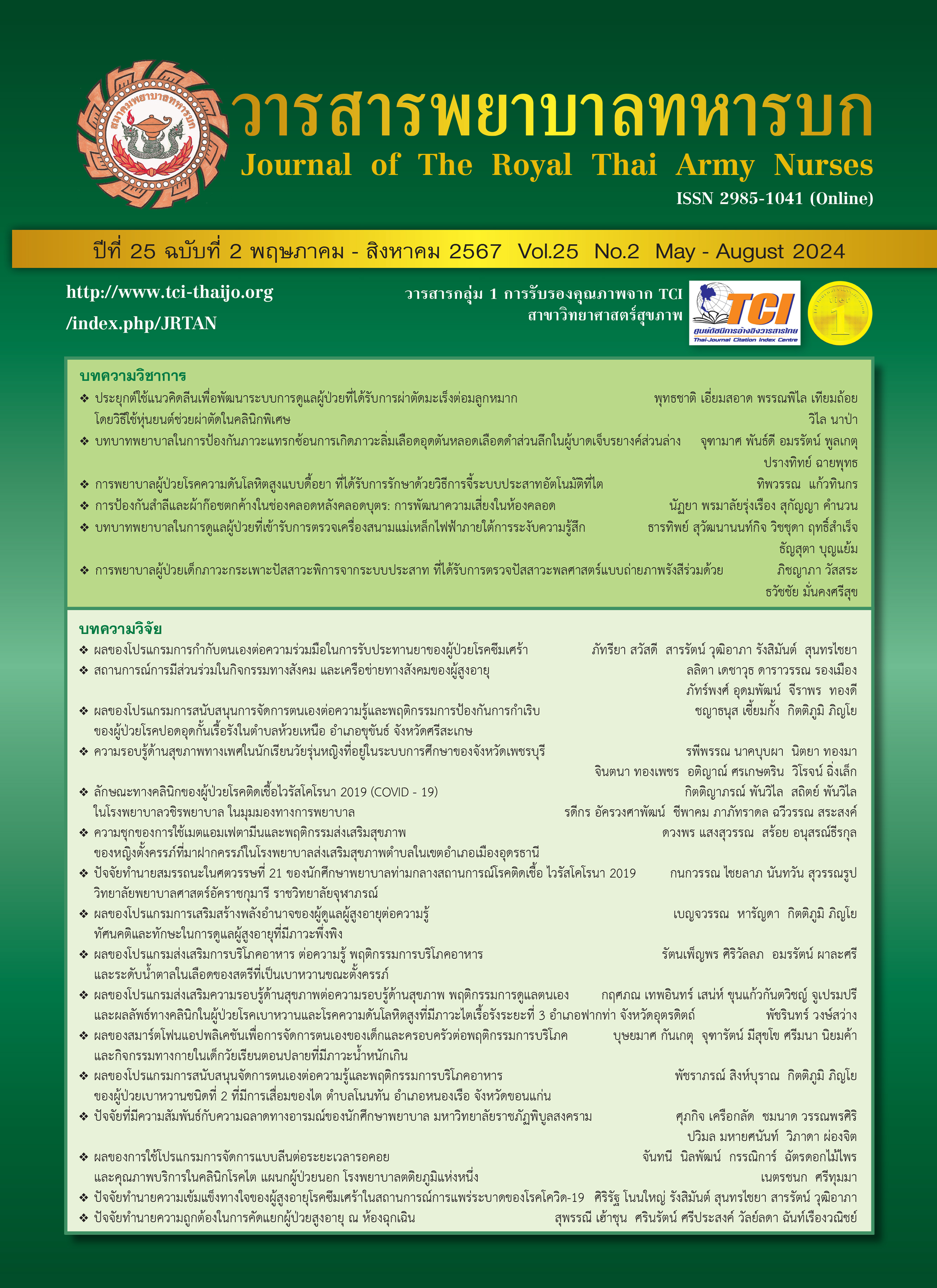
The Effect of a Self-Regulation Program on Medication Adherence in Patients with Major Depressive Disorders
Keywords:
self-regulation program, medication adherence, patients with major depressive disordersAbstract
A self-regulation program is designed to direct a person’s behavior towards a targeted action. A selfregulation consists of the process of self-observation, self-judgment, and self-reaction. This quasi-experimental research aimed to determine the effects of a self-regulation program on medication adherence in patients with depressive disorder. The sample consisted of 60 patients with depressive disorder aged 18-60, for outpatients receiving services at Nakhon Ratchasima Rajanagarindra Psychiatric Hospital. The study was randomly assigned into the experimental and the control group, with 30 people in each group. The experimental group participated in the self-regulation program. This program consisted of 6 activities for 6 consecutive weeks. Data was analyzed using descriptive statistics including percentage, mean, standard deviation, and t-test; a dependent t-test was used to compare the mean of the medication adherence scores before and after the intervention in each group; and an independent t-test was used to examine the mean differences in the medication adherence scores between the experimental and control groups.The study found that there was a statistically significant increase in the mean of medication adherence scores (M = 7.90, SD = .40) after participating in the self-regulation program (t = 13.22, p < .05) and there was a statistically significant difference in the mean differences in the medication adherence scores. (D̅1 = 4.03, D̅2 = -0.03) between the pre and post-interventions for both groups (t = 10.14, p < .05).
The findings suggest that such a self-regulation program was able to increase medication adherence in patients with depressive disorders effectively.
Downloads
References
World Health Organization. The International Classification of diseases and related Health Problem 10th Revision classification of mental and behavioural disorders: clinical descriptions and diagnostic guidelines. Geneva, Switzerland 2007.
World Health Organization. Depression and other common mental disorders: Global health estimates. Geneva, Switzerland 2017.
Beck AT. Depression: Clinical, experimental, and theoretical aspects. New York: Harper & Row 1967.
Robin L Lepper H. Depression is a risk factor for noncompliance with medical treatment: meta-analysis of the effects of anxiety and depression on patient adherence. Archives of internal medicine 2000; 16(4): 101-7.
Moonchai K, Sangon S, Ninthachan P, Rungrungsiripan M. Factors Associated with Adherence to Medication in Major Depressive Disorder Patients. Thai Red Cross Nursing Journal 2020; 13(1): 241-60. (in Thai)
Srichai A, Foofoeng T, Pacharapakornsin P. Factors Related with Medication Adherence in Patients with Depression. Regional Health Promotion Center 2021; 15(38): 671–84. (in Thai)
Pliankerd P. Depressive disorder: Nurse’s role in nursing care. Journal of The Royal Thai Army Nurse 2014; 15(1): 18-21. (in Thai)
Khamkum P, Keawkingkaew S, Nintachan P. Effects of psychoeducation program on medication adherence among patients with depression. Thammasat Medical Journal 2011; 11(4): 528–34. (in Thai)
Suemram P, Wattanapailin A, Yuttatri P. Correlation between Beliefs about Depression, Social Support, Medical Co-Morbidity and Drug Adherence Behavior in Elderly with Major Depressive Disorder. The Journal of Baromarajonani College of Nusing Nakhonratchasima 2016; 22(1): 108–19. (in Thai)
Bandura A. Social cognitive theory of selfregulation. Organizational Behavior and Human Decision Processes 1991; 50(2): 248-87.
Kongsuk T, Supanya S, Kenbubpha K, Phimtra S, Sukhawaha S, Leejongpermpoon J. Services for depression and suicide in Thailand. World Health Organization Southeast Asian Journal of Tropical Medicine and Public Health. 2017; 6(1): 34-8. (in Thai)
Klongdee K, Benjakul S, Kengganpanich M, Kengganpanich T, Effects of the Smart Diet Program Applying the Concept of Self-Regulation for Diabetes Control in Type 2 Diabetic Patients in Hospital for Tropical Diseases. Ramathibodi Nursing Journal 2019; 25(3): 326-39 (in Thai)
Miller WR, Rollnick S. Talking oneself into change: Motivational interviewing stages of change and therapeutic process. Journal of Cognitive Psychotherapy 2004; 18(4): 299-308.
Downloads
Published
How to Cite
Issue
Section
License
Copyright (c) 2024 Journal of The Royal Thai Army Nurses

This work is licensed under a Creative Commons Attribution-NonCommercial-NoDerivatives 4.0 International License.
บทความหรือข้อคิดเห็นใดใดที่ปรากฏในวารสารพยาบาลทหารบกเป็นวรรณกรรมของผู้เขียน ซึ่งบรรณาธิการหรือสมาคมพยาบาลทหารบก ไม่จำเป็นต้องเห็นด้วย
บทความที่ได้รับการตีพิมพ์เป็นลิขสิทธิ์ของวารสารพยาบาลทหารบก
The ideas and opinions expressed in the Journal of The Royal Thai Army Nurses are those of the authors and not necessarily those
of the editor or Royal Thai Army Nurses Association.






