
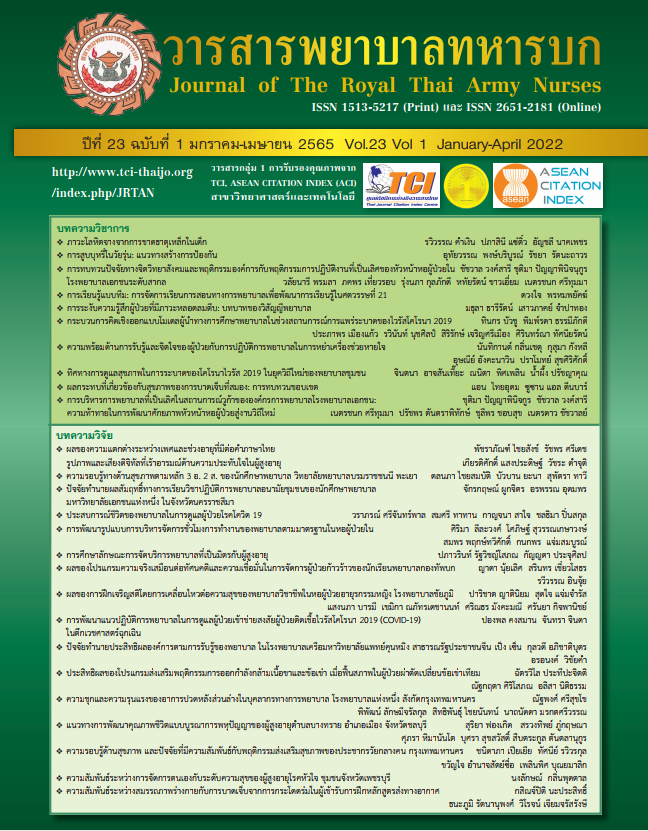
การทบทวนปัจจัยทางจิตวิทยาสังคมและพฤติกรรมองค์การ กับพฤติกรรมการปฏิบัติงานที่เป็นเลิศของหัวหน้าหอผู้ป่วย ในโรงพยาบาลเอกชนระดับสากล
คำสำคัญ:
ปัจจัยทางจิตวิทยาสังคม, พฤติกรรมองค์การ, หัวหน้าหอผู้ป่วย, พฤติกรรมการปฏิบัติงานที่เป็นเลิศบทคัดย่อ
การบริการส่วนใหญ่ในโรงพยาบาลเป็นการบริการทางการพยาบาลโดยมีหัวหน้าหอผู้ป่วยเป็นผู้กำกับงานและร่วมส่งมอบ การบริการที่มีคุณภาพแก่ผู้รับบริการ ทั้งนี้หัวหน้าหอผู้ป่วยมีบทบาทสำคัญในการนำนโยบายมาปฏิบัติให้เกิดประสิทธิภาพ ประสิทธิผลและเป็นผู้สนับสนุนนวัตกรรมในหอผู้ป่วยที่สร้างความได้เปรียบในการแข่งขันให้กับโรงพยาบาลอีกด้ว หัวหน้าหอผู้ป่วย จึงเปรียบเสมือนปัจจัยแห่งความสำเร็จของฝ่ายการพยาบาล ปัจจุบันแนวโน้มการบริหารการพยาบาลมีการมุ่งมาตรฐานคุณภาพ ระดับสากลและสถานการณ์ในงานมีความซับซ้อนมากขึ้น หัวหน้าหอผู้ป่วยต้องตระหนักในการพัฒนาศักยภาพตนเองให้อยู่ในระดับ สูงสุดเสมอ บทความนี้จึงมีวัตถุประสงค์เพื่อทบทวนปัจจัยที่มีความสัมพันธ์กับพฤติกรรมการปฏิบัติงานที่เป็นเลิศใน 4 มิติ ดังนี้ การปฏิบัติงานตามบทบาทหน้าที่กำหนด การปฏิบัติงานนอกเหนือบทบาทหน้าที่กำหนด การปฏิบัติงานตามการปรับตัวและการลด ผลกระทบในการปฏิบัติงาน และเพื่อเสนอปัจจัยทางจิตวิทยาสังคมและพฤติกรรมองค์การที่สนับสนุนให้หัวหน้าหอผู้ป่วยมีพฤติกรรม การปฏิบัติงานที่เป็นเลิศ อาทิ พฤติกรรมการริเริ่มด้วยตนเอง ความผูกพันในงาน ภาวะผู้นำพฤติกรรมเชิงนวัตกรรม ความพึงพอใจ ในงาน บรรยากาศด้านจิตใจ การออกแบบงานและการรับรู้ความสามารถของตนเอง ผู้เขียนหวังว่าบทความนี้จะมีส่วนกระตุ้น ให้หัวหน้าหอผู้ป่วยได้ตระหนักในการพัฒนาพฤติกรรมการปฏิบัติงานที่เป็นเลิศของตนเองอันจะเป็นประโยชน์ต่อการดำเนินงาน ของหอผู้ป่วยต่อไป
Downloads
เอกสารอ้างอิง
Wongprasit, N. Human resource development model of private hospitals in Thailand. JMS-UBU. 2013; 2(3): 22-38. (InThai)
Chaleoykitti,S., Kamprow,P., and Promdet, S. Patient Safety and Quality of Nursing Service. JRTAN. 2014; 15(2): 66-70. (InThai)
Kruse, F. M., Stadhouders, N. W., Adang, E. M., Groenewoud, S., & Jeurissen, P. P. Do private hospitals outperform public hospitals regarding efficiency, accessibility, and quality of care in the European Union? A literature review. The International journal of health planning and management. 2018; 33(2): e434-e453.
Joint Commission International. Joint Commission International Accreditation Standards for hospitals. Including Standards for Academic Medical Center Hospitals (6thed.). 2017.
Nanthapornsak, S., and Manmart, L. The factors affecting physicians’ employee engagement of private hospitals in the northeastern region, Thailand. KKU Research J. 2019; 7(2): 145-162. (InThai)
Thuekun, P., Wisesrith,W. Scenarios of nursing organization in private international medicalhubs during 2022-2026. JRTAN. 2020; 15(2): 181-191. (InThai)
West, E. Frontier nursing in appalachia: history, organization and the changing culture of care. Springer International Publishing. 2019.
Luo, C. M. A., Chang, H. F., & Su, C. H. Balanced Scorecard’as an operation-level strategic planning tool for service innovation. The service industries journal. 2012; 32(12): 1937-1956.
Marquis, B. and Huston, C. . Leadership roles and management functions in nursing. (9thed). Philadelphia, PA: Wolters Kluwer.2017.
Tongmuangtunyatep, K., Kunaviktikul, W., Nantsupawat, R., & Akkadechanunt, T. Development of a competency assessment scale for head nurses in community hospitals. Pacific Rim International Journal of Nursing Research. 2015;19(2): 122-134.
Titzer, J., Phillips, T., Tooley, S., Hall, N., & Shirey, M. Nurse manager succession planning: synthesis of the evidence. Journal of Nursing Management.2013; 21(7): 971-979.
Koopmans, L., Bernaards, C. M., Hildebrandt, V. H., de Vet, H. C., & van der Beek, A. J. Measuring individual work performance: Identifying and selecting indicators. Work. 2014; 48(2): 229-238.
Borman WC, Motowidlo SJ. Expanding the criterion domain to include elements of contextual performance. In: Schmitt N, Borman WC, eds. Personnel selection in organizations. San Francisco, CA: Jossey Bass.1993.
Campbell, J. P., McCloy, R. A., Oppler, S. H., & Sager, C. E. . A theory of performance. Personnel selection in organizations.1993; 3570: 35-70.
Greenslade, J. H., & Jimmieson, N. L. Distinguishing between task and contextual performance for nurses: Development of a job performance scale. Journal of Advanced Nursing. 2007;, 58(6): 602-611.
Wongsaree.C. Development of a performance excellence behaviors scale (PEBS) of head nurses in private international hospitals, Thailand Research report. 2021. (InThai)
Alomairy, M. The effect of Baldrige performance excellence program on organization’s innovation/dynamic capabilities. Thesis Ph.D. in industrial Engineering and Management Systems, College of Engineering and Computer Science: University of Central Florida. USA. 2016
Cebula, Nancy, Elizabeth Craig, John Eggers, PhD, Marge Douville Fajardo, James Gray, COL (Ret), and TheresaLantz. Achieving Performance Excellence: The Inflence of Leadership on Organizational Performance. Washington, DC: U.S. Department of Justice, National Institute of Corrections. 2012.
Bandura, A. . Self-efficacy: The exercise of control. New York: Freeman and Co.1997.
Frese, M., & Fay, D. Personal initiative (PI): An active performance concept for work in the 21st century. In B.M. Staw & R.M. Sutton (Eds.), Research in Organizational Behavior. Amsterdam: Elsevier Science.2001.
Lisbona, A., Palaci, F., Salanova, M., & Frese, M. The effects of work engagement and self-efficacy on personal initiative and performance. Psicothema. 2018; 30(1): 89-96.
Jamlongkun, C. The relationship model among transformational leadership work engagement, and job performance of head nurses in general hospitals. Thesis Ph.D. in Nursing Management, Christian university of Thailand: Nakhon Pathom. 2020. (InThai)
Kittimanont, H., and Wongkhomthong, S. A Causal model of health professional personnel performances in the university hospitals in Thailand. Journal of Business, Economics and Communications.2014; 9(2): 70-82 (InThai)
Wongcharoen.W.,Singchungchai,P.,Wongkhomtho ng, J., and Meehanpong.P.The structural equation model of leadership of in-patient unit head nurses as perceived by professional nurses, nurses’ work engagement, and job performance of professional nurses in community hospitals. JRTAN. 2018; 19(3): 97-106. (InThai)
Sriboonwong, L., Singchangchai, P., Aree, P. The relationship model among transformational leadership of head nurses, innovative work behavior and task performance as perceived by professional nurses in general hospitals. Thai Journal of Cardio-Thoracic Nursing.2020; 31(2): 96 -111. (InThai)
Suprasri, T., Sritoomma, N., and Luangamonlert, S. Effects of job design and generation Y nurse relations on generation Y nurses, performance at tertiary level hospitals under the ministry of public health. JPHD. 2021; 19(1): 19-30.
Schaufeli, W.B. and Bakker, A.B. Defining and measuring work engagement: bringing clarity to the concept, in Work Engagement: A Handbook of Essential Theory and Research (eds A.B. Bakker and M.P. Leiter). Psychology Press, New York. 2010.
De Jong, Jeroen, and Deanne Den Hartog. Measuring innovative work behaviour. Creativity and innovation management. 2010; 19(1): 23-36.
Schnake, Mel E. An empirical assessment of the effects of affective response in the measurement of organizational climate. Personnel Psychology. 1983; 36(4): 791-804.
Schneider, Benjamin, Mark G. Ehrhart, and William H. Macey. Organizational climate research.in The handbook of organizational culture and climate (eds Neal M. Ashkanasy, Celeste P M Wilderom, Mark F. Peterson). SAGE. 2011
Noe RA., Hollenbeck J R, Gerhart B and Wright PM. Fundamentals of Human Resource Management. New York: acid -free paper. 2016.
Jones, Gareth R. “Socialization Tactics, SelfEfficacy, and Newcomers’ Adjustments to Organizations. The Academy of Management Journal.1986; 29(2): 262–79. https://doi.org/10.2307/256188.
ดาวน์โหลด
เผยแพร่แล้ว
รูปแบบการอ้างอิง
ฉบับ
ประเภทบทความ
สัญญาอนุญาต
ลิขสิทธิ์ (c) 2022 วารสารพยาบาลทหารบก

อนุญาตภายใต้เงื่อนไข Creative Commons Attribution-NonCommercial-NoDerivatives 4.0 International License.
บทความหรือข้อคิดเห็นใดใดที่ปรากฏในวารสารพยาบาลทหารบกเป็นวรรณกรรมของผู้เขียน ซึ่งบรรณาธิการหรือสมาคมพยาบาลทหารบก ไม่จำเป็นต้องเห็นด้วย
บทความที่ได้รับการตีพิมพ์เป็นลิขสิทธิ์ของวารสารพยาบาลทหารบก
The ideas and opinions expressed in the Journal of The Royal Thai Army Nurses are those of the authors and not necessarily those
of the editor or Royal Thai Army Nurses Association.