
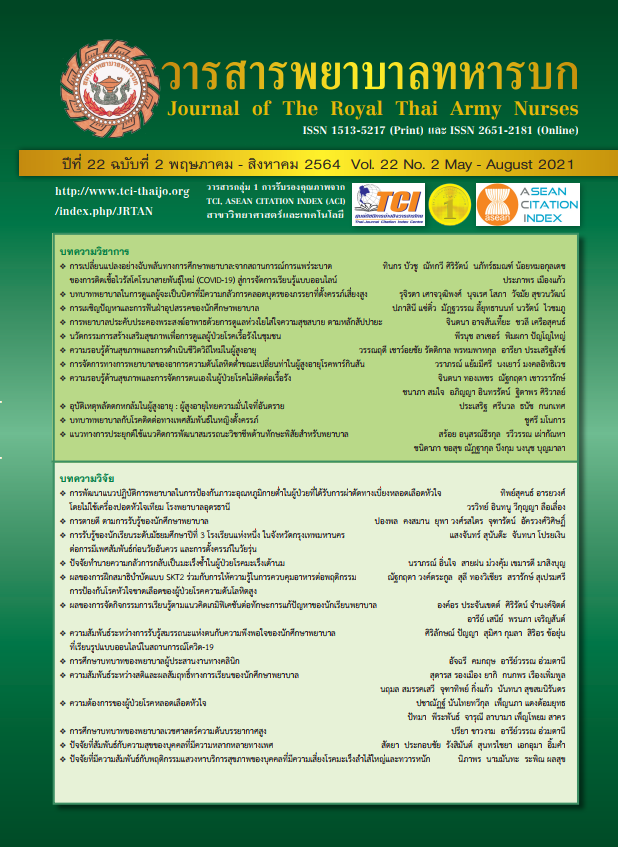
บทบาทพยาบาลในการดูแลผู้จะเป็นบิดาที่มีความกลัวการคลอดบุตร ของภรรยาที่ตั้งครรภ์เสี่ยงสูง
คำสำคัญ:
การตั้งครรภ์เสี่ยงสูง, บทบาทพยาบาลบทคัดย่อ
ความกลัวการคลอดบุตรในผู้จะเป็นบิดาเป็นความรู้สึกที่เกิดจากการคาดการณ์ทางลบเกี่ยวกับการตั้งครรภ์และการคลอด ของภรรยา ซึ่งการตั้งครรภ์เสี่ยงสูงเป็นภาวะที่อาจส่งผลอันตรายกับภรรยาและทารกในครรภ์ เป็นสิ่งที่ไม่สามารถคาดการณ์ได้ ซึ่งมีปัจจัยที่เกี่ยวข้อง คือ อายุของบิดา การขาดประสบการณ์ในการเป็นบิดา ความวิตกกังวล ความรู้สึกมีคุณค่าในตนเอง และการสนับสนุนทางสังคม ซึ่งเป็นสิ่งกระตุ้นให้ผู้จะเป็นบิดาเกิดความกลัวการคลอดบุตรของภรรยา ดังนั้น บทบาทพยาบาล ผดุงครรภ์จึงควรเป็นผู้ให้ความรู้และคำปรึกษาทางด้านสุขภาพเกี่ยวกับอาการและการดูแลภรรยาที่ตั้งครรภ์เสี่ยง รวมถึงประสานงาน กับทีมสหวิชาชีพที่เกี่ยวข้องเพื่อให้สตรีตั้งครรภ์ได้รับการรักษาที่เหมาะสมกับภาวะเสี่ยงที่เกิดขึ้น และให้คำแนะนำในการปรับเปลี่ยน สิ่งแวดล้อมทั้งด้านพฤติกรรมสุขภาพ และสิ่งแวดล้อมรอบข้าง ส่งผลให้สามารถปฏิบัติกิจกรรมในชีวิตประจำวันได้อย่าง เหมาะสม รวมถึงบทบาทในการเป็นนักวิจัย เพื่อศึกษาสาเหตุหรือแนวทางในการดูแลผู้จะเป็นบิดาและภรรยาที่ตั้งครรภ์เสี่ยงสูง ให้มีสุขกายและใจที่สมบูรณ์แข็งแรง
Downloads
เอกสารอ้างอิง
Cunningham, F.G., Leveno, J. K., Bloom, L. S., Spong, Y. C., Dashe, S. J., Hoffman, L.B…, Casey, M. B. & Sheffield. S. J. Williams obstetrics (24 th ed.). Columbus, OH: Mc GrawHill; 2018.
Michael, E.L. The Role of the Father in Child Development (5th ed.). Canada, Published simultaneously; 2010.
Eriksson, C., Westman, G., &Hambreg, K. Content of childbirth-related fear in Swedishwomen and men: Analysis of an open-end question. Journal of Midwifery & Women’s health. 2006;51(2):112-118.
Eriksson, C., Salander, P., & Hamberg, K. Men’s experiences of intense fear related to childbirth investigated in a Swedish qualitative study. Journal of Men’s Health and Gender. 2007;4(4):409-418.
Sansiriphun, N. Emotional Experience of Expectant Fathers: Fear of Childbirth. Nursing Journal. 2009;40(3):121-128. (In Thai)
Keawya, P., Sansiriphun, N., & Baosoung, C. Fear of childbirth among first time expectant fathers and related factors. Nursing Journal. 2013;41(3):13-23. (In Thai)
Spielberger, C. D., &Sydeman, S. J. State-Trait anxieiety inventory and State-Trait anger expression inventory. In M. E. Marvish (Ed.). The use of phychological test for treatment planning and outcome assessment. 1994: 292-321.
Sansiriphun, N., Kantaruksa, K., Klunklin, A., Baosoung, C., & Jordan, P. Thai men becoming a first-time father. Nursing & Health Sciences. 2010;12(4):403-409. (In Thai)
Rosenberg, M. Society and the adolescent self-image (Rev. ed.). Princeton: Princeton University Press. 1989.
House, J. S. Work stress and social support. New Jersey: Prentice Hall. 1981.
Serçekuş. P. &Başkale, H. Effects of antenatal education on fear of childbirth, maternal self-efficacy and parental attachment. Midwifery. 2016;34:166-172.
Hanson, S.M.H., & Boyd, S.T. Family Health Care Nursing: Theory Practice, and Research. Philadelphia: F.A. Davis. 1996.
Poomsanguan, K. Health Empowerment: Nurses Important Role. Journal of The Royal Thai Army Nurses. 2014;15(3):86-90. (In Thai)
ดาวน์โหลด
เผยแพร่แล้ว
รูปแบบการอ้างอิง
ฉบับ
ประเภทบทความ
สัญญาอนุญาต
บทความหรือข้อคิดเห็นใดใดที่ปรากฏในวารสารพยาบาลทหารบกเป็นวรรณกรรมของผู้เขียน ซึ่งบรรณาธิการหรือสมาคมพยาบาลทหารบก ไม่จำเป็นต้องเห็นด้วย
บทความที่ได้รับการตีพิมพ์เป็นลิขสิทธิ์ของวารสารพยาบาลทหารบก
The ideas and opinions expressed in the Journal of The Royal Thai Army Nurses are those of the authors and not necessarily those
of the editor or Royal Thai Army Nurses Association.