
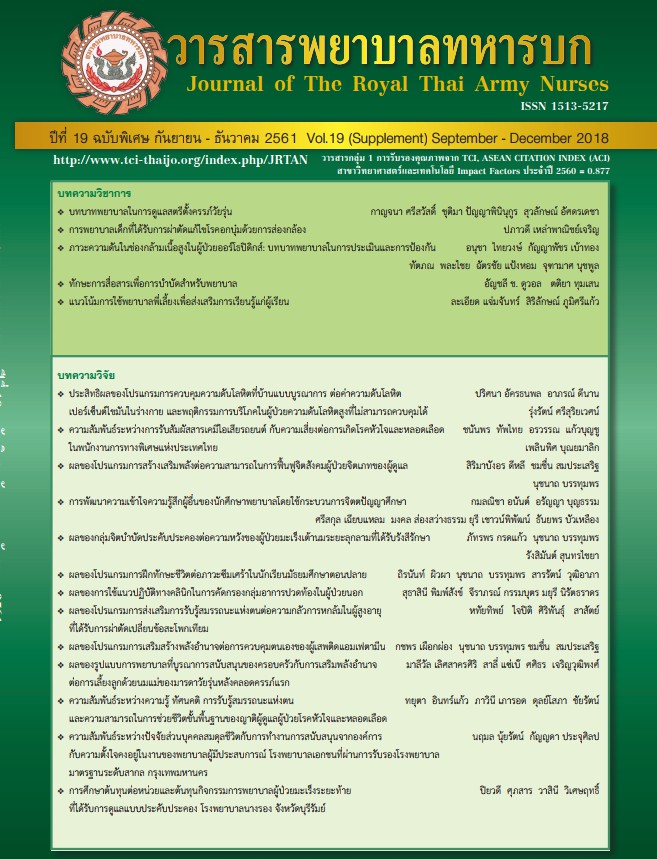
ผลของโปรแกรมการส่งเสริมการรับรู้สมรรถนะแห่งตนต่อความกลัวการหกล้มในผู้สูงอายุที่ได้รับการผ่าตัดเปลี่ยนข้อสะโพกเทียม
คำสำคัญ:
การรับรู้สมรรถนะแห่งตน, ความกลัวการหกล้ม, การผ่าตัดเปลี่ยนข้อสะโพกเทียมบทคัดย่อ
การวิจัยครั้งนี้เป็นการวิจัยกึ่งทดลองแบบสองกลุ่มวัดก่อนและหลังการทดลอง โดยมีวัตถุประสงค์ เพื่อศึกษาผลของ โปรแกรมการส่งเสริมการรับรู้สมรรถนะแห่งตนต่อความกลัวการหกล้มในผู้สูงอายุที่ได้รับการผ่าตัดเปลี่ยนข้อสะโพกเทียม กลุ่ม ตัวอย่าง คือ ผู้สูงอายุทั้งเพศชายและหญิงที่ได้รับการวินิจฉัยจากแพทย์ว่าเป็นกระดูกหักจากการพลัดตกหกล้มที่เข้ารับการผ่าตัด เปลี่ยนข้อสะโพกเทียมในหอผู้ป่วยศัลยกรรมกระดูกโรงพยาบาลราชวิถี ที่มีความกลัวการหกล้มเล็กน้อยถึงมากหลังผ่าตัดเปลี่ยนข้อ สะโพกเทียม เลือกกลุ่มตัวอย่างแบบเจาะจงจำนวน 44 คน แบ่งออกเป็นสองกลุ่มคือ กลุ่มทดลองและกลุ่มควบคุม กลุ่มละ 22 คน โดยจับคู่ให้มีคุณสมบัติคล้ายคลึงกัน (matched pair) ในด้าน เพศ อายุ ระดับความกลัว กลุ่มทดลองได้รับโปรแกรมการส่งเสริม การรับรู้สมรรถนะแห่งตนเป็นระยะเวลา 4 สัปดาห์ กลุ่มควบคุมได้รับได้รับการพยาบาลตามปกติ เครื่องมือที่ใช้ในการทดลอง ได้แก่ โปรแกรมการส่งเสริมการรับรู้สมรรถนะแห่งตน แบบสอบถามส่วนบุคคล แบบทดสอบสอบสมรรถภาพสมองเบื้องต้น ฉบับภาษา ไทย แบบสอบถามความกลัวการหกล้ม (FES) แบบประเมินอาการกลัวหกล้มในผู้สูงอายุไทย (Thai FES - I) และแบบสอบถามการ รับรู้สมรรถนะแห่งตน ตรวจสอบความเที่ยงโดยใช้สถิติ Cronbach’s Alpha โดยใช้วิธี Test-retest แบบสอบถามความกลัวการ หกล้ม (FES) แบบประเมินอาการกลัวหกล้มในผู้สูงอายุไทย (Thai FES - I) และแบบสอบถามการรับรู้สมรรถนะแห่งตนมีค่าความ เที่ยงเท่ากับ .81 , .84 และ .87 ตามลำดับ วิเคราะห์ข้อมูลโดยหาค่าเฉลี่ย ร้อยละ ส่วนเบี่ยงเบนมาตรฐานและสถิติทดสอบค่าทีโดย กำหนดนัยสำคัญที่ระดับ .05 ผลการวิจัยพบว่า ผู้สูงอายุที่ได้รับโปรแกรมการส่งเสริมการรับรู้สมรรถนะแห่งตนมีความกลัวการหกล้ม หลังผ่าตัดน้อยกว่าก่อนการทดลองอย่างมีนัยสำคัญทางสถิติและผู้สูงอายุที่ได้รับการพยาบาลตามโปรแกรมการส่งเสริมการรับรู้ สมรรถนะแห่งตนมีความกลัวการหกล้มหลังผ่าตัดน้อยกว่ากลุ่มควบคุมที่ได้รับการพยาบาลตามปกติอย่างมีนัยสำคัญทางสถิติ
Downloads
เอกสารอ้างอิง
2. Thanutvanich Y and Julmet P. Transition in the lives of hospitalized elderly women after having sustained hip fracture. Journal of Faculty of Nursing,BUU. 2011; 11(2): 1-7. (in Thai)
3. Kressig RW, Wolf SL, Sattin RW, O’Grady M, Greenspan A, Curns A and Kutner M. Associations of demographic, functional, and behavioral characteristics with activityrelated fear of falling among older adults transitioning to frailty. Journal of the American Geriatrics Society. 2001; 49(11): 1456-1462.
4. Khuankwai K. Factors related to falls among community-dwelling elderly people. Unpublished master’s thesis). Khon Kaen University, Khon Kaen, Thailand. 2007. (in Thai)
5. Howland J, Lachman ME, Peterson EW, Cote J, Kasten L and Jette A. Covariates of fear of falling and associated activity curtailment. The Gerontologist. 1998; 38(5): 549-555.
6. Chandler JM, Duncan PW, Sanders L, Studenski S. The fear of falling syndrome: Relationship to falls, physical performance, and activities of daily living in frail older persons. Topics in Geriatric Rehabilitation. 1996 Mar 1;11(3):55-63.
7. Tamsat A. Fear of Falling and Functional Ability in Older Adults Undergoing Hip Surgery (Doctoral dissertation, Mahidol University). 2014. (in Thai)
8. Stone JT and Wyman JF. Clinical gerontological nursing: a guide to advanced practice. 2nd ed. Philadelphia: W.B. Saunders. 1999; 68-341.
9. Marungga L. Fear of falling experiences of older persons. (Unpublished master’s thesis). Chulalongkorn University, Bankok, Thailand. 2010. (in Thai)
10. Fuzhong L, McAuley E, Fisher KJ, Harmer P, Chaumeton N and Wilson NL. Self-efficacy as a mediator between fear of falling and functionalability in the elderly. Aging Health. 2002; 14(4): 452-66.
11. Hellstrom K, Vahlberg B, Urell C and Emtner M. Fear of falling, fall-related self-efficacy, anxiety and depression in individuals with chronic obstructive pulmonary disease. Clinical Rehabilitation. 2009; 23: 1136-1144.
12. Tinetti ME, Richman D and Powell L. Falls efficacy as a measure of fear of falling. Journal of Gerontology. 1990; 45(6): 239-243.
13. Fletcher PC and Hirdes JP. Restriction in activity associated with fear of falling among community-based seniors using home care services. Age and Ageing. 2004; 10: 1-7.
14. Bandura A. Self efficacy the exercise of control (4 thed.). United States of America: W. H. Freeman. 1997.
15. Thiamwong L. Psychometric Testing of the Falls Efficacy Scale-International. Songklanagarind Medical Journal. 2012 Mar 6;29(6):277-287. (in Thai)
16. Rittiwong T. The effect of perceived self-efficacy promoting program in weight reduction on the severity of knee osteoarthritis in overweight older persons. (Unpublished master’s thesis). Chulalongkorn University, Bankok, Thailand. 2010. (in Thai)
17. Wirojyuti S, Kengganpanich M, Kengganpanich T, Tansakul S. Effectiveness of Post Surgery Rehabilltatinon Program for Elderly Patients with HIP Fractuer in Phramongkutklao Hospital. Journal of The Royal Thai Army Nurses.;15(2): 187-194. (in Thai)
18. Thanyasawad T, Sappayanon S, Thongklom C, Kogchana W, Moolsin P, Boonthuk P, Jungsuvadee Hathirat. A Study of Barthel Activities of Daily Living In Elderly patient Hip Replacement. Journal of The Royal Thai Army Nurses.;19(1):201-209. (in Thai)
ดาวน์โหลด
เผยแพร่แล้ว
รูปแบบการอ้างอิง
ฉบับ
ประเภทบทความ
สัญญาอนุญาต
บทความหรือข้อคิดเห็นใดใดที่ปรากฏในวารสารพยาบาลทหารบกเป็นวรรณกรรมของผู้เขียน ซึ่งบรรณาธิการหรือสมาคมพยาบาลทหารบก ไม่จำเป็นต้องเห็นด้วย
บทความที่ได้รับการตีพิมพ์เป็นลิขสิทธิ์ของวารสารพยาบาลทหารบก
The ideas and opinions expressed in the Journal of The Royal Thai Army Nurses are those of the authors and not necessarily those
of the editor or Royal Thai Army Nurses Association.