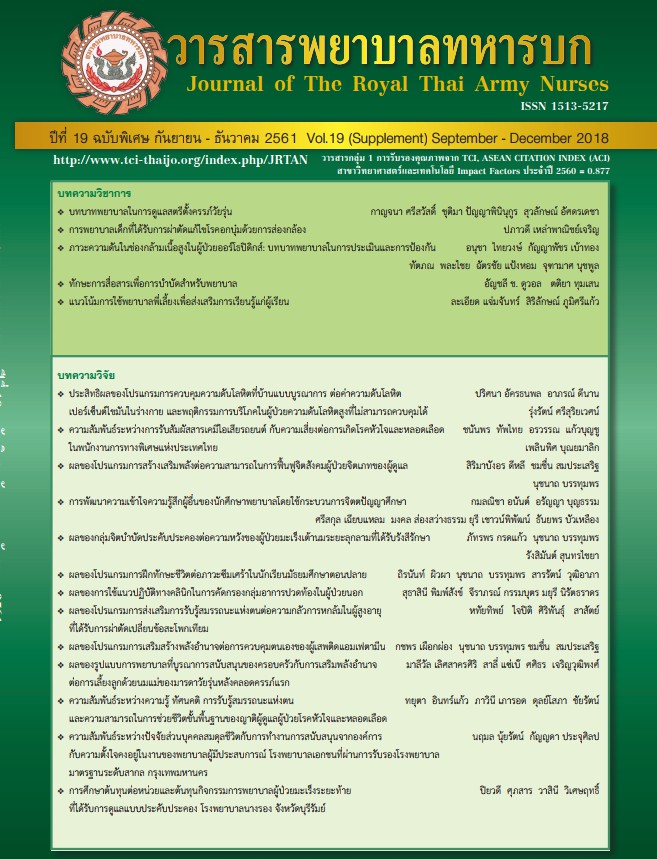
ความสัมพันธ์ระหว่างการรับสัมผัสสารเคมีไอเสียรถยนต์ กับความเสี่ยงต่อ การเกิดโรคหัวใจและหลอดเลือดในพนักงานการทางพิเศษแห่งประเทศไทย
คำสำคัญ:
พนักงานการทางพิเศษแห่งประเทศไทย, การไหลเวียนเลือดส่วนปลาย, สารเคมี, ไอเสียรถยนต์, ความเสี่ยงการต่อการเกิดโรคหัวใจและหลอดเลือดบทคัดย่อ
การศึกษานี้มีจุดประสงค์ เพื่อศึกษาความสัมพันธ์ระหว่างการรับสัมผัสสารเคมีไอเสียรถยนต์กับความเสี่ยงต่อการเกิดโรคหัวใจและหลอดเลือดในพนักงานการทางพิเศษแห่งประเทศไทยเป็นการวิจัยแบบภาคตัดขวางกลุ่มตัวอย่างจำนวน 177 คนเก็บรวบรวมข้อมูลโดยใช้แบบสอบถามและตรวจประเมินปริมาณการไหลเวียนของหลอดเลือดส่วนปลาย โดยเครื่อง The second derivative finger photo-plethysmogram (SDPTG) วิเคราะห์ความสัมพันธ์โดยใช้สถิติสัมประสิทธิ์สหสัมพันธ์แบบเพียร์สันและวิเคราะห์การถดถอยเชิงพหุคูณ ผลการศึกษาพบว่า ค่าเฉลี่ยของค่าดัชนีการไหลเวียนหลอดเลือดส่วนปลาย (SDPTG-AI) เท่ากับ -0.51 0.32 และพบ ว่าการสัมผัสสารเคมีไอเสียรถยนต์มีความสัมพันธ์กับค่าความเสี่ยงต่อการเกิดโรคหัวใจและหลอดเลือดในพนักงานการทางพิเศษแห่ง ประเทศไทย อย่างมีนัยสำคัญ (r=0.132 p-value=0.035) ภายหลังจากควบคุมปัจจัยส่วนบุคคลและพฤติกรรมสุขภาพ ผลการวิจัยครั้งนี้ มีข้อเสนอแนะให้หน่วยงานควรส่งเสริมพฤติกรรมสุขภาพ เช่น การควบคุมน้ำหนัก และการรับประทาน อาหารเค็ม และพฤติกรรมการทำงาน เช่นการใช้อุปกรณ์ป้องกันอันตรายส่วนบุคคล เพื่อลดความเสี่ยงต่อการเกิดโรคหัวใจและหลอดเลือด
Downloads
เอกสารอ้างอิง
2. Strategy and Planning Division, Office of the Permanent Secretary. Strategy, metrics and Storage guidelines Ministry of Public Health. Bangkok: Samcharoen Panich Co., Ltd; 2016. (in Thai)
3. Expressway Authority of Thailand. Annual report 2016. Bangkok: Expressway Authority of Thailand. (in Thai)
4. Bureau of Non Communicable Diseases, Department of Disease Control, Ministry of Public Health. Guidelines for Assessment of Cardiovascular Risk. Bangkok: WVO Officer of Printing Mill, The War Veterans Organization of Thailand Under Royal Patronage of His Majesty the King; 2014. (in Thai)
5. Jirojanakul P., Nipathatapong S, Keinwong T, Pipatsombat P, Rowsathien N. Cardivascular Risk Factors in a Cross-Sectional Study. Thai Journal
of Cardio-Thoracic Nursing 2013; 24(1): 44-55. (in Thai)
6. O’Donnell CJ, Elosua R. Cardiovascular Risk Factors. Insights From Framingham Heart Study. Revista Esponala Cardiologia 2008; 61(3): 299-310.
7. Diene E, Fouquet A, Esquirol Y. Cardiovascular diseases and psychosocial factors at work. Archives of Cardiovascular Disease 2011; 105: 33-39.
8. Solomon A. et al. Induction of platelet aggregation after a direct physical interaction with diesel exhaust particles. Journal of Thrombosis and
Haemostasis 2012; 11: 325-334.
9. Jeng HA. Polycyclic aromatic hydrocarbon-induced oxidative stress and lipid peroxidation in relation to immunological alteration. Occupational & Environmental Medicine 2010; 68(9): 653-58.
10. Everett CJ. et al. Association of urinary polycyclic aromatic hydrocarbons and serum C-reactive protein. Environmental Research 2009; 110:
79–82.
11. Silpasuwan P. Occupational Health Nursing: Concepts and Practice. 2015 Bangkok: Chuanpim Printing. (in Thai).
12. Wayne WD. Biostatistics Afoundation for analysis in the Health Sciences. New Jersey: Wiley; 2005.
13. Ilar A. et al. Myocardial infarction and occupational exposure to motor exhaust: a populationbase case-control study in Sweden. Occupational Epidemiology 2014; 29: 517-525.
14. Phaktongsuk P. & Apakupakul N. Validation and modification of Karasek job stress questionnaire in Thai population. The Thailand Research Fund; 2005. (in Thai)
15. Otsuka T, Kawada T, Katsumata M, & Ibuki C. Utility of Second Derivative of the Finger Photoplethysmogram for the Estimation of the Risk of Coronary Heart Disease in the General Population. Circulation Journal 2006; 70: 304-310.
16. Kaewboonchoo O. et al. Blood Lead Level and Cardiovascular Risk Factors among Bus Drivers in Bangkok, Thailand. Industrial Health 2010; 48: 61–65.
17. Naknoi S. Effects of Exposure Prevention Behavior Promoting Program to Pesticides on Peripheral Blood Flow in Rice Farmers. [Thesis in Community Nurse Practitioner]. Bangkok; Faculty of Graduate Studies Mahidol University; 2016. (in Thai)
18. Alshaarawy O., Elbaz H. A. & Andrew M. E. The association of urinary polycyclic aromatic hydrocarbon biomarkers and cardiovascular disease in the US population. Environment International. Environmental International 2016; 89(90): 174-178.
19. Nipaspong K. Factors Related to Health Status of Firefighters in Bangkok. [Thesis in Public Health Nurse]. Bangkok; Faculty of Graduate Studies Mahidol University; 2013. (in Thai)
20. Yaruang N, Sukonthasarn P. Occupational Safety Behaviors and Health Status Among Rice Farmers in Chiang Rai Province. Journal of The Royal Thai Army Nurses. 2016; 17(2) : 163-174. (in Thai).
ดาวน์โหลด
เผยแพร่แล้ว
รูปแบบการอ้างอิง
ฉบับ
ประเภทบทความ
สัญญาอนุญาต
บทความหรือข้อคิดเห็นใดใดที่ปรากฏในวารสารพยาบาลทหารบกเป็นวรรณกรรมของผู้เขียน ซึ่งบรรณาธิการหรือสมาคมพยาบาลทหารบก ไม่จำเป็นต้องเห็นด้วย
บทความที่ได้รับการตีพิมพ์เป็นลิขสิทธิ์ของวารสารพยาบาลทหารบก
The ideas and opinions expressed in the Journal of The Royal Thai Army Nurses are those of the authors and not necessarily those
of the editor or Royal Thai Army Nurses Association.