
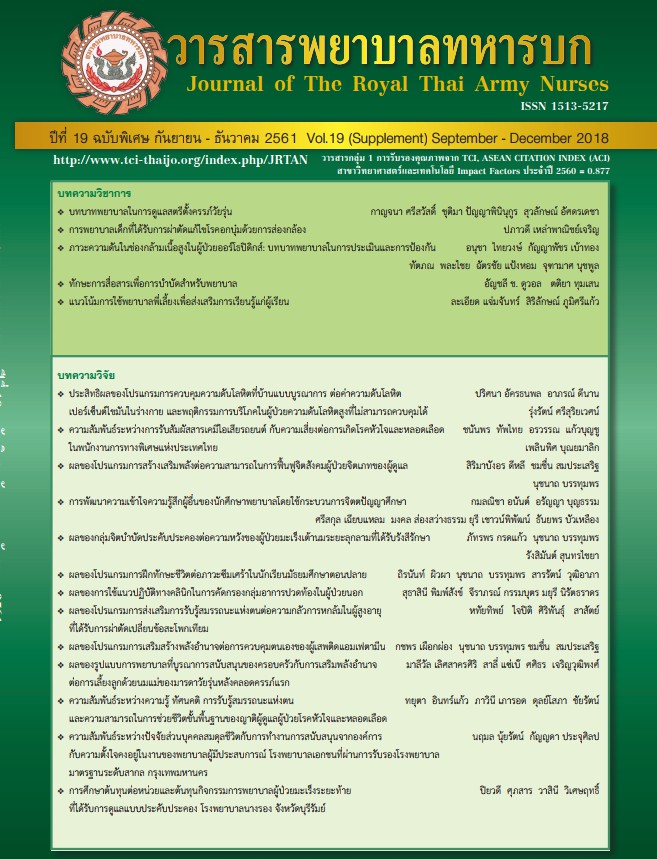
The Effectiveness of The Integrated Home-Based Program on Blood Pressure, Body Fat Percentage And Eating Behavior among Uncontrolled Hypertensive Patients
Keywords:
home-based program, uncontrolled hypertension, self-regulation, body fat, eating behaviorAbstract
The study’s aimed to determine the effects of an integrated home-based (IHB) program on blood pressure, body fat and eating behavior among patients with uncontrolled hypertension. The IHB was based on evidence-based practices and self-regulation concept. Program strategies included nurse counseling, goal setting, health education, home blood pressure monitoring, self-appraisal in making progress by an action plan, revision of goals and action plans, and telephone support within six weeks. Eighty patients with uncontrolled hypertension who met the inclusion criteria were recruited to participate in the study. A quasi-experimental design was used by assigning 40 participants to the IHB group and other 40 to the control group. Participants in the experimental group received IHB program as an intervention and usual care, while the control group received usual care. Blood pressure, body fat and the three-factors eating questionnaire (TFEQ) were measured at baseline, week 7 and week 11. Descriptive statistics, chi-square, paired t-tests, and Repeated Measures ANOVA were used to analyze the data. The results found that majority was female. Mean age was 60.9 years, and average duration of hypertension was 4.4 years. The IHB group had significantly lower systolic and diastolic blood pressures, lower percentages of body fat, and improved eating behavior compared to the baseline and the control group. The results suggested that The IHB program was benefits for uncontrolled HT and could be used in community setting.
Downloads
References
2. Gu Q, Burt VL, Dillon CF, & Yoon S. Trends in antihypertensive medication use and blood pressure control among United States adults with hypertension the National Health and Nutrition Examination Survey, 2001 to 2010. Circulation 2012;126:2105-14.
3. Wang TJ, Vasan RS. Epidemiology of uncontrolled hypertension in the United States. Circulation 2005;112:1651-62.
4. Low KJ, Pelter MA, Deamer RL, Burchette RJ. Identification and evaluation of risk factors in patients with continuously uncontrolled hypertension. J Clin Hypertens 2015;17:281-9.
5. Khosravi A, Pourheidar B, Roohafza H, Moezzi M, Mousavi M, Hajiannejad, et al. Evaluating factors associated with uncontrolled hypertension: Isfahan cohort study, Iran. ARYA Atheroscler 2014;10:311-8.
6. Dave GJ, Bibeau DL, Schulz MR, Aronson RE, Ivanov LL, Black A, et al. Predictors of uncontrolled hypertension in the Stroke Belt. J Clin Hypertens 2013;15:562-9.
7. Elperin DT, Pelter MA, Deamer RL, Burchette RJ. A large cohort study evaluating risk factors associated with uncontrolled hypertension. J Clin Hypertens 2014;16:149-54.
8. Cordero A, Bertomeu-Martínez V, Mazón P, Fácila L, Bertomeu-González V, Cosín J, et al. Factors associated with uncontrolled hypertension in patients with and without cardiovascular disease. Rev Esp Cardiol 2011;64:587-93.
9. Ogedegbe G, Fernandez S, Fournier L, Silver SA, Kong J, Gallagher S, et al. The counseling older adults to control hypertension (COACH) trial: Design and methodology of a group-based lifestyle intervention for hypertensive minority older adults. Contemp Clin Trials 2013;35:70-9.
10. Piercefield EW, Howard ME, Robinson MH, Kirk CE, Ragan AP, Reese SD. Antihypertensive medication adherence and blood pressure control among central Alabama veterans. J Clin Hypertens 2017;19:543-9.
11. Farquhar WB, Edwards DG, Jurkovitz CT, Weintraub WS. Dietary sodium and health: more than just blood pressure. J Am Coll Cardiol 2015;65:1042-50.
12. Reddy V, Sridhar A, Machado RF, Chen J. High sodium causes hypertension: evidence from clinical trials and animal experiments. J Integr Med 2015;13:1-8.
13. Leelacharas S, Kerdonfag P, Chontichachalalauk J, Sanongdej W. Illness perceptions, lifestyle behaviors, social support, and cardiovascular risks in people with hypertension in urban and rural areas of Thailand. Pac Rim Int J Nurs Res Thail 2015;19:245-56.
14. Zeng Q, Dong SY, Sun XN, Xie J, Cui Y. Percent body fat is a better predictor of cardiovascular risk factors than body mass index. Braz J Med Biol Res 2012;45:591-600.
15. Cooper LA, Roter DL, Carson KA, Bone LR, Larson SM, Miller ER 3rd, et al. A randomized trial to improve patient-centered care and hypertension control in underserved primary care patients. J Gen Intern Med 2011;26:1297-304.
16. Ahmad R, ur Rahman S, uz Zaman F, Jan S. Percent body fat and its relationship with Obesity and Hypertension in adult population of Mingora, Swat. Gomal Journal of Medical Sciences 2010;9:120-3.
17. Maruf FA, Akinpelu AO, Salako BL. Effects of aerobic exercise and drug therapy on blood pressure and antihypertensive drugs: A randomized controlled trial. Afr Health Sci 2013;13:1-9.
18. Bernocchi P, Scalvini S, Bertacchini F, Rivadossi F, Muiesan ML. Home based telemedicine intervention for patients with uncontrolled hypertension: A real life-nonrandomized study. BMC Med Inform Decis Mak 2014;14:52-9.
19. Meinema JG, van Dijk N, Beune EJ, Jaarsma DA, van Weert HC, Haafkens JA. Determinants of adherence to treatment in hypertensive patients of African descent and the role of culturally appropriate education. PloS One 2015;10:1-14.
20. McKinstry B, Hanley J, Wild S, Pagliari C, Paterson M, Lewis S, et al. Telemonitoring based service redesign for the management of uncontrolled
hypertension: Multicentre randomised controlled trial. BMJ 2013; 346: 1-18.
21. Kongjarern S, Wattana C, W, Harnirattisai T. Effects of a self-regulation program for blood pressure control on self-regulation behaviors, blood pressure level and stroke risk among Thai Muslim with hypertension. Nursing Journal 2013;40:23-33. (in Thai)
22. Hébert ET, Caughy MO, Shuval K. Primary care providers’ perceptions of physical activity counselling in a clinical setting: a systematic review. Br J Sports Med 2012;46:625-31.
23. Kerry SM, Markus HS, Khong TK, Cloud GC, Tulloch J, Coster D, et al. Home blood pressure monitoring with nurse-led telephone support among patients with hypertension and a history of stroke: A community-based randomized controlled trial. CMAJ 2013; J185: 23-31.
24. Sukwatjanee A. Use behavioral change program to decrease hyperlipidemia and hypertension in primary health setting. GSTF JNHC 2017; 1:37-42.
25. Bandura A, Wood R. Effect of perceived controllability and performance standards on self-regulation of complex decision making. J Pers Soc Psychol 1989;56:805-14.
26. Amico KR. Percent total attrition: A poor metric for study rigor in hosted intervention designs. American J Public Health 2009;99:1567-75.
27. Stunkard AJ, Messick S. The three-factor eating questionnaire to measure dietary restraint, disinhibition and hunger. J Psychosom Res 1985;29:71-83.
28. Barnard ND, Cohen J, Jenkins DJ, Turner-McGrievy G, Gloede L, Green A, et al. A low-fat vegan diet and a conventional diabetes diet in the treatment of type 2 diabetes: a randomized, controlled, 74-wk clinical trial. Am J Clin Nutr 2009;89:1588S–96S.
29. Wattanakorn K, Deenan A, Puapan S, Schneider JK. Effects of an eating behaviour modification program on thai people with diabetes and obesity: A randomised clinical trial. Pac Rim Int J Nurs Res 2013;17:356-70.
30. Garfinkle MA. Salt and essential hypertension: pathophysiology and implications for treatment. J Am Soc Hypertens 2017;11, 385-91.
31. DeMarco VG, Aroor AR, Sowers JR. The pathophysiology of hypertension in patients with obesity. Nat Rev Endocrinol 2014;10:364-76.
32. James PA, Oparil S, Carter BL, Cushman WC, Dennison-Himmelfarb C, Handler J, et al. Evidence-based guideline for the management of high blood pressure in adults: report from the panel members appointed to the Eighth Joint National Committee (JNC 8). JAMA 2014;311:507-20.
33. Poonperm R. Food Consumption Behaviors of Family in the Community of Phramongkutklao Hospital personnel’s Residence. Journal of
The Royal Thai Army Nurses 2016;17:78-88. (in Thai)
Downloads
Published
How to Cite
Issue
Section
License
บทความหรือข้อคิดเห็นใดใดที่ปรากฏในวารสารพยาบาลทหารบกเป็นวรรณกรรมของผู้เขียน ซึ่งบรรณาธิการหรือสมาคมพยาบาลทหารบก ไม่จำเป็นต้องเห็นด้วย
บทความที่ได้รับการตีพิมพ์เป็นลิขสิทธิ์ของวารสารพยาบาลทหารบก
The ideas and opinions expressed in the Journal of The Royal Thai Army Nurses are those of the authors and not necessarily those
of the editor or Royal Thai Army Nurses Association.