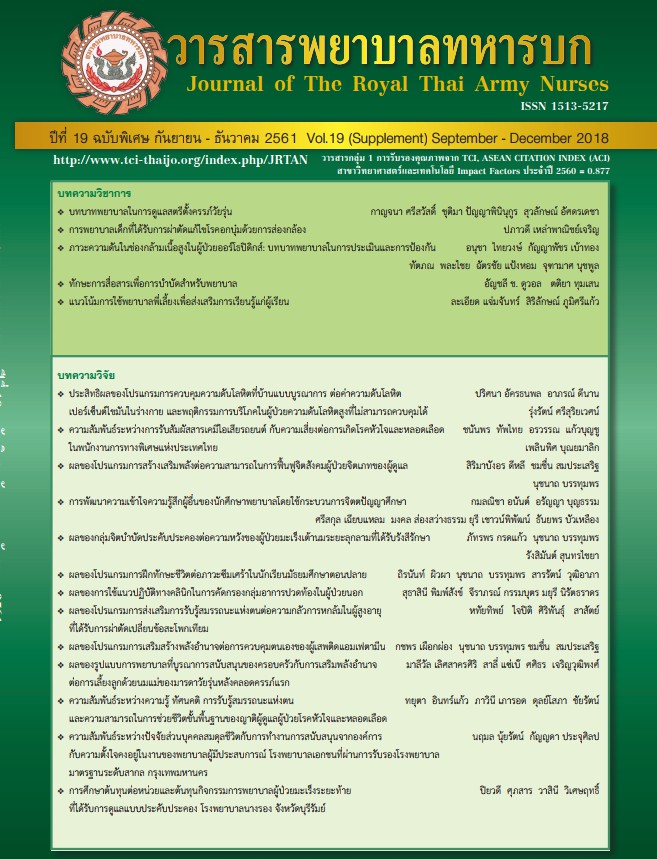
ภาวะความดันในช่องกล้ามเนื้อสูงในผู้ป่วยออร์โธปิดิกส์: บทบาทพยาบาลในการประเมินและการป้องกัน
คำสำคัญ:
ภาวะความดันในช่องกล้ามเนื้อสูง, การพยาบาล, การประเมิน, การป้องกันบทคัดย่อ
ภาวะความดันในช่องกล้ามเนื้อสูงเป็นภาวะฉุกเฉินที่สำคัญในผู้ป่วยที่มีปัญหากระดูกและกล้ามเนื้อจำเป็นต้องได้รับการ รักษาอย่างทันท่วงที ผลจากการเพิ่มขึ้นของความดันในช่องกล้ามเนื้อจะกดการไหลเวียนหลอดเลือดฝอยและการทำงานของเส้น ประสาท ทำให้เนื้อเยื่อขาดเลือดมาเลี้ยงและเน่าตายได้อย่างรวดเร็ว เป็นเหตุให้เกิดการสูญเสียอวัยวะ เส้นประสาทสูญเสียหน้าที่ เกิดความพิการ ในรายที่มีอาการรุนแรงอาจเสียชีวิตได้ ส่งผลกระทบต่อผู้ป่วยและครอบครัวทั้งทางตรงและทางอ้อม พยาบาลเป็น ส่วนหนึ่งของทีมสหสาขาวิชาชีพ จึงจำเป็นต้องมีความรู้และทักษะในการประเมินการทำหน้าที่ของเส้นประสาทและหลอดเลือด การ ติดตามเฝ้าระวังอย่างต่อเนื่อง และวางแผนการดูแลป้องกันภาวะความดันในช่องกล้ามเนื้อสูงที่ดีและมีประสิทธิภาพ เพื่อลดภาวะ แทรกซ้อนและการสูญเสียที่อาจเกิดขึ้น
Downloads
เอกสารอ้างอิง
2. Wongsaree C, SriparatJ. Nurse’s role in basic medical and continuing care for patients got bitten by snakes.Christian University of Thailand Journal.2018;24(3):467-78. (in Thai)
3. Raza H, Mahapatra A. Acute compartment syndrome in orthopedics: causes, diagnosis, and management. Adv Orthop 2015. 2015:doi: 10.1155/2015/543412
4. Schmidt AH. Acute compartment syndrome. Orthop Clin N AM. 2016;47(3):517–25.
5. Via AG, Oliva F, Spoliti M, Maffulli N. Acute compartment syndrome. Muscles, Ligaments and Tendons J. 2015;5(1):18-22.
6. Walls MH. Compartment syndrome: an orthopedic emergency. J Emerg Nurs. 2017;43(4):303-7.
7. Malik AA, Khan WSA, Chaudhry A, Ihsan M, Cullen NP. Acute compartment syndrome-a life and limb threatening surgical emergency. Journal of perioperative practice. 2009;19(5):137-42.
8. Shadgan B, Menon M, Sanders D, Berry G, Martin JrC, Duffy P, et al., Current thinking about acute compartment syndrome of the lower extremity. Can J Surg. 2010;53(5):329-34.
9. Tiptirapong W. Nursing care in close comminuted fracture of the leg with acute compartment syndrome: case study. Region 4 Medical Journal. 2015;17(3):237-44. (in Thai)
10. Shadgan B, Pereira G, Menon M, Jafari S, Darlene RW, O’Brien PJ. Risk factors for acute compartment syndrome of the leg associated with tibial diaphyseal fractures in adults. J Orthop Traumatol. 2015;16(3): 185–92.
11. Pechar J, Lyons MM. Acute compartment syndrome of the lower leg: a review. J Nurse Pract. 2016;12(4):265-70.
12. Donaldson J, Haddad B, Khan WS. The pathophysiology, diagnosis and current management of acute compartment syndrome. Open Orthop J. 2014;8:185-93.
13. Frink M, Hildebrand F, Krettek C, Brand J, Hankemeier S. Compartment syndrome of the lower leg and foot. Clin Orthop Relat Res. 2010;468(4):940–50.
14. Chayasit Y, Piboonrungroj P. Compartment syndrome: concept and nursing practice. Journal of Nursing Division 2012;39(3):65-74. (in Thai)
15. Von Keudell AG, Weaver MJ, Appleton PT, Bae DS, Dyer GS, Heng M, et al. Diagnosis and treatment of acute extremity compartment syndrome.
Lancet 2015;308:1299-310.
16. Wall CJ, Lynch J, Harris IA, Richardson MD, Brand C, Lowe AJ, et al. Clinical practice guidelines for the management of acute limb compartment syndrome following trauma. ANZ J Surg. 2010;80(3):151-6.
17. Mabvuure NT, Malahias M, Hindocha S, Khan W, Juma A. Acute compartment syndrome of the limbs: current concepts and management. Open Orthop J. 2012;6(Supply 3: M7):535-43.
18. Kanlic EM, Pinski SE, Verwiebe EG, Saller J, Smith WR. Acute morbidity and complications of thigh compartment syndrome: a report of 26 cases. Patient Safety in Surgery. 2010;4:13.
19. Schmidt AH. The impact of compartment syndrome on hospital length of stay and charges among adult patients admitted with a fracture of the tibia. J Orthop Trauma. 2011;25(6):355-67.
20. Crespo AM, Manoli A, Konda SR, Egol KA. Development of compartment syndrome negatively impacts length of stay and cost after tibia fracture. J Orthop Trauma. 2015;29 (7):312-5.
21. Giannoudis PV, Nicolopoulos C, Dinopoulos H, Ng A, Adedapo S, Kind P. The impact of lower leg compartment syndrome on health related quality of life. Injury. 2002;33(2):117-21.
22. Lollo L, Grabinsky A. Clinical and functional outcomes of acute lower extremity compartment syndrome at a Major Trauma Hospital. Int J Crit Illn Inj Sci. 2016;6(3):133-42.
23. Schreiber ML. Neurovascular assessment: an essential nursing focus. Medsurg Nurs. 2016;25(1):55-7.
24. Schmidt AH. Acute compartment syndrome. Injury 2017;48(Suppl1):S22-S25.
25. Hayakawa H, Aldington DJ, Moore RA. Acute traumatic compartment syndrome: a systematic review of results of fasciotomy. Trauma 2009;11:5-35.
26. Wongprach B, Poomsanguan K. Innovation development of the army nurse condom ring for male patient with applying a drainage condom. Journal of The Royal Thai Army Nurses 2018;19(1):56-65. (in Thai)
27. Taiwong A, Saraphok W, Boonmas N, Bunsuk P. Developing evidence-based nursing innovations for supporting and promoting necessary self-care for colostomy patients. Journal of The Royal Thai Army Nurses 2018;19 (suppl):41-9. (in Thai)
ดาวน์โหลด
เผยแพร่แล้ว
รูปแบบการอ้างอิง
ฉบับ
ประเภทบทความ
สัญญาอนุญาต
บทความหรือข้อคิดเห็นใดใดที่ปรากฏในวารสารพยาบาลทหารบกเป็นวรรณกรรมของผู้เขียน ซึ่งบรรณาธิการหรือสมาคมพยาบาลทหารบก ไม่จำเป็นต้องเห็นด้วย
บทความที่ได้รับการตีพิมพ์เป็นลิขสิทธิ์ของวารสารพยาบาลทหารบก
The ideas and opinions expressed in the Journal of The Royal Thai Army Nurses are those of the authors and not necessarily those
of the editor or Royal Thai Army Nurses Association.