
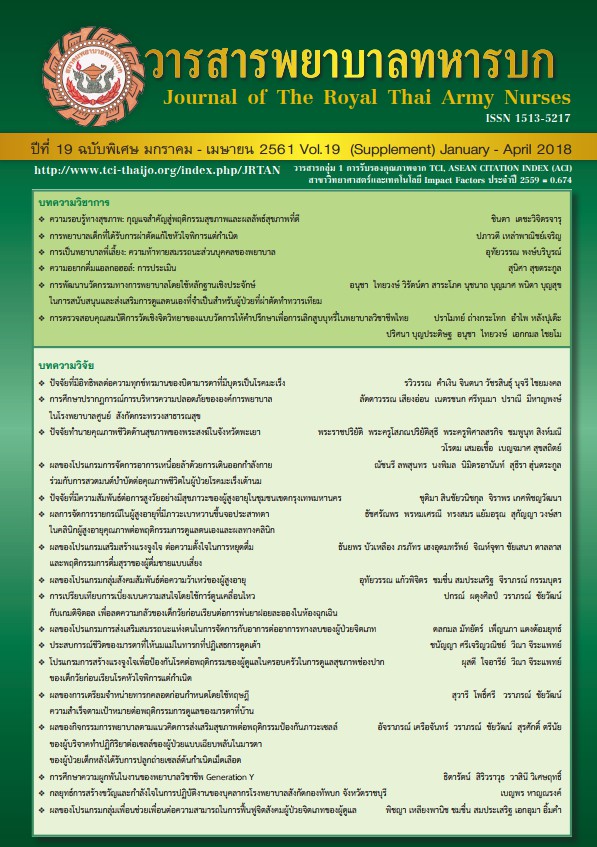
ปัจจัยที่มีความสัมพันธ์กับกลุ่มอาการ ก่อนมีประจำเดือนในนักศึกษาพยาบาลสตรี
คำสำคัญ:
กลุ่มอาการก่อนมีประจำเดือน, นักศึกษาพยาบาลสตรีบทคัดย่อ
กลุ่มอาการก่อนมีประจำเดือนเป็นปัญหาสุขภาพที่พบได้บ่อยในสตรีวัยเจริญพันธุ์ การวิจัยเชิงพรรณนาหาความสัมพันธ์ ครั้งนี้มีวัตถุประสงค์เพื่อศึกษากลุ่มอาการก่อนมีประจำเดือนและปัจจัยที่มีความสัมพันธ์กับกลุ่มอาการก่อนมีประจำเดือนในนักศึกษา พยาบาลสตรี กลุ่มตัวอย่างจำนวน 186 คนโดยใช้การสุ่มแบบแบ่งชั้นภูมิ เครื่องมือที่ใช้ในการวิจัยประกอบด้วย แบบสอบถามข้อมูล ส่วนบุคคล แบบประเมินอาการปวดประจำเดือน แบบประเมินความเครียดของสวนปรุง และแบบประเมินกลุ่มอาการก่อนมีประจำเดือน วิเคราะห์ข้อมูลโดยใช้สถิติพรรณนา สหสัมพันธ์แบบสเปียร์แมน และสถิติทดสอบไคร์สแควร์ ผลการศึกษาพบว่ากลุ่มตัวอย่าง ทุกรายมีอาการก่อนมีประจำเดือนอย่างน้อย 1 อาการ ระดับปวดประจำเดือนมีความสัมพันธ์ทางบวกระดับต่ำกับกลุ่มอาการก่อน มีประจำเดือนอย่างมีนัยสำคัญทางสถิติ (rs = .148, p < .05) ความเครียดมีความสัมพันธ์ทางบวกในระดับปานกลางกับกลุ่มอาการ ก่อนมีประจำเดือนอย่างมีนัยสำคัญทางสถิติ (rs = .520, p < .01) การดื่มเครื่องดื่มที่มีคาเฟอีนไม่มีความสัมพันธ์กับกลุ่มอาการก่อน มีประจำเดือน ผลการวิจัยครั้งนี้สามารถนำไปพัฒนาแนวทางการป้องกันและบรรเทากลุ่มอาการก่อนมีประจำเดือนในนักศึกษาพยาบาล
Downloads
เอกสารอ้างอิง
2. Chin LN & Nambia S. Management of premenstrual syndrome. Obstetrics, Gynaecology & Reproductive Medicine 2017; 27(1): 1-6.
3. Direkvand-Moghadam A, Sayehmiri K Delpisheh A & Kaikhavandi S. Epidemiology of Premenstrual Syndrome (PMS)-A Systematic Review and Meta-Analysis Study. Journal of Clinical and Diagnostic Research 2014; 8(2): 106–109.
4. Ryu A & Kim, T-H. Premenstrual syndrome: A mini review. Maturitas 2015; 82(4): 436-440.
5. Farahmand M Ramezani Tehrani F Khalili D Amin G & Negarandeh R. Factors associated with the severity of premenstrual syndrome among Iranian college students. The journal of obstetrics and gynaecology research 2017; 43(11):1726-1731.
6. Cheng S-H, Shih C-C, Yang. Y-K Chen K-T, Chang Y-H & Yang Y-C. Factors associated with premenstrual syndrome - A survey of new female university students. The Kaohsiung-Journal of Medical Sciences 2013;29(2): 100-105.
7. Seedhom AE Mohammed ES & Mahfouz EM. Life Style Factors Associated with Premenstrual-Syndrome among El-Minia University Students, Egypt. Public Health 2013: 1-6.
8. Mohebbi M Akbar S Mahmodi Z & Nasiri M. Comparison between the lifestyles of university students with and without premenstrual syndromes. Electronic
Physician 2017;9(6): 4489-4496.
9. Al-Batanony M & Alnohair S. Prevalence of Premenstrual Syndrome and Its Impact on Quality of Life among University Medical Students, Al Qassim University, KSA, Public Health Research 2014 ;4 (1):1-6.
10. Tolossa FW & Bekele ML. Prevalence, impacts and medical managements of premenstrual syndrome among female students: crosssectional study in College of Health Sciences, Mekelle University, Mekelle, northern Ethiopia. BMC Womens Health 2014; 14:52-62.
11. Naeimi N. The Prevalence and Symptoms of Premenstrual Syndrome under Examination. Journal of Biosciences and Medicines 2015; 3:1-8.
12. Arpanantikul M. Putwatana & Wittayasooporn J. Health Status and Health Practices of Thai Nursing Students. Thai Journal of Nursing Council 2011; 26(4): 123-136. (in Thai)
13. Ross R Boonyanurak P & Stoppe C. Worries and Depressive Symptoms among Baccalaureate Nursing Students in Thailand: An embedded Mixed Methods Study. Journal of The Royal Thai Army Nurses 2014; 15(1): 52-63. (in Thai)
14. Ross R & et. Al. Depression and Its Predictors among Nursing Students in Four Countries: USA, Thailand, Taiwan and Japan. The Royal Thai Army Nurses 2014: 15(3). 195-201. (in Thai)
15. Rathnayake S & Ekanayaka J. Depression, Anxiety and Stress among Undergraduate Nursing Students in a Public University in Sri Lanka. International Journal of Caring Sciences 2016: 9(3).1020-1032.
16. Kaur N & Thakur R. A descriptive study to assess the premenstrual syndrome and coping behavior among nursing students, NINE, PGIMER, Chandigarh. Nursing and Midwifery Research Journal 2009; 5(1): 19-23.
17. Haji FA Najib MB. premenstrual syndrome among college of nursing students. Zanco Journal of Medical Sciences 2010: 14(1): 170-175.
18. Elnagar M & Awed H. Self-Care Measures Regarding premenstrual syndrome among Female Nursing Students. International Journal of Nursing Didactics 2015; 5(2): 1-10.
19. Karout N. Prevalence and pattern of menstrual problems and relationship with some factorsamong Saudi nursing Students. Journal of Nursing Education and Practice 2015: 5(12): 1-8.
20. Akhtar Z. Qazi Q Iqbal M Muhammad S & Rafiq M. premenstrual syndrome in students nursing school of A tertiary care hospital. Journal of Medical Sciences 2017;25(3): 353-356.
21. Seven M Güvenç G Akyüz A & Eski F. Evaluating Dysmenorrhea in a Sample of Turkish NursingStudents. Pain Management Nursing 2014;15(3):664-671.
22. Pulido-Martos M Augusto-Landa JM, Lopez-Zafra E. Sources of stress in nursing students: a systematic review of quantitative studies. International Nursing Review 2012; 59(1):15-25.
23. Kulkrachang K & Lowirakorn S. Unhealthy Beverage Consumption of Nursing Students at Boromarajjonani College, Nakhon Ratchasima Province. Thailand journal of health promotion and environmental 2011: 31-41.( in Thai)
24. Dawood Y. Primary Dysmenorrhea Advances in Pathogenesis and Management. Obstetrics & Gynecology 2006: 108(2):428-441.
25. Al-Saleh SA, Al-Madi EM, Al-Angari NS, Al-Shehri HA, Shukri MM. Survey of perceived stress inducing problems among dental students, Saudi Arabia. Saudi Dent J 2010; 22(2):83-8.
26. Smith BD Gupta U & Gupta BS. Caffeine and activation theory: Effects on Health and behavior.2006. [cited 2018 Jun 10].
27. Ju H Jones M Mishra GD. Premenstrual syndrome and dysmenorrhea: Symptom trajectories over 13 years in young adults. Maturitas 2014;78(2): 99-105.
28. Vo, H. Smith B & Rubinow D. Effect of Caffeine Consumption on Premenstrual Syndrome: A Prospactive Study. The Internet Journal of Endocrinogy 2010: 6(2): 1-6.
29. Purdue-Smithe, A.C, Manson, J.E, Hankinson, S.E, & Bertone-Johnson, E.R. A prospective study of caffeine and coffee intake and premenstrual syndrome. The American Journal of Clinical Nutrition 2016; 104: 499-507.
30. Krejcie, R.V., & Morgan, D.W. Determining Sample Size for Research Activities. Educational and Psychological Measurement 1970: 30, 607-610.
31. McCaffery M & Beebe A. Pain: Clinical manual for nursing practice. London, England: Mosby Company; 1993.
32. Mahannirunkul, S. Pumpairanchai, W. & Tapunya, P. Suanprung Stress Test – 20, SPST– 20. Suanprung Hospital. 1997.( in Thai)
33. Bakhshani NM, Mousavi MN, Khodabandeh G: Prevalence and severity of premenstrual symptoms among Iranian female university students. J Pak Med Assoc 2009; 59:205-208.
34. Thu M, Diaz E O and Sawhsarkapaw. Premenstrual Syndrome among Female University Students in Thailand AU J.T 2006; 9: 158-162 .
ดาวน์โหลด
เผยแพร่แล้ว
รูปแบบการอ้างอิง
ฉบับ
ประเภทบทความ
สัญญาอนุญาต
บทความหรือข้อคิดเห็นใดใดที่ปรากฏในวารสารพยาบาลทหารบกเป็นวรรณกรรมของผู้เขียน ซึ่งบรรณาธิการหรือสมาคมพยาบาลทหารบก ไม่จำเป็นต้องเห็นด้วย
บทความที่ได้รับการตีพิมพ์เป็นลิขสิทธิ์ของวารสารพยาบาลทหารบก
The ideas and opinions expressed in the Journal of The Royal Thai Army Nurses are those of the authors and not necessarily those
of the editor or Royal Thai Army Nurses Association.