
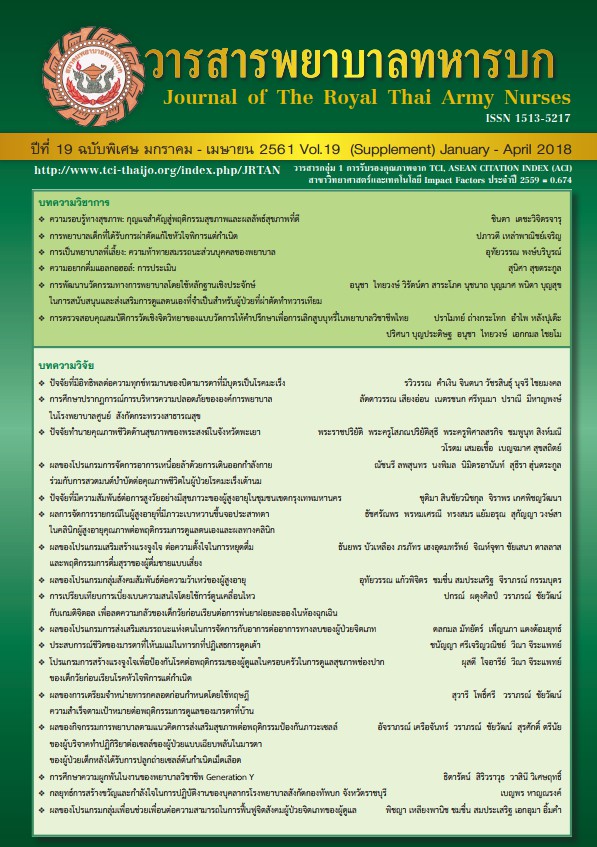
The Effect Of The Nursing Intervention Based On Health Promotion Model On Acute Graft-Versus - Host Disease Preventive Behaviors In Mothers Of Children Underwent Stem Cell Transplantation
Keywords:
health promotion model, acute graft-versus - host disease preventive behaviors, children underwent stem cell transplantationAbstract
The purpose of this experimental research repeated measures design was to compare acute graft-versus-host disease (aGVHD) preventive behaviors in mothers of children underwent stem cell transplantation at one, two, and three weeks after discharge. Thirty-one mothers of children in Bone Marrow Transplant Unit, Ramathibodi hospital were randomly assigned to the experimental and control groups. Sixteen mothers in the control group received the usual nursing care, while 15 mothers in the experimental group received the nursing intervention based on health promotion model. This intervention promoted the mothers’ perceived benefits of aGVHD preventive behaviors and their self-efficacy, as well as reduced their perceived
barriers. The aGVHD preventive behaviors in mothers of children underwent stem cell transplantation was measured by the questionnaire developed by the researcher. Its content validity index was .82 and its KR-20 was .83. Data were analyzed by descriptive statistics and repeated measures ANOVA. It was founded that mothers receiving the nursing intervention based on health promotion model performed better aGVHD preventive behaviors than mothers receiving the usual nursing care at one, two, and three weeks after discharge, at the statistical significance level of .05.
Downloads
References
2. Asadi M, Manookian A, Nasrabadi AN. Parents’ experiences of their children bone marrow transplantation: a qualitative study. International Journal of Hematology-Oncology and Stem Cell Research 2011; 5(1): 1-7.
3. Bandura A. Self-efficacy: The exercise of control. New York: W.H. Freeman and Company, 1997.
4. Barton-Burke M, Dwinell DM, Kafkas L, Lavalley C, Sands H, Proctor C, et al. Graft-versus-host disease: a complex long-term side Effect of hematopoietic stem cell transplant. Oncology nurse edition 2008; 22(11): 31-45.
5. Burleson JK. Graft Versus Host Disease. In Chernecky CC, Murphy-Ende K. Acute Care Oncology Nursing. USA: Elsevier Inc, 2009.
6. Daguindau E, Muhammad MD, Elmore L, Nelson Jr RP, Farag S, Paczesny S. Diagnosis and management of acute and chronic graft-Versus-host disease. Hematology 2014; 9(2): 1-13.
7. Eshah NF, Bond AE, Froelicher ES. The effects of a cardiovascular disease prevention program on knowledge and adoption of a heart healthy lifestyle in Jordanian working adults. EuropeanJournal of Cardiovascular Nursing 2010; 9(4): 244-253.
8. Gibbs G. Learning by doing: A guide to teaching and learning methods. Oxford Further Education Unit: Oxford, 1988.
9. Janyatham A, Jirapaet V. Experiences of Parents in Caring for Pediatric Patients after Hematopoietic Stem Cell Transplantation. Journal of The Royal Thai Army Nurses 2013; 14(2): 59-68. (In Thai)
10. Kotirum S, Leelahavarong P, Sanpakit K, Hongeng S, Teerawattananon Y, Tantivess S. Hematopoietic stem cell transplantation severe thalassemic patients in two university hospitals in Bangkok: Experiences of caregivers. Journal of Health Systems Research 2012; 6(2): 193-206.
11. Larsen HB, Heilmann C, Johansen C, Adamsen L. An analysis of parental roles during haematopoietic stem cell transplantation of their offspring: a qualitative and participant observational study. Journal of advanced nursing 2011; 67(7):1458-1467.
12. Mattson MR. Graft-Versus-Host Disease: Review and Nursing Implications. Oncology Nursing 2007;11(3): 325-328.
13. Munchel A, Chen A, Symons H. Emergent complications in the pediatric hematopoietic stem cell transplant patient. Clinical Pediatric Emergency Medicine 2011; 12(3): 233-244.
14. Pender NJ, Murdaugh CL, Parsons MA. Health Promotion in Nursing (5th Eds.). New Jersey: Pearson Education, Inc, 2006.
15. Pramoolsinsup K. The Effect of Health Promotion Program on Health Promoting Behavior Primigravida Adolescents. Master Thesis of Nursing Science Huachiew Chalermprakiet University, 2012. (In Thai)
16. Shin YH, Hur HK, Pender NJ, Jang HJ, Kim MS. Exercise self-efficacy, exercise benefits and barriers, and commitment to a plan for exercise among Korean women with osteoporosis and osteoarthritis. International Journal of Nursing Studies 2006; 43(1): 3-10.
17. Shulman DS, London WB, Guo D, Duncan CN, Lehmann LE. Incidence and Causes of Hospital Readmission in Pediatric Patients after Hematopoietic Cell Transplantation. Biology of Blood and Marrow Transplantation 2015; 21(5): 913-919.
18. Yilmaz MC, Aksoylar S, Kansoy S. The Informational Needs of Mothers about Physical Care at Home for Children who Underwent Stem Cell Transplants. International Journal of Caring Sciences 2013; 6(1): 106-114.
Downloads
Published
How to Cite
Issue
Section
License
บทความหรือข้อคิดเห็นใดใดที่ปรากฏในวารสารพยาบาลทหารบกเป็นวรรณกรรมของผู้เขียน ซึ่งบรรณาธิการหรือสมาคมพยาบาลทหารบก ไม่จำเป็นต้องเห็นด้วย
บทความที่ได้รับการตีพิมพ์เป็นลิขสิทธิ์ของวารสารพยาบาลทหารบก
The ideas and opinions expressed in the Journal of The Royal Thai Army Nurses are those of the authors and not necessarily those
of the editor or Royal Thai Army Nurses Association.






