
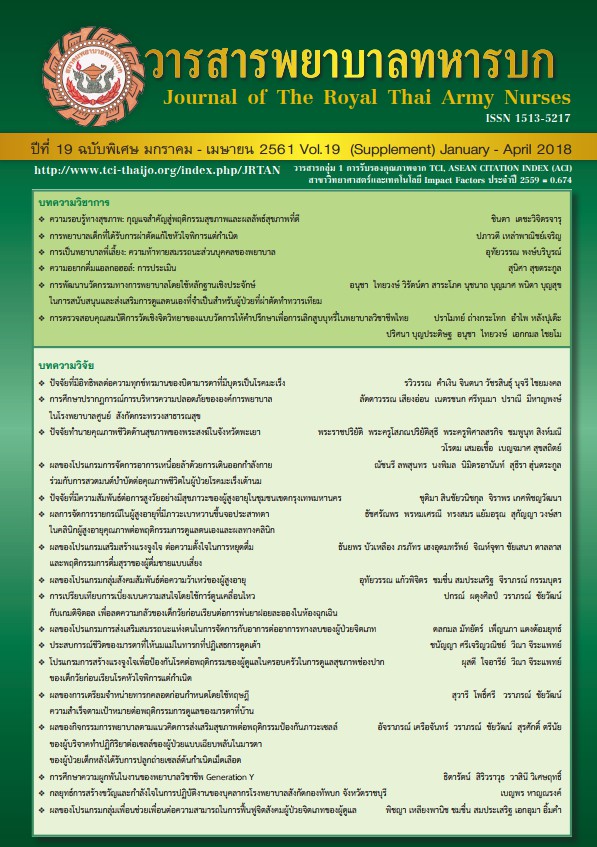
ผลของโปรแกรมกลุ่มสังคมสัมพันธ์ต่อความว้าเหว่ของผู้สูงอายุ
คำสำคัญ:
กลุ่มสังคมสัมพันธ์, ความว้าเหว่, ผู้สูงอายุบทคัดย่อ
การวิจัยครั้งนี้เป็นการวิจัยกึ่งทดลองแบบสองกลุ่มวัดสองครั้งก่อนและหลังทดลอง มีวัตถุประสงค์เพื่อศึกษาผลของ โปรแกรมกลุ่มสังคมสัมพันธ์ต่อความว้าเหว่ของผู้สูงอายุ กลุ่มตัวอย่างคือผู้สูงอายุที่มีอายุ 60 ปีบริบูรณ์ขึ้นไปและมีคุณสมบัติตาม เกณฑ์ที่กำหนดจำนวน 62 คน และทำการสุ่มตัวอย่างอย่างง่าย แบ่งเป็นกลุ่มทดลองและกลุ่มควบคุมกลุ่มละ 31 คน กลุ่มทดลอง ได้รับโปรแกรมกลุ่มสังคมสัมพันธ์ที่สร้างขึ้นโดยผู้วิจัย ตามแนวคิดการสนับสนุนทางสังคมและเครือข่ายทางสังคม ระยะเวลาการ ทดลอง 8 สัปดาห์ และกลุ่มควบคุมได้รับการดูแลปกติ เครื่องมือที่ใช้ในการวิจัย คือโปรแกรมกลุ่มสังคมสัมพันธ์ ที่ผ่านการตรวจ สอบความตรงเนื้อหาโดยผู้ทรงคุณวุฒิจำนวน 3 ท่าน และแบบวัดความว้าเหว่ในผู้สูงอายุหาความเที่ยงด้วยค่าสัมประสิทธิ์สัมพันธ์ อัลฟ่าของครอนบาค เท่ากับ.70 วิเคราะห์ข้อมูลทั่วไปโดยใช้สถิติพรรณนาและเปรียบเทียบคะแนนเฉลี่ยความว้าเหว่ของผู้สูงอายุใน กลุ่มทดลอง ก่อนและหลังการทดลองด้วยสถิติทดสอบค่าทีชนิดไม่เป็นอิสระต่อกัน (dependent t-test) และเปรียบเทียบผลต่าง ของค่าเฉลี่ยคะแนนความว้าเหว่ก่อนและหลังการทดลอง ระหว่างกลุ่มทดลองและกลุ่มควบคุมด้วยสถิติทดสอบค่าทีชนิดที่เป็นอิสระ ต่อกัน (independent t-test) ผลการวิจัยสรุปว่า 1) ค่าเฉลี่ยคะแนนความว้าเหว่ของผู้สูงอายุของกลุ่มทดลองที่ได้รับโปรแกรม กลุ่มสังคมสัมพันธ์ ภายหลังการทดลอง (X = 28.13, SD = 5.96) ต่ำกว่าก่อนการทดลอง (X = 34.23, SD = 7.19) อย่างมีนัยสำคัญทางสถิติ (t = 16.39, p<.001) 2) ผลต่างของค่าเฉลี่ยคะแนนความว้าเหว่ของผู้สูงอายุระหว่างก่อนและหลังได้รับ โปรแกรมกลุ่มสังคมสัมพันธ์ของกลุ่มทดลอง ( = 6.10, SD = 2.07) สูงกว่ากลุ่มควบคุมที่ได้รับการดูแลปกติ ( = .16, SD = 1.04) อย่างมีนัยสำคัญทางสถิติ (t = 15.045, p<.001)
Downloads
เอกสารอ้างอิง
2. National statistical office. Report on the elderly population survey in Thailand 2014. Bangkok: Thana Place; 2014. (in Thai)
3. Institute of health systems research. Knowledge management and synthesis of hospital health promotion practices: Elderly services practices.
Bangkok: Saham printing and publishing; 2010. (in Thai)
4. Nunsubpawat V. Mental health of the elderly. Journal of nurse’s association of Thailand northeasters division.2009; 27(1): 27-32. (in Thai)
5. Hawkins, B. A., Principle and practice of activity programs.State College, PA: Venture. 2009.
6. Wilson, R. S., Krueger, K. R., Arnold, S. E., Schneider, J. A., Kelly, J.F., Barnes, L.L.,etal. Loneliness and risk of Alzheimer disease. Archives of General Psychiatry.2007; 64(2): 234-240.
7. Luo, Y., Hawkley, L. C., Waite, L. J., & Cacioppo, J. T. Loneliness, health, and mortality in old age: A national longitudinal study. Social Science and Medicine. 2010; 74(6): 907-914.
8. Cacioppo, J. T., Hughes, M. E., Waite, L. J., Hawkley, L. C., and Thisted, R. A. Loneliness as a specific risk factor for depressive symptoms: Cross-sectional and longitudinal analyses. Psychology and Aging. 2006; 21(1): 140-151.
9. Van Baarsen, B. Theories on coping with loss: The impact of social support and self-esteem on adjustment to emotional and social loneliness following a partner’s death in later life. Journal of Gerontology: Social Sciences.2002; 57: 33-42.
10. Ayalon, L. andShiovitz-Ezra, S.The relationship between loneliness and passive death wishes in the second half of life. International Psychogerıatrıcs. 2011; 23(10): 1677-1685.
11. Adams, K. B., Sanders, S., & Auth, E.Risk Factors of Depression and Loneliness in an Independent Living Retirement Community. Aging & Mental
Health.2004; 8(6): 475–485.
12. Victor, C. R., Scambler, S. J., Bowling, A. N. N., and Bond, J.The prevalence of, & risk factors for, loneliness in later life: a survey of older people in Great Britain. Ageing and Society. 2005; 25(3): 357-375.
13. Pinquart, Martin, Sörensen, Silvia. Influences on loneliness in older adults: A meta-Analysis. Basic and Applied Social Psychology. 2001; 23(4): 245-266
14. Cattan M, White M, Bond J, Learmouth A. Preventing social isolation and loneliness among older people: A systematic review of health promotion interventions. Ageing & Society. 2005; 25: 41–67.
15. Phimphachiyaboon L. Factors influencing loneliness of the elderly in social welfare development center for older for older persons: Burapha University; 2015. (in Thai).
16. Heaney C. & Israel B.Social networks and social support. In: Glanz K, Rimer BK, Lewis FM, editors. Health behavior and health education: Theory, research and practice. 3rd ed. Jossey-Bass; San Francisco, CA: 2002:185–202.
17. Choi NG, Wodarski JS. The relationship between social support and health status of elderly people: Does social support slow down physical and functional deterioration. Soc Work Res. 1996; 20(1): 52-63.
18. Damrikanlert L. Situation and the needs of elderly care in the community, in: Sriwanitchakarn S, Editors. Elderly care integrated in the communit. Nakornpratom:T Q P; 2012; 11-9. (in Thai)
19. Hazer, O., & Boylu, A. A. (2010).The examination of the factor affecting the feeling of loneliness of the elderly. Procedia Social and behavioral Sciences. 2010; 9: 2083-2089.
20. Thanakwang, K., Ingersoll – Dayton, B., & Soonthorndhada, K. The relationships among family, friends, and psychological well - being for Thai elderly. Aging and Mental Health.2012; 16 (8): 993 - 1003
21. Malathum P, Kongiem J, Intarasombat P. Relationships of family support and friend support to life satisfaction of older adults in rural areas. Rama Nurse J. 2009; 15(3): 431-48. (in Thai)
22. Malekafzali H, Eftekhari MB, Hejazi F, Khojasteh T, Noot R. The effectiveness of educational intervention in the health promotion in elderly people. Iran J Public Health. 2010; 39(2): 18
23. Kodchana C, Virasiri S. The effecct of social support group on grandmothers, childrearing abilities and stress during raising preschool grandchildren in Phu Kradueng District Loei Province .Thailand J of Health Promotion and Environmental Health. 2010; 33(2): 42-52. (in Thai)
24. Petburi P. The effect of a social support program on the mental health of the elderly: Thammasat University; 2016. (in Thai).
25. Chaihan R, Nanthamongkolchai S, Thechaboonsermsak P, Munsawaengsub C. Effect of social participatory training program on self-esteem of the elderly in La-un district Ranong province. J of Public Health. 2010; 40(1): 76-85. (in Thai).
ดาวน์โหลด
เผยแพร่แล้ว
รูปแบบการอ้างอิง
ฉบับ
ประเภทบทความ
สัญญาอนุญาต
บทความหรือข้อคิดเห็นใดใดที่ปรากฏในวารสารพยาบาลทหารบกเป็นวรรณกรรมของผู้เขียน ซึ่งบรรณาธิการหรือสมาคมพยาบาลทหารบก ไม่จำเป็นต้องเห็นด้วย
บทความที่ได้รับการตีพิมพ์เป็นลิขสิทธิ์ของวารสารพยาบาลทหารบก
The ideas and opinions expressed in the Journal of The Royal Thai Army Nurses are those of the authors and not necessarily those
of the editor or Royal Thai Army Nurses Association.