
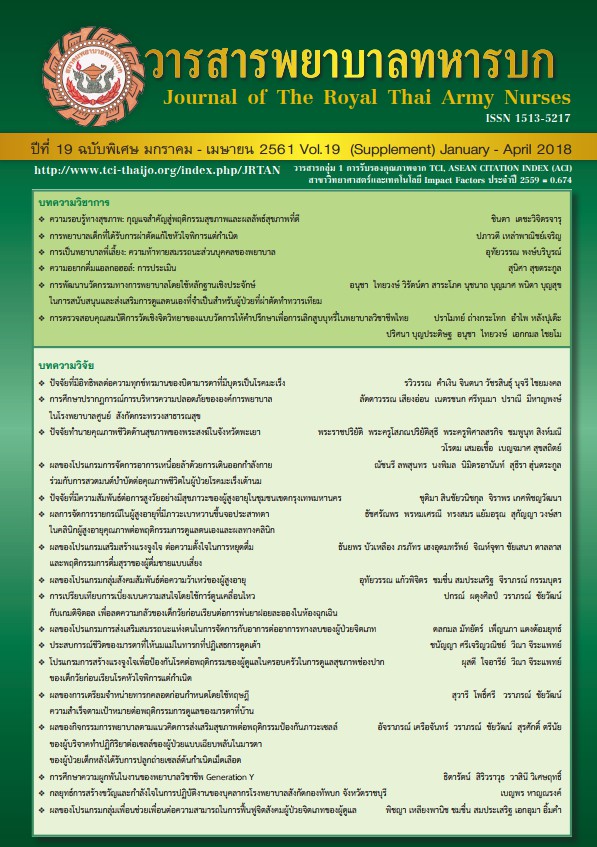
Factors Related to Healthy Aging Among The Older Persons in Community-Dwelling of Bangkok Metropolitan
Keywords:
Healthy Aging, Physical function, Nutrition, Self-esteem, the older personAbstract
This research aims to study the correlation between gender, education, income, physical activity, nutrition and self-esteem, and healthy aging in the target area of Bangkok. The participants were 282 older persons live in the area of the Crown Property Bureau in Huai Khwang and Wang Thonglang Districts. The quality of life community model development was implemented.The instrumentation in the present study can be divided into the following 5 components:(1) Questionnaires on personal factors; (2) Barthel ADL index; (3) Mini Nutrition Assessment [MNA]; (4) Rosenberg self-esteem scale and (5) Healthy Aging Instrument [HAI]. The instruments were tested for content validity by a panel of qualified experts. The Rosenberg self-esteem scale and Healthy Aging Instrument were tested for content validity and reliability by calculating for Cronbach’s Alpha Coefficient, at .85 and .80, respectively. Data were analyzed by using frequency, percentage, mean, standard deviation, Eta coefficient, Pearson’s product moment correlation and One-way ANOVA. The statistical significance level was set at .05. The finding can be summarized as follows: (1) The older persons in the communities were found to have high scores for healthy aging. ( = 4.25, SD = 0.72) (2) Gender was found to be positively correlated with healthy aging the statistical at .05 (Eta = .484) (3) Income, physical function nutrition and self-esteem were found to be positively correlated with healthy aging with statistical significance at .05 (r = .199, .197, .265, .499, respectively) (4) Older persons with difference education levels had no difference in terms of healthy aging with statistical significance at .05
Downloads
References
2. Hansen-Kyle L. A Concept Analysis of Healthy Aging. Nursing Forum 2005; 40(2): 457
3. Peel, N. M., McClure, R. J., and Bartlett, H. P. Behavioral Determinants of Healthy Aging. American Journal of Preventive Medicine 2005; 28(3), 298-304.
4. Thiamwong L, McManus MS, Suwanno J. Development of the Thai healthy aging model: A grounded theory study. Nursing & health sciences. 2013 Jun 1; 15(2): 256-61. (in Thai).
5. The Crown Property Bureau. Sustainable Development and Balance. Annual Report, 2014. Bangkok: Daoreuk Communications. 2015. (in Thai).
6. Chamratrithiwong A, Pacharabenjakul K. Urban Environment and Mental Health: A Multi-Level Analysis of Districts in Bangkok Metropolis, Population and Social. Nakhon Pathom: Duantula press 2011: 215-233. (in Thai).
7. Choorat W, Sawangdee Y, Arunraksombat S. Factors influencing the risk of having mental health problems of Thai elderly. Thai Population Journal 2012; 3(2): 87-109. (in Thai).
8. College of Population Studies Chulalongkorn University. The Plan to improve the quality of life of the older persons in Bangkok Phase 1(2557-2560 BC). Bangkok: Thana Chet Press; 2014. (in Thai).
9. Health Department Bangkok Metropolitan Administration. The project evaluation report on the implementation of Long-Term Care for Elderly in Community Health Centers in Bangkok Metropolitan. Bangkok: Chula Press; 2015. (in Thai).
10. National Statistical Office. The elderly population survey in Thailand, 2014. Ministry of Digital Economy and Society; 2015. (in Thai).
11. Kespichayawattana J, Wivatvanit S. Participation in the study of the situation of the older persons in Society. Bangkok. 2015. (in Thai).
12. Jitapunkul S. Principles of Geriatric Medicine 3rd edition. Bangkok: Chula Press. 2001. (in Thai).
13. Vellas B, Villars H, Abellan G, Soto ME. Overview of the MNA®-ITS history and challenges/discussion. The Journal of Nutrition, Health & Aging. 2006; 10(6): 456.
14. Mahasitiwat Y. The relationship between perception of Bio-Psychosocial change, self- esteem and health behavior of the elderly in Amphur Muang Saraburee Province. [Thesis]. Bangkok. Mahidol University, 1983. (in Thai).
15. Thanakwang K. Mechanisms by which social networks influence healthy aging among the Thai elderly in Nan province. [Thesis]. Bangkok: Mahidol University; 2008. (in Thai).
16. Rattanapun S, Fongkeaw W, Chontawan R, Panuthai S, Wesumperuma D. Characteristics healthy ageing among the elderly in Southern Thailand. Chiang Mai University Journal of Natural Science 2009; 8(2), 143-160.
17. Manasatchakun P, Chotiga P, Hochwälder J, Roxberg Å, Sandborgh M, Asp M. Factors Associated with Healthy Aging among Older Persons in Northeastern Thailand. Journal of Cross-Cultural Gerontology. 2016 Jul 18:1-6.
18. Han K, Lee Y, Gu J, Oh H, Han J, Kim K. Psychosocial factors for influencing healthy aging in adults in Korea. Health and quality of life outcomes.
2015 Mar 7; 13(1): 1.
19. Thanakwang K, Soonthorndhada K, Mongkolprasoet J. Perspectives on healthy aging among Thai elderly: A qualitative study. Nursing & health
sciences. 2012; 14(4): 472-479.
20. Saxon SV, Etten MJ, Perkins EA. Physical Change & Aging a guide for the helping profession 6th edition. New York, NY: Springer Publishing Company; 2015.
21. Mhaolain AM, Gallagher D, Connel HO, Chin AV, Bruce C, Hamilton F, et al. Subjectove well-being amongst community-dwelling elder: what determines satisfaction with life? Findings from the Dublin Healthy Aging Study. International Psychogeriatric. 2012; 24(2): 316-323
22. Touhy TA, Jett K. Ebersole & Hess’ Toward Healthy Aging Human Needs & Nursing Response 8th edition. St. Louis, Missouri: Elsevier; 2012.
23. Wahlqvist ML, Savige GS. Interventions aimed at dietary and lifestyle changes to promote healthy aging. European Journal of Clinical Nutrition. 2000 Jun 1; 54(3): S148.
24. Sowa A, Tobiasz-Adamczyk B, Topór-Mądry R, Poscia A, la Milia DI. Predictors of healthy ageing: public health policy targets. BMC Health Services Research. 2016; 16(5): 289.
25. Rosenberg M, Pearlin LI. Social class and selfesteem among children and adults. American Journal of sociology. 1978 Jul 1: 53-77.
26. Wongpanarak N, Wongpiriyayothar A. Relationships between self-esteem, social support, and quality of life among persons with disabilities
in urban area. Journal of The Royal Thai Army Nurses. 2015: 16(3) : 14-22. (in Thai)
Downloads
Published
How to Cite
Issue
Section
License
บทความหรือข้อคิดเห็นใดใดที่ปรากฏในวารสารพยาบาลทหารบกเป็นวรรณกรรมของผู้เขียน ซึ่งบรรณาธิการหรือสมาคมพยาบาลทหารบก ไม่จำเป็นต้องเห็นด้วย
บทความที่ได้รับการตีพิมพ์เป็นลิขสิทธิ์ของวารสารพยาบาลทหารบก
The ideas and opinions expressed in the Journal of The Royal Thai Army Nurses are those of the authors and not necessarily those
of the editor or Royal Thai Army Nurses Association.