
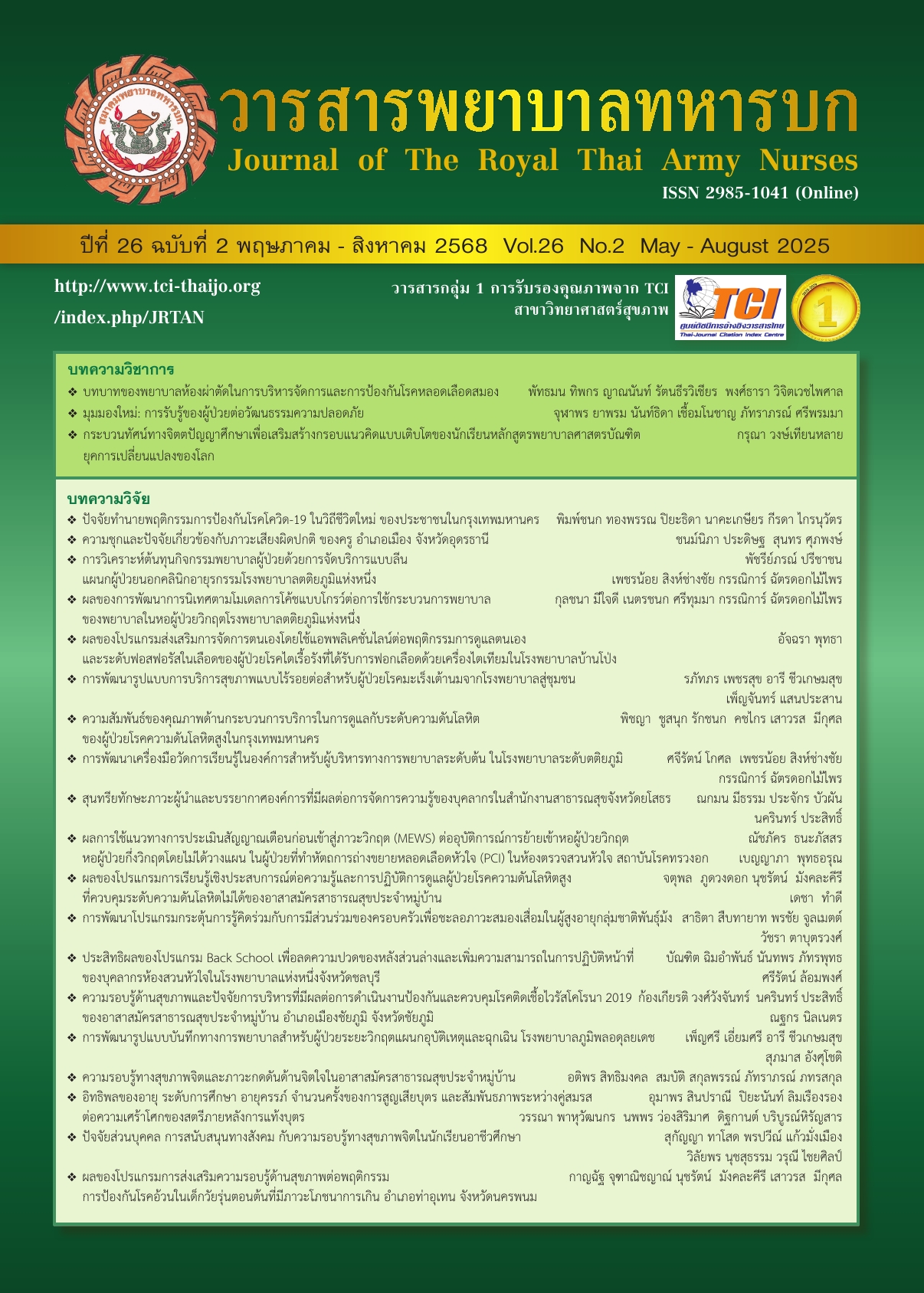
The Prevalence and Factors Related to Voice Disorders Among Teachers in Muang District, Udonthani Province
Keywords:
voice disorders, hoarseness, teachers, prevalenceAbstract
This study aimed to investigate the prevalence of voice disorders among teachers in Muang District, Udonthani Province, and to identify factors associated with the occurrence of voice disorders. The Voice Handicap Index (VHI), a 30-item questionnaire with high reliability (Cronbach’s alpha = 0.96), was utilized to assess a sample of 373 teachers selected through stratified random sampling. The findings revealed that the prevalence of voice disorders among teachers in Muang District, Udonthani Province was 25.7%. Teachers who taught both primary and secondary levels had the highest prevalence at 63.6%, which was significantly higher than teachers who taught only primary or secondary level (p-value = 0.032). Factors which were significantly associated with voice disorders including frequent catching a cold (Adjusted OR = 3.75, 95%CI: 1.74 - 8.10), being single (Adjusted OR = 2.61, 95%CI: 1.51 - 4.52), occasional alcohol consumption (Adjusted OR = 2.07, 95%CI: 1.21 - 3.54), and a family history of voice disorders (Adjusted OR = 6.10, 95%CI: 1.60 - 23.27). On the contrary, teachers who know how to prevent hoarseness had a reduced risk (Adjusted OR = 0.44, 95%CI: 0.26 - 0.76). These findings indicate that personal factors and knowledge of voice preservation are significantly associated with the occurrence of voice disorders in teachers.
Downloads
References
Akinbode R, Lam KB, Ayres JG & Sadhra S. Voice disorders in Nigerian primary school teachers. Occupational Medicine (London). 2014; 64(5):382-6.
Lee YR, Kim HR & Lee S. Effect of teacher’s working conditions on voice disorder in Korea: a nationwide survey. Annals of Occupational and Environmental Medicine; 2018.
Roy N, Merrill RM, Thibeault S, Parsa RA, Gray SD & Smith EM. Prevalence of voice disorders in teachers and the general population. Journal of Speech, Language, and Hearing Research. 2014;47(2):281-93.
Da Costa V, Prada E, Roberts A & Cohen S. Voice disorders in primary school teachers and barriers to care. Journal of Voice. 2012;26(1): 69-76.
Leão SH, Oates JM, Purdy SC, Scott D & Morton RP. Voice problems in New Zealand teachers: a national survey. Journal of Voice. 2015; 29(5):645.e1-645.e13.
Alshuhayb BS, Alkhars AZ, AlMaghlouth MK, Alkhars FS, Alamer ZA, Alarfaj AA, et al. Voice disorders among teachers in Al-Ahsa, Eastern Region, KSA: vocal complaints, treatment-seeking behaviors, and knowledge of vocal care. Journal of Voice. 2022;36(1):1-8.
de Sousa E, Goel HC & Fernandes VLG. Study of voice disorders among school teachers in Goa. Indian Journal of Otolaryngology and Head and Neck Surgery. 2019;71(4):679-83.
Moy FM, Hoe VC, Hairi NN, Chu AH, Bulgiba A & Koh D. Determinants and effects of voice disorders among secondary school teachers in Peninsular Malaysia using a validated Malay version of VHI-10. PLoS One. 2015; 10(11):e0141963.
Alrahim AA, Alanazi RA & Al-Bar MH. Hoarseness among school teachers: a cross-sectional study from Dammam. Journal of Family and Community Medicine. 2018;25(3):205-10.
Tao Y, Lee CT, Hu YJ & Liu Q. Relevant work factors associated with voice disorders in early childhood teachers: a comparison between kindergarten and elementary school teachers in Yancheng, China. International Journal of Environmental Research and Public Health. 2020;17(4):1-12.
Menon UK, Raj M, Antony L, Soman S & Bhaskaran R. Prevalence of voice disorders in school teachers in a district in South India. Journal of Voice. 2021;35(1):1-8.
Jansri U. Prevalence and factors related to voice disorders in teachers of Bangkok Metropolitan Schools. Thammasat Medical Journal. 2015; 15(3):1-10. (in Thai)
Cochran WG. Sampling Techniques. Cambridge: Harvard University; 1953.
Menon UK, Raj M, Antony L, Soman S & Bhaskaran R. Prevalence of voice disorders in school teachers in a district in South India. Journal of Voice. 2021;35(1):1-8.
Jaruchinda P & Suwanwarangkool T. Cross-cultural adaptation and validation of the Voice Handicap Index into Thai. Journal of the Medical Association of Thailand. 2015; 98(11):1199-208. (in Thai)
Ruotsalainen JH, Sellman J, Lehto L, Jauhiainen M & Verbeek JH. Interventions for preventing voice disorders in adults. Cochrane Database of Systematic Reviews. 2015;2015(8):CD006372.
Nguanboonnak B, Tobua S & Lapanachokdee W. The Development Of An Evaluation Model For Operation A Health Promotion School With Sustainable Participation. Journal of The Royal Thai Army Nurses. 2017;18(1):74-83. (in Thai)
Downloads
Published
How to Cite
Issue
Section
License
Copyright (c) 2025 Journal of The Royal Thai Army Nurses

This work is licensed under a Creative Commons Attribution-NonCommercial-NoDerivatives 4.0 International License.
บทความหรือข้อคิดเห็นใดใดที่ปรากฏในวารสารพยาบาลทหารบกเป็นวรรณกรรมของผู้เขียน ซึ่งบรรณาธิการหรือสมาคมพยาบาลทหารบก ไม่จำเป็นต้องเห็นด้วย
บทความที่ได้รับการตีพิมพ์เป็นลิขสิทธิ์ของวารสารพยาบาลทหารบก
The ideas and opinions expressed in the Journal of The Royal Thai Army Nurses are those of the authors and not necessarily those
of the editor or Royal Thai Army Nurses Association.






