
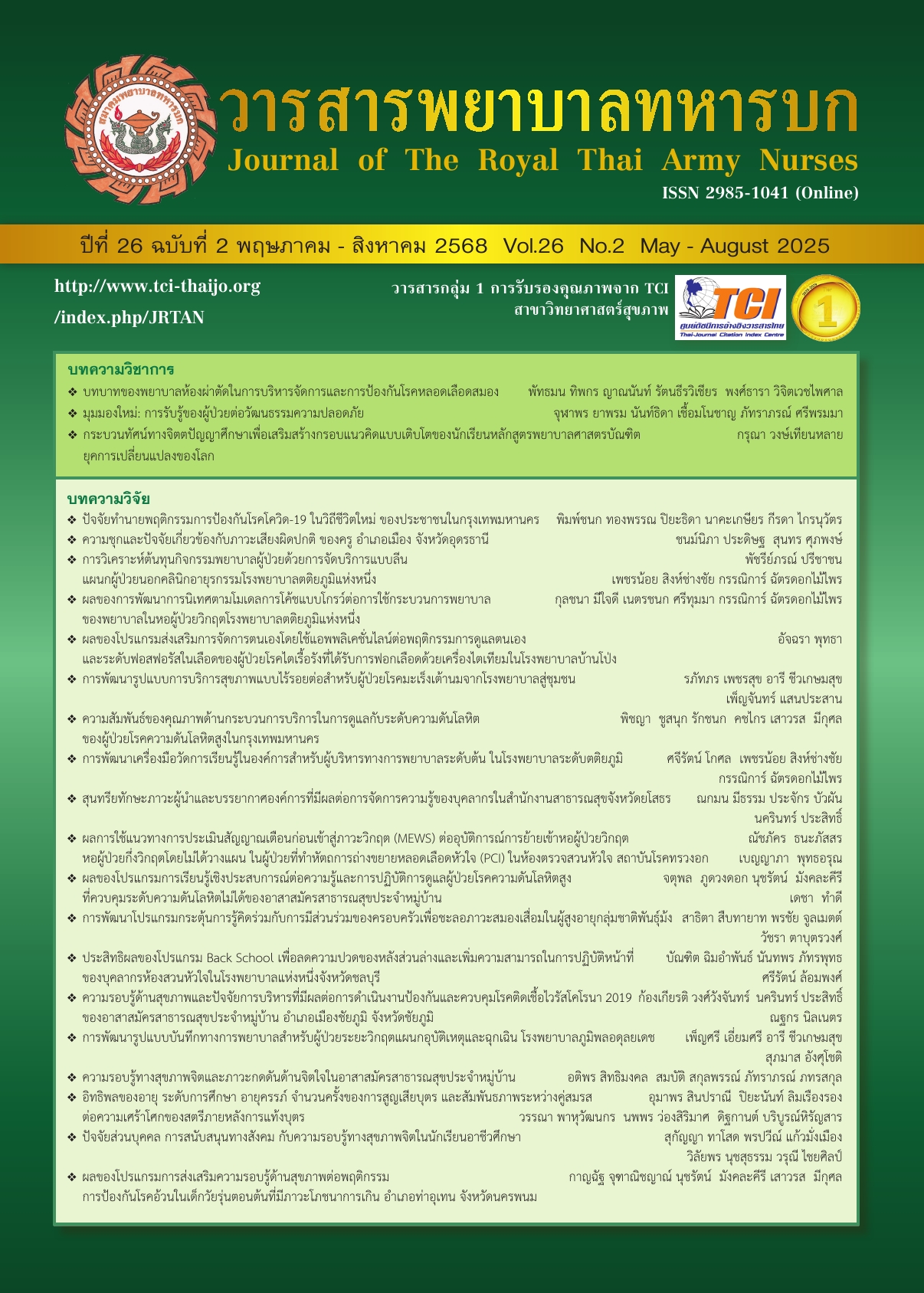
Effective of Back School Program to Decrease Low Back Pain and Increase Functional Capacity among Cardiac Catheterization Laboratory Personnel in a Hospital, Chonburi Province
Keywords:
Back School program, Low back pain, Low back pain disability, Lead apronAbstract
This research aims to study the effectiveness of the Back School program in reducing lower back pain and improving the functional ability among cardiac catheterization laboratory personnel in a hospital, Chonburi province. The sample group consisted of 16 cardiac catheterization room personnel experiencing lower back pain who wore lead aprons while working. The sample group participated in the Back School program for a period of 6 weeks. Data collection included personal information, lower back pain level scores and scores on the functional limitation due to lower back pain. The data was analyzed using Friedman test and Wilcoxon signed rank test.
The majority of sample group were females (93.70%) with a mean age of 29.31 years and mean working hours with lead aprons of 22.00 hours per week. Before participating in the Back School program, the median scores for lower back pain and disability were 4.50 and 6.50 respectively. After participating in the program for 2, 4 and 6 weeks, the sample group showed statistically significant differences in lower back pain scores and disability scores compared to before participating in the Back School program at p <.05, with scores decreasing when compared pairwise with pre-program scores.
This study demonstrates the effectiveness of the Back School program in reducing lower back pain and improving the functional ability among cardiac catheterization laboratory personnel who wear lead aprons while working.
Downloads
References
Becker BA, & Childress MA. Nonspecific Low Back Pain and Return To Work. American Academy of Family Physicians. 2019;100(11):697-703.
Keawnual A, Lohapoontagoon B, & Pochana K. Prevalence of Work-related Musculoskeletal Disorders in various occupations. The Public Health Journal of Burapha University. 2017; 12(2):53-64. (in Thai).
Meyoutam C. The Prevalence and Related Factors of Low Back Pain Among Nursing Personnel in Nakhonpathom Hospital. Region 4-5 Medical Journal. 2020;39(4):578-90. (in Thai).
Dixon RG, Khiatani V, Statler JD, Walser EM, Midia M, Miller DL, et al. Society of Interventional Radiology: Occupational Back and Neck Pain and the Interventional Radiologist. Journal of Vascular and Interventional Radiology. 2017;28(2):195-9.
Andrew S, Abdelmonem MR, Kohli S, & Dabke H. Evaluation of Back Pain and Lead Apron Use Among Staff at a District General Hospital. Cureus. 2021;13(10):e18859.
Al-Makhamreh H, Al-Bitar F, Saadeh A, Al-Ani A, Azzam M, Alkhulaifat D, et al. Evaluating the physical, psychosocial and ergonomic burden of lead aprons among Jordanian interventionists: a nationwide study. International Journal of Occupational Safety and Ergonomics. 2022;28(4):2501-8.
Moore B, vanSonnenberg E, Casola G, & Novelline RA. The relationship between back pain and lead apron use in radiologists. American Journal of Roentgenology. 1992;158(1):191-3.
Pongsuteethavorn T, & Krisorn P. Herniated Nucleus Pulposus in Healthcare Workers in the Cardiac Catheterization Lab: Case Report. Srinagarind Medical Journal. 2023;38(2):311-20. (in Thai).
Hartvigsen J, Hancock MJ, Kongsted A, Louw Q, Ferreira ML, Genevay S, et al. What low back pain is and why we need to pay attention. Lancet. 2018;391(10137):2356-67.
Brox JI, Storheim K, Grotle M, Tveito TH, Indahl A, & Eriksen HR. Evidence-informed management of chronic low back pain with back schools, brief education, and fear-avoidance training. Spine Journal. 2008;8(1):28-39.
Yaruang N. Low back pain in rice farmers with the role of community health nurses. Journal of The Royal Thai Army Nurses. 2016;17(1):1-9. (in Thai).
Tiwawatpakorn J, Wongkiratimethawi T, & Sukubol S. The Development and Effectiveness of the Hat-Yat Back School Program in patients with chronic low back pain. Thai Journal of Physical Therapy. 2021; 44(1):29-46. (in Thai).
Forssell MZ. The back school. Spine (Phila Pa 1976). 1981;6(1):104-6.
Downie WW, Leatham PA, Rhind VM, Wright V, Branco JA, & Anderson JA. Studies with pain rating scales. Annals of the Rheumatic Diseases. 1978;37(4):378-81.
Sakulsriprasert P, Vachalathiti R, Vongsirinavarat M, & Kantasorn J. Cross-Cultural Adaptation of Modified Oswestry Low Back Pain Disability Questionnaire to Thai and Its Reliability. Journal of The Medical Association of Thailand. 2006;89:1694-701. (in Thai).
Pakbaz M, Hosseini MA, Aemmi SZ, & Gholami S. Effectiveness of the back school program on the low back pain and functional disability of Iranian nurse. Journal of Exercise Rehabilitation. 2019;15(1):134-8.
Noisuwan P, Sutthakorn W, & Songkham W. Effects of Back School Program on Low Back Pain and Functional Status in Rice Farmers. Nursing Journal. 2019;46(3):142-56. (in Thai).
Downloads
Published
How to Cite
Issue
Section
License
Copyright (c) 2025 Journal of The Royal Thai Army Nurses

This work is licensed under a Creative Commons Attribution-NonCommercial-NoDerivatives 4.0 International License.
บทความหรือข้อคิดเห็นใดใดที่ปรากฏในวารสารพยาบาลทหารบกเป็นวรรณกรรมของผู้เขียน ซึ่งบรรณาธิการหรือสมาคมพยาบาลทหารบก ไม่จำเป็นต้องเห็นด้วย
บทความที่ได้รับการตีพิมพ์เป็นลิขสิทธิ์ของวารสารพยาบาลทหารบก
The ideas and opinions expressed in the Journal of The Royal Thai Army Nurses are those of the authors and not necessarily those
of the editor or Royal Thai Army Nurses Association.