
Nurses's Role in Promoting Health Literacy of Caregivers School-age Children with Cyanotic Congenital Heart Disease
Keywords:
Nurse’s role, Health Literacy, Caregivers, School-age Children, Cyanotic Congenital Heart DiseaseAbstract
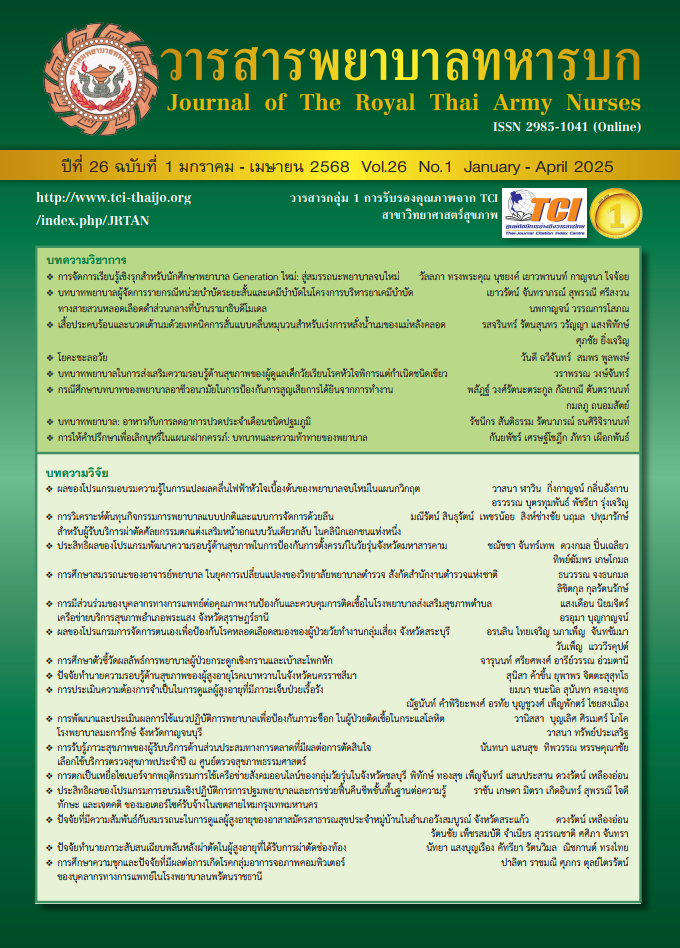
Cyanotic Congenital heart disease, It is an abnormality of the heart and blood vessel structure from birth. Children often have complex health problems that require special care. School-aged children with this disease also require the cooperation of their caregivers to provide continuous care both in the hospital and at home because they are at an age where they are not yet able to take care of their health by themselves. To help keep children safe, be healthy, and have a good quality of life, nurses play an important role in promoting health literacy by developing information-seeking skills, understanding, evaluating, and skills in media literacy, and deciding to take care of their behaviors to prevent harm from complications that may occur. Additionally, nurses should advise caregivers or parents to be able to care for children with congenital heart disease with cyanosis effectively. It also promotes the health of school-aged children so that they can grow and develop appropriately according to their age as well as general school-age children.
This article will discuss the importance of cyanotic congenital heart disease with low blood flowing to the lungs, unconsciousness caused by a lack of oxygen to the brain, signs and symptoms, definitions and important components of health literacy, and the role of nurses in promoting health literacy and providing advice to caregivers of school-aged children with congenital heart disease.
Downloads
References
Wu W, He J, & Shao X. Incidence and mortality trend of congenital heart disease at the global, regional, and national level, 1990-2017. Medicine. 2020;99(23): e20593.
Kuptanon C, & Pangkanon S. Birth defect. Journal of the Department of Medical Services. 2018;43(4):11-3. (in Thai)
Theannamngian O. Nursing Care for Children with Cyanotic Heart Disease at Risk of Cyanotic Spells. Thai Red Cross Nursing Journal. 2023;16(2):13-27. (in Thai)
Wongchan W. Health Literacy of Prevention Diabetes Mellitus Type 2 in School Age Children. Journal of The Royal Thai Army Nurses. 2019;20(2):1-8. (in Thai)
Potipatsa G, Muenthaisong S, Raknatee D, & Supunya J. Childhood parenting by grandparents in a skipped - generation family. Journal of Sakon Nakhon Hospital. 2020; 23(2): 182-91. (in Thai)
Orem DE. Nursing: Concept of practice. 6thed. Mosby-Year Book; 2001.
Bridges SM, Parthasarathy DS, Wong HM, Yiu CKY, Au TK, & MrGrath CPJ. The relationship between caregiver functional oral health literacy and child oral health status. Patient Education and Counseling. 2014;94(3):411-6.
Wicha K, Jintrawet U, & Lamchang S. Health Literacy and Care Behaviors of Parents in Preventing Respiratory Infection in Children with Congenital Heart Disease Prior to Cardiac Surgery. Nursing Journal. 2021;48(2):193-205. (in Thai)
Intaranarong K, Klunklin P, & Namprom N. Health Literacy and Caring for Children with Congenital Heart Disease after Cardiac Surgery of Caregivers. The Southern College Network Journal of Nursing and Public Health. 2023;10(1):182-95. (in Thai)
Gawalkar AA, Shrimanth YS, Batta A, & Rohit MK. Management of Tet Spell-An Updated Review. Current Research in Emergency Medicine. 2021;1(1):1002.
Meyer G, Jansen L, Shaw K, & Franklin O. Tetralogy of Fallot: Emergengy Management of Hypercyanotic “Tet” Spells. Iris Association Emergency Medicine Guidelines. 2024.
Mishra S, Shridhar A, & Prakash J. Standard treatment guidelines 2022: cyanotic spells. Indian Academy of Pediatrics (IAP). 2022.
Government of Western Australia Child and Adolescent Health Service. Hypercyanotic spells. 2021.
Schroeder ML, Baker AL, Bastardi H, & O’Brien P. The child with cardiovascular dysfunction. In: Hockenberry MJ, Wilson D, & Rodgers CC, editors. Wong’s Nursing Care of Infants and Children. 11thed. St. Louis: Elsevier; 2019. p.958-1019.
World Health Organization. Promoting health: guide to national implementation of the shanghai declaration. Geneva: World Health Organization. 2018.
Nutbeam D. Health literacy as a public health goal: a challenge for contemporary health education and communication strategies into the 21st century. Health Promotion International. 2000;15(3):259-67.
Nutbeam D. The evolving concept of health literacy. Social Science & Medicine. 2008; 67(12):2072-8.
Puektes S, & Techawathakul S. Promoting Health Literacy Among Pregnant Woman to Prevent Fine Particulate Matter (PM2.5) Exposure: A Midwife’s Role. Thai Red Cross Nursing Journal. 2023;16(2):42-63. (in Thai)
Choeisuwan V. Health literacy: concept and application for nursing practice. Royal Thai Navy Medical Journal. 2017;44(3):183-97. (in Thai)
Waencwaen N, Srichantaranit A, & Sanasuttipun W. The Relationship between Health Perception, Health Literacy, and Caring Behavior of Caregivers of Children with Acyanotic Congenital Heart Disease. Nursing Science Journal of Thailand. 2021;39(1):24-37. (in Thai)
Lohmae U, Karunan K, Chehdoloh S, & Pattanasombutsook M. Caring for children with congenital heart disease: Impact and Assist Guidelines. Journal of Nursing and Health Research. 2017;18(3):39-45. (in Thai)
Wattana S, Jintrawet U, & Lamchang S. Factors Related to Family Management in Families Having Children with Congenital Heart Disease. Nursing Journal CMU. 2022;49(2): 153-66. (in Thai)
Mukherjee S, Sharma M, Devgan A, & Jatana S. Iron deficiency anemia in children with cyanotic congenital heart disease and effect on cyanotic spells. Indian Heart Journal. 2018; 70(4):474-8.
Rajagopalan S, Al-Kindi SG, & Brook RD. Air pollution and cardiovascular disease: JACC state-ofthe-art review. Journal of the American College of Cardiology. 2018;72(17): 2054-70.
Gonzalez VJ, Kimbro RT, Cutitta KE, Shabosky JC, Bilal MF, Penny DJ, & Lopez KN. Mental health disorders in children with congenital heart disease. Pediatric. 2021;147: e20201693.
Downloads
Published
How to Cite
Issue
Section
License
Copyright (c) 2025 Journal of The Royal Thai Army Nurses

This work is licensed under a Creative Commons Attribution-NonCommercial-NoDerivatives 4.0 International License.
บทความหรือข้อคิดเห็นใดใดที่ปรากฏในวารสารพยาบาลทหารบกเป็นวรรณกรรมของผู้เขียน ซึ่งบรรณาธิการหรือสมาคมพยาบาลทหารบก ไม่จำเป็นต้องเห็นด้วย
บทความที่ได้รับการตีพิมพ์เป็นลิขสิทธิ์ของวารสารพยาบาลทหารบก
The ideas and opinions expressed in the Journal of The Royal Thai Army Nurses are those of the authors and not necessarily those
of the editor or Royal Thai Army Nurses Association.






