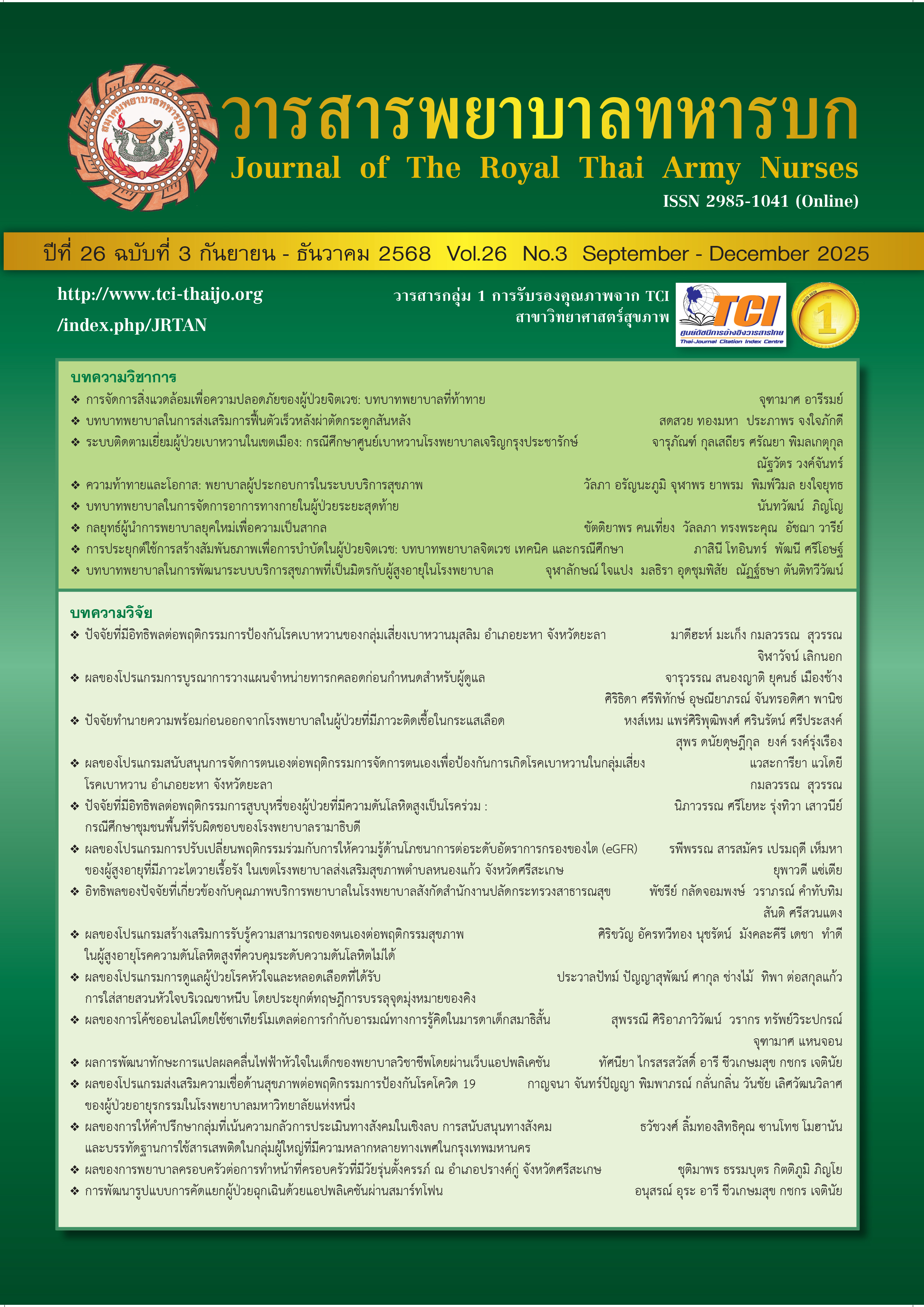
ผลของการให้คำปรึกษากลุ่มที่เน้นความกลัวการประเมินทางสังคมในเชิงลบ การสนับสนุนทางสังคม และบรรทัดฐานการใช้สารเสพติด ในกลุ่มผู้ใหญ่ที่มีความหลากหลายทางเพศในกรุงเทพมหานคร
คำสำคัญ:
ผู้ใหญ่ที่มีความหลากหลายทางเพศ, ความกลัวการประเมินทางสังคมในเชิงลบ, การสนับสนุนทางสังคม, บรรทัดฐานการใช้สารเสพติดบทคัดย่อ
วิจัยนี้มีจุดประสงค์เพื่อทดสอบผลของการให้คำปรึกษากลุ่มที่เน้นความกลัวการประเมินทางสังคมในเชิงลบ การสนับสนุนทางสังคม และบรรทัดฐานการใช้สารเสพติดในกลุ่มผู้ใหญ่ที่มีความหลากหลายทางเพศในกรุงเทพมหานคร ผู้กลุ่มตัวอย่าง 16 คน แบ่งเป็นกลุ่มทดลองและควบคุมกลุ่มละ 8 คน โดยส่งต่อจากผู้เข้าร่วมคนอื่น กลุ่มทดลองได้รับคำปรึกษากลุ่ม 60 นาที 8 ครั้ง รวม 8 อาทิตย์ และจดจำคำในหนึ่งวันสำหรับกลุ่มควบคุม โดยทำแบบสอบถามความกลัวการประเมินทางสังคมในเชิงลบ การสนับสนุนทางสังคม และบรรทัดฐานการใช้สารเสพติด ใช้การวิเคราะห์ความแปรปรวนแบบวัดซ้ำ พบว่ากลุ่มทดลองมีความกลัวการประเมินทางสังคมในเชิงลบและบรรทัดฐานการใช้สารเสพติดลดลงแต่การสนับสนุนทางสังคมเพิ่มขึ้นอย่างมีนัยสำคัญ ส่วนการสนับสนุนจากครอบครัวและบรรทัดฐานการใช้สารเสพติดเป็นประจำไม่เปลี่ยนแปลงอย่างมีนัยสำคัญ ผลวิจัยสรุปว่าการให้คำปรึกษากลุ่ม สามารถลดความกลัวการประเมินทางสังคมในเชิงลบ บรรทัดฐานการใช้สารเสพติด และเพิ่มการสนับสนุนทางสังคมในผู้ใหญ่ที่มีความหลากหลายทางเพศอย่างมีนัยสำคัญ ผลวิจัยนี้สามารถใช้ส่งเสริมสุขภาพจิตและออกแบบนโยบายที่เหมาะสม ข้อเสนอแนะวิจัยครั้งต่อไป ควรให้ความสำคัญกับรายบุคคล ปฏิสัมพันธ์ระหว่างผู้ร่วมทดลอง หรือเลือกกลุ่มอัตลักษณ์ทางเพศที่เฉพาะเจาะจง
Downloads
เอกสารอ้างอิง
Rungreangkulkij S, & Kittirattanapaiboon P. The impact of gender on mental health and concepts of gender approach mental health policy. Journal of Mental Health of Thailand. 2021;29(3):259-72. (in Thai)
Kiekens W, la Roi C, Bos H, Kretschmer T, van Bergen D, & Veenstra R. Explaining health disparities between heterosexual and LGB adolescents by integrating the minority stress and psychological mediation frameworks: findings from the trails study. Journal of Youth And Adolescence. 2020;49(9):1767-82.
Watson D, & Friend R. Measurement of social-evaluative anxiety. Journal of Consulting and Clinical Psychology. 1969;33(4):448-57.
Pachankis J, Goldfried M, & Ramrattan M. Extension of the rejection sensitivity construct to the interpersonal functioning of gay men. Journal of Consulting and Clinical Psychology. 2008;76(2):306-17.
Greene DC, & Britton PJ, & Fitts B. Long-term outcomes of lesbian, gay, bisexual, and transgender recalled school victimization. Journal of Counseling & Development. 2014;92(4):406-17.
Rosa D, Pavaputanon P, & Monyarit S. The implementation mechanism to reduce HIV-related stigma and discrimination in Thailand (Crisis Response System: CRS). Journal of The Royal Thai Army Nurses. 2024;25(1):29-35. (in Thai)
Chanpanit P, Wongmanee W, & Judabood N. Strengthening the community: role of village health volunteer. Journal of The Royal Thai Army Nurses. 2023;24(3):23-30. (in Thai)
Stinchcombe A, Smallbone J, Wilson K, & Kortes-Miller K. Healthcare and Endof-Life needs of Lesbian, Gay, Bisexual, and Transgender (LGBT) older adults: a scoping review. Geriatrics. 2017;2(1):1-13.
Snapp S, Burdge H, Licona A, Moody R, & Russell S. Students’ perspectives on LGBTQ-inclusive curriculum. Equity & Excellence in Education. 2015;48(2):249-65.
Klein E. Community mental health disparities facing the LGBT community. 3rd ed. London; Routledge. 2017.
Mereish E, Kuerbis A, & Morgenstern J. A daily diary study of stressful and positive events, alcohol use, and addiction severity among heavy drinking sexual minority men. Drug And Alcohol Dependence. 2018;187(8):149-54.
Ristianti D, Danim S, Winarto H, & Dharmayana I. The development of group counselling assessment instruments. International Journal of Scientific & Technology Research. 2019; 8(10):267-72.
Boehmer U, Glickman M, Winter M, & Clark M. Lesbian and bisexual women’s adjustment after a breast cancer diagnosis. Journal of The American Psychiatric Nurses Association. 2013;19(5):280-92.
Lamb C. The impact of a group counseling intervention on lesbian, gay, bisexual, transgender, and queer older adolescents’ levels of hope, coping, and suicidality. (dissertation). Orlando: University of Central Florida; 2014.
Hassan E, Oladipo S, & Owoyele J. COUNSELLING PSYCHOLOGY. 1sted. Ljagun; Department of Counselling Psychology, College of Applied Education and Vocational Technology, Tai Solarin University of Education. 2018.
Carleton R, Collimore K, McCabe R, & Antony M. Addressing revisions to the Brief Fear of Negative Evaluation scale: measuring fear of negative evaluation across anxiety and mood disorders. Journal Of Anxiety Disorders. 2011;25(6):822-8.
Fox R, Kwakkenbos L, Carrier M, Mills S, Gholizadeh S, Jewett L, et al. Reliability and validity of three versions of the Brief Fear of Negative Evaluation Scale in patients with systemic sclerosis: a scleroderma Patient-Centered intervention network cohort study. Arthritis Care & Research. 2018; 70(11):1646-52.
Wongpakaran T, Wongpakaran N, & Ruktrakul R. Reliability and validity of the Multidimensional Scale of Perceived Social Support (MSPSS): Thai version. Clinical practice and epidemiology in mental health(CP & EMH). 2011;7(1):161-6.
Wongpakaran N, & Wongpakaran T. A revised Thai multi-dimensional scale of perceived social support. The Spanish Journal of Psychology. 2012;15(3):1503-9.
Greene K, Ray A, Choi H, Glenn S, Lyons R, & Hecht M. Short term effects of the REAL media e-learning media literacy substance prevention curriculum: An RCT of adolescents disseminated through a community organization. Drug And Alcohol Dependence. 2020;214(1):e108170.
World Health Organization. Translation and linguistic evaluation protocol and supporting material. WHO/United Nations ESCAP Project on Health and Disability Statistics. 2013.
Killermann S. A guide to gender. The social justice advocate’s handbook. 2nd ed. Texas; Impetus Books. 2017.
Gerge A. Revisiting the safe place: method and regulatory aspects in psychotherapy when easing allostatic overload in traumatized patients. International Journal of Clinical and Experimental Hypnosis. 2018;66(2).147-73.
Moorey S. The six cycles maintenance model: growing a “Vicious Flower” for depression. Behavioural and Cognitive Psychotherapy. 2010;38(2):173-84.
Muhammad LN. Guidelines for repeated measures statistical analysis approaches with basic science research considerations. The Journal of clinical investigation. 2023;133(11):e171058.
Kircanski K, Lieberman MD, & Craske MG. Feelings into words. Psychological Science. 2012; 23(10):1086-91.
Shurick AA, Hamilton JR, Harris LT, Roy AK, Gross JJ, & Phelps EA. Durable effects of cognitive restructuring on conditioned fear. Emotion. 2012;12(6):1393-7.
Yao Y, Chen J, Dong D, Feng Y, Qiao Z. The relationship between exercise and mental health outcomes during the COVID-19 pandemic: from the perspective of hope. International Journal of Environmental Research and Public Health. 2022;19(7):1-10.
Dadandi I. The fear of covid-19 mediates the relationships between psychological vulnerability, social support and psychological distress. Psychiatria Danubina. 2022;34(4): 766-72.
Sangha S, Diehl MM, Bergstrom HC, Drew MR. Know safety, no fear. Neuroscience & Biobehavioral Reviews. 2022;108(1):218-30.
Felner JK, Wisdom JP, Williams T, Katuska L, Haley S J, Jun HJ. Stress, coping, and context: examining substance use among LGBTQ young adults with probable substance use disorders. Psychiatric services. 2020; 71(2):112–20.
ดาวน์โหลด
เผยแพร่แล้ว
รูปแบบการอ้างอิง
ฉบับ
ประเภทบทความ
สัญญาอนุญาต
ลิขสิทธิ์ (c) 2025 วารสารพยาบาลทหารบก

อนุญาตภายใต้เงื่อนไข Creative Commons Attribution-NonCommercial-NoDerivatives 4.0 International License.
บทความหรือข้อคิดเห็นใดใดที่ปรากฏในวารสารพยาบาลทหารบกเป็นวรรณกรรมของผู้เขียน ซึ่งบรรณาธิการหรือสมาคมพยาบาลทหารบก ไม่จำเป็นต้องเห็นด้วย
บทความที่ได้รับการตีพิมพ์เป็นลิขสิทธิ์ของวารสารพยาบาลทหารบก
The ideas and opinions expressed in the Journal of The Royal Thai Army Nurses are those of the authors and not necessarily those
of the editor or Royal Thai Army Nurses Association.