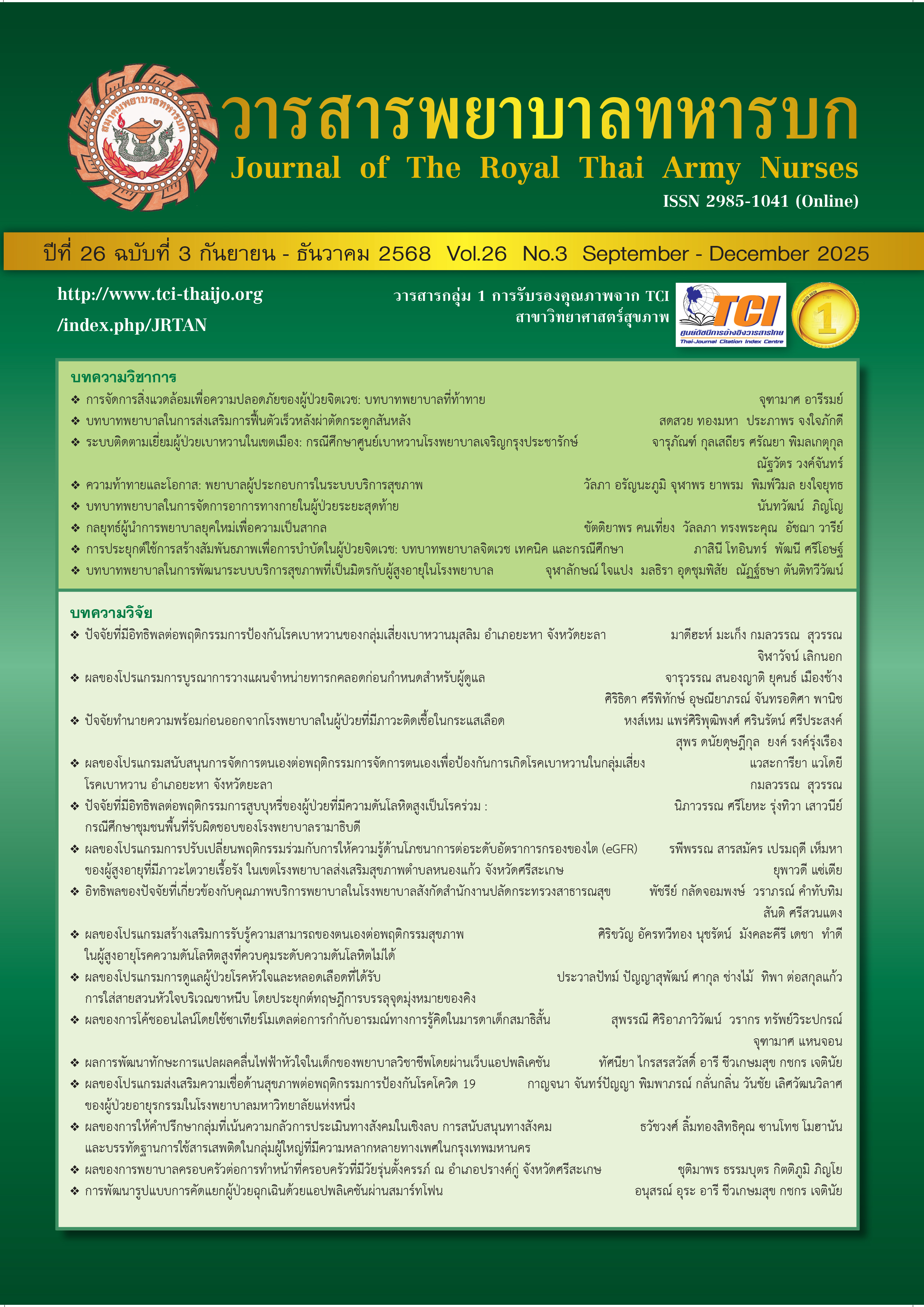
ผลของการโค้ชออนไลน์โดยใช้ซาเทียร์โมเดลต่อการกำกับอารมณ์ทางการรู้คิดในมารดาเด็กสมาธิสั้น
คำสำคัญ:
การโค้ชออนไลน์, ซาเทียร์โมเดล, การกำกับอารมณ์ทางการรู้คิด, มารดาเด็กสมาธิสั้นบทคัดย่อ
การวิจัยเป็นแบบกึ่งทดลอง เพื่อศึกษาผลการโค้ชออนไลน์โดยใช้ซาเทียร์โมเดลต่อการกำกับอารมณ์ทางการรู้คิดในมารดาเด็กสมาธิสั้น กลุ่มตัวอย่าง คือ มารดาที่มีบุตรสมาธิสั้น จำนวน 44 คน สุ่มจำแนกเข้ากลุ่ม เป็นกลุ่มทดลอง และกลุ่มควบคุม กลุ่มละ 22 คน เครื่องมือที่ใช้ ได้แก่ โปรแกรมการโค้ชออนไลน์โดยใช้ซาเทียร์โมเดลเพื่อเสริมสร้างการกำกับอารมณ์ทางการรู้คิดสำหรับมารดาเด็กสมาธิสั้น และแบบประเมินการกำกับอารมณ์ทางการรู้คิด กลุ่มทดลองได้รับโปรแกรม 6 ครั้ง ๆ ละ 45 - 50 นาที สัปดาห์ละ 2 ครั้ง เก็บรวบรวมข้อมูลระยะก่อนทดลอง หลังทดลอง และติดตามผล วิเคราะห์ข้อมูลด้วยการวิเคราะห์ความแปรปรวน แบบวัดซ้ำประเภทหนึ่งตัวแปรระหว่างกลุ่ม และหนึ่งตัวแปรภายในกลุ่ม เปรียบเทียบค่าเฉลี่ยเป็นรายคู่ด้วยวิธีแบบบอนเฟอโรนี ผลการวิจัยพบว่า กลุ่มทดลองมีค่าเฉลี่ยการกำกับอารมณ์ทางการรู้คิด หลังทดลอง และระยะติดตามผลสูงกว่าก่อนทดลองอย่างมีนัยสำคัญทางสถิติที่ระดับ .05 และกลุ่มทดลองมีค่าเฉลี่ยการกำกับอารมณ์ทางการรู้คิดหลังทดลอง และระยะติดตามผลสูงกว่ากลุ่มควบคุมอย่างมีนัยสำคัญทางสถิติที่ระดับ .05 จึงควรนำโปรแกรมนี้ไปใช้ในงานประจำของโรงพยาบาลที่มีแผนกจิตเวชเด็ก และวัยรุ่น
Downloads
เอกสารอ้างอิง
American Psychiatric Association. Diagnostic and statistical manual of mental disorders (DSM-5®). 5th ed. Washington DC: American Psychiatric Publishing; 2013.
Iswinarti I, Jadmiko G, & Hasanati N. Cognitive Emotion Regulation: Its Relationship to Parenting Stress. J Soc Stud Educ Res 2020; 11(2): 204-22.
Theule J, Wiener J, Tannock R, & Jenkins JM. Parenting stress in families of children with ADHD: A meta-analysis. J Emot Behav Disord 2013; 21(1): 3-17.
Garnefski N, & Kraaij V. The Cognitive Emotion Regulation Questionnaire Psychometric Features and Prospective Relationships with Depression and Anxiety in Adults. Eur J Psychol Assess 2007; 23(3): 141-9.
Ashena M, Besharat M, Malihialzackerini S, & Rafezi Z. The effectiveness of unified transdiagnostic therapy on strategies cognitive emotion regulation in mothers of children with cancer. J Psychol Sci 2021; 20(104): 1383-1402.
Veek SMC, Kraaij V, & Garnefski N. Cognitive Coping Strategies and Stress in Parents of Children with Down Syndrome: A Prospective Study. Intellect Dev Disabil 2009; 47(4): 295-306.
Crandall A, Deater-Deckard K, & Riley A. Maternal emotion and cognitive control capacities and parenting: A conceptual framework. Dev Rev 2015; 1(36): 105-26.
Srisuwan K. The effects of an adaptive enhancement program on stress management skills of mothers with children with ADHD. J Royal Thai Army Nurses 2019; 20(3): 286-95. (in Thai)
Saboonma Ch. The effects of a group experiential learning program for parents on the aggressive behavior of children with ADHD. Master study, Chulalongkorn University; 2019.
Arabi A, Moghaddam LF, & Sahebaizamni M. The effect of emotion regulation training on family relationships of hyperactive children. J Educ Health Promot 2022; 9: 1-8.
Haitoglou D. The Satir Systemic Coaching Model. Satir Int J. 2017; 5(1): 4-16.
Steel K, Cox D, & Garry H. Therapeutic videoconferencing interventions for the treatment of long-term conditions. J Telemed Telecare 2011; 17(3): 109-17.
Phuttharod P, & Silpakampises K. The effects of Satir Model based on individual psychotherapy program on depression among the Elderly. Journal of Public Health Nursing 2021; 35(1): 108-22. (in Thai)
Ritmoontree S. Abstract effect of group Satir Model based on program on self-esteem enhancement of amphetamine dependence in compulsory rehabilitation. Journal of the Department of Medical Services 2021; 46(1): 212-17. (in Thai)
Garnefski N, Kraaij V, & Spinhoven Ph. Negative life events, cognitive emotion regulation and emotional problems. Pers Individ Differ 2001; 30(8): 1311-27.
Howell DC. Statistical methods for psychology. 6thed. Belmont, California: Duxbury Press; 2007.
Satir V, Banmen J, Gerber J, & Gomori M. The Satir Model Family Therapy and Beyond. Palo Alto, California: Science and Behavior Books Inc.; 1991.
Srikosai S, Wongpothi U, Wongmueang N, & Thakham A. Development of a Mental Health Service System for Guardians of Children and Adolescents with Mental Health and Developmental Problems. J Thail Nurs Midwifery Counc 2023; 38(2): 88-104. (In Thai)
Khumsabanant S, Rattanatirawan P, Nakthongkeaw S, & Jampathong L. Effect of Group Therapy base on Satir Model in Parents of Children with Intellectual Disabilities. Rajanukul Inst J 2012; 27(3): 25-37. (In Thai)
Srikosai S, Dornnork P, Taweewattanaprecha S, & Saipanish R. Clinical Outcomes and Parents’ Life Congruence of Children with Attention Deficit-Hyperactive Disorder after Satir Model Based Psychoeducational Program. J Psychiatr Assoc Thail 2018; 68(3): 227-46. (In Thai)
Burrous T. A comparison study on E-coaching and Face-to-Face coaching. Dissertation, University of Pennsylvania; 2021.
Kamkliang K. Prototype development: Satir Model in parents’ group of attention deficit and hyperactivity disorders children. J Ment Health Thail 2008; 16(3): 144-56. (In Thai)
Seo SH, & Kim JS. The Effects of a Parental Education Program based on Satir Transformational Systemic Therapy Model for Preschoolers’ Mothers. J Korean Acad Psychiatr Ment Health Nurs 2015; 24(4): 330-41.
ดาวน์โหลด
เผยแพร่แล้ว
รูปแบบการอ้างอิง
ฉบับ
ประเภทบทความ
สัญญาอนุญาต
ลิขสิทธิ์ (c) 2025 วารสารพยาบาลทหารบก

อนุญาตภายใต้เงื่อนไข Creative Commons Attribution-NonCommercial-NoDerivatives 4.0 International License.
บทความหรือข้อคิดเห็นใดใดที่ปรากฏในวารสารพยาบาลทหารบกเป็นวรรณกรรมของผู้เขียน ซึ่งบรรณาธิการหรือสมาคมพยาบาลทหารบก ไม่จำเป็นต้องเห็นด้วย
บทความที่ได้รับการตีพิมพ์เป็นลิขสิทธิ์ของวารสารพยาบาลทหารบก
The ideas and opinions expressed in the Journal of The Royal Thai Army Nurses are those of the authors and not necessarily those
of the editor or Royal Thai Army Nurses Association.