
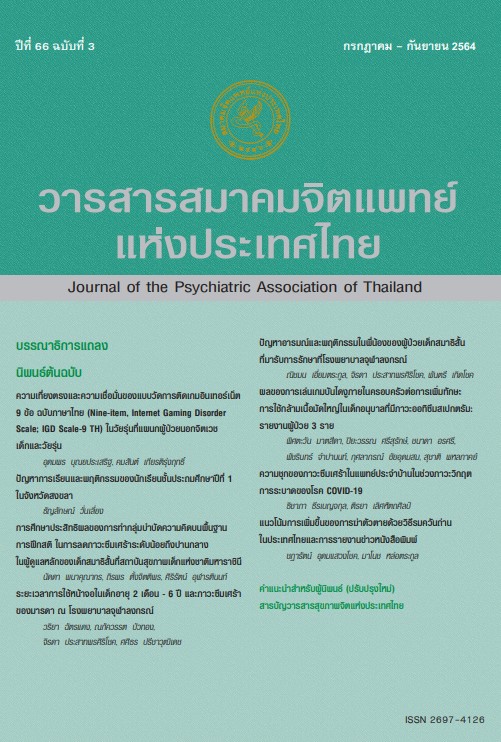
ความเที่ยงตรงและความเชื่อมั่นของแบบวัดการติดเกมอินเทอร์เน็ต 9 ข้อ ฉบับภาษาไทย (Nine-item, Internet Gaming Disorder Scale; IGD Scale-9 TH) ในวัยรุ่นที่แผนกผู้ป่วยนอกจิตเวชเด็กและวัยรุ่น
Article Sidebar
Main Article Content
บทคัดย่อ
วัตถุประสงค์: เพื่อศึกษาความเชื่อถือได้ (reliability) และความแม่นตรง (validity) ของแบบสอบถาม Internet Gaming Disorder Scale แบบ 9 ข้อ ฉบับภาษาไทย (IGD Scale-9 TH) ในการคัดกรองและวินิจฉัยโรคติดเกม (internet gaming disorder) ตามเกณฑ์การวินิจฉัย DSM-5 และ ICD-11 ในวัยรุ่นอายุ 11-17 ปี
วิธีการศึกษา: ผู้วิจัยแปลแบบสอบถาม IGD Scale-9 เป็นภาษาไทย และแปลกลับโดยผู้เชี่ยวชาญทางภาษา วัยรุ่นและผู้ปกครองจำนวน 90 คู่ที่มาเข้ารับการรักษาที่แผนกตรวจผู้ป่วยนอกจิตเวชเด็กและวัยรุ่นทำแบบสอบถามข้อมูลส่วนตัว แบบสอบถาม Internet Gaming Disorder Scale (วัยรุ่นเป็นผู้ตอบ) แล้วจึงสัมภาษณ์แบบกึ่งโครงสร้าง (semi-structure) โดยจิตแพทย์หรือแพทย์ประจำบ้านสาขาจิตเวชเด็กและวัยรุ่นเพื่อยืนยันการวินิจฉัยโรคติดเกม ใช้สถิติในการหา inter-rater reliability, internal consistency, reliability และ validity ของแบบสอบถาม
ผลการศึกษา: แบบสอบถามมีค่า internal consistency อยู่ในเกณฑ์ดี (Cronbach’s alpha = 0.69) การสัมภาษณ์มีค่า Inter-rater reliability อยู่ในเกณฑ์ดีมาก (Cohen’s kappa = 1) แบบสอบถาม IGD Scale-9 TH เมื่อเทียบกับเกณฑ์การวินิจฉัย DSM-5 ที่จุดตัดคะแนนเท่ากับ 5 มีค่า sensitivity = 0.69, specificity = 0.91, positive predictive value (PPV) = 82.8, negative predictive value (NPV) = 82.0 และ area under curve (AUC) = 0.86, และเมื่อเทียบกับเกณฑ์การวินิจฉัย ICD-11 ที่จุดตัดคะแนนเท่ากับ 4 มีค่า sensitivity = 0.50, specificity = 0.98, PPV = 50.0, NPV = 97.6 และ AUC = 0.92
สรุป: แบบสอบถาม IGD Scale-9 TH มีค่าความเชื่อถือได้ (reliability) และค่าความแม่นตรง (validity) อยู่ในเกณฑ์ดี มีคุณสมบัติที่จะใช้คัดกรองและวินิจฉัยโรคติดเกมในวัยรุ่นไทยโดยเฉพาะอย่างยิ่งในบริบททางคลินิกได้
คำสำคัญ: โรคติดเกม คัดกรอง แบบสอบถาม ความเชื่อถือได้ ความแม่นตรง
Article Details
บทความที่ส่งมาเพื่อพิจารณา ต้องไม่เคยตีพิมพ์หรือได้รับการตอบรับให้ตีพิมพ์ในวารสารฉบับอื่น และต้องไม่อยู่ระหว่างการส่งไปพิจารณาในวารสารอื่น
เอกสารอ้างอิง
National Statistical Office Thailand. The information and communication technology survey on household. Bangkok, 2017.
Electronic Transactions Development Agency. Thailand Internet User Profile 2018. Bangkok, 2018.
Colwell J, Payne J. Negative correlates of computer game play in adolescents. Br J Psychol. 2000; 91 ( Pt 3): 295-310.
Griffiths MD, Hunt N. Dependence on computer games by adolescents. Psychol Rep. 1998; 82(2): 475-480.
Mihara S, Higuchi S. Cross-sectional and longitudinal epidemiological studies of Internet gaming disorder: A systematic review of the literature. Psychiatry Clin Neurosci. 2017; 71(7): 425-444.
Hongsanguansri S, Silpakit C, Ruangkanchanasetr S. The Development of Problem Video Game Playing (PVP) Questionnaire, Thai version. J Psychiatr Assoc Thailand. 2006; 51(4): 315-329.
Pornnoppadol C, Sornpaisarn B, Khamklieng K, Pattana-amorn S. The Development of Game Addiction Screening Test (GAST). J Psychiatr Assoc Thailand. 2014; 59(1): 3-14.
American Psychiatric Association. Diagnostic and Statistical Manual of Mental Disorders. Fifth ed. Arlington, VA: American Psychiatric Publishing; 2013.
Lindmeier C. WHO releases new International Classification of Diseases (ICD-11): World Health Organization; 2018. [Cited….] Available from: https://www.who.int/news-room/detail/18-06-2018-who-releases-new-international-classification-of-diseases-(icd-11.
World Health Organization. Gaming disorder 2018. [Cited….] [Available from: https://www.who.int/features/qa/gaming-disorder/en/.
Jo YS, Bhang SY, Choi JS, Lee HK, Lee SY, Kweon YS. Clinical Characteristics of Diagnosis for Internet Gaming Disorder: Comparison of DSM-5 IGD and ICD-11 GD Diagnosis. J Clin Med. 2019; 8(7):945.
Lemmens JS, Valkenburg PM, Gentile DA. The Internet Gaming Disorder Scale. Psychol Assess. 2015; 27(2): 567-582.
Lemmens JS, Hendriks SJ. Addictive Online Games: Examining the Relationship Between Game Genres and Internet Gaming Disorder. Cyberpsychol Behav Soc Netw. 2016; 19(4): 270-276.
Cheng C, Li AY. Internet addiction prevalence and quality of (real) life: a meta-analysis of 31 nations across seven world regions. Cyberpsychol Behav Soc Netw. 2014; 17(12): 755-760.
Wichstrom L, Stenseng F, Belsky J, von Soest T, Hygen BW. Symptoms of Internet Gaming Disorder in Youth: Predictors and Comorbidity. J Abnorm Child Psychol. 2019;47(1):71-83.
Das A, Sharma MK, Thamilselvan P, Marimuthu P. Technology Addiction among Treatment Seekers for Psychological Problems: Implication for Screening in Mental Health Setting. Indian J Psychol Med. 2017; 39(1): 21-7.
Na E, Choi I, Lee TH, Lee H, Rho MJ, Cho H, et al. The influence of game genre on Internet gaming disorder. J Behav Addict. 2017; 6(2)::1-8.
Ko CH, Lin HC, Lin PC, Yen JY. Validity, functional impairment and complications related to Internet gaming disorder in the DSM-5 and gaming disorder in the ICD-11. Aust N Z J Psychiatry. 2020; 54(7): 707-718.
Carbonell X. El DiagnÓstico De AdicciÓn a Videojuegos En El Dsm-5 Y La Cie-11: Retos Y Oportunidades Para ClÍnicos. Papeles del Psicólogo - Psychologist Papers. 2020; 41(2).
Paik SH, Cho H, Chun JW, Jeong JE, Kim DJ. Gaming Device Usage Patterns Predict Internet Gaming Disorder: Comparison across Different Gaming Device Usage Patterns. Int J Environ Res Public Health. 2017; 14(12): 1512.
Evren C, Dalbudak E, Topcu M, Kutlu N, Evren B. The psychometric properties of the Turkish version of the Internet Gaming Disorder Scale. Dusunen Adam: The Journal of Psychiatry and Neurological Sciences. 2017; 30::316-324.
Rodriguez MC, Maeda Y. Meta-analysis of coefficient alpha. Psychol Methods. 2006; 11(3): 306-322.
Helms JE, Henze KT, Sass TL, Mifsud VA. Treating Cronbach’s Alpha Reliability Coefficients as Data in Counseling Research. The Counseling Psychologist. 2006; 34(5): 630-660.
Ponterotto JG, Ruckdeschel DE. An overview of coefficient alpha and a reliability matrix for estimating adequacy of internal consistency coefficients with psychological research measures. Percept Mot Skills. 2007; 105(3 Pt 1): 997-1014.
Ho RC, Zhang MW, Tsang TY, Toh AH, Pan F, Lu Y, et al. The association between internet addiction and psychiatric co-morbidity: a meta-analysis. BMC Psychiatry. 2014;14: 183.
Przybylski AK, Weinstein N, Murayama K. Internet Gaming Disorder: Investigating the Clinical Relevance of a New Phenomenon. Am J Psychiatry. 2017; 174(3): 230-236.
Gentile DA, Bailey K, Bavelier D, Brockmyer JF, Cash H, Coyne SM, et al. Internet Gaming Disorder in Children and Adolescents. Pediatrics. 2017; 140(Suppl 2): S81-S5.
