
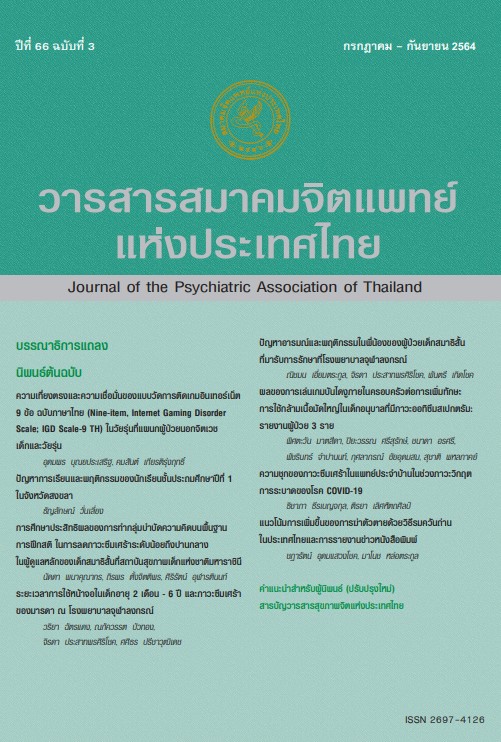
ปัญหาการเรียนและพฤติกรรมของนักเรียนชั้นประถมศึกษาปีที่ 1 ในจังหวัดสงขลา
Article Sidebar
Main Article Content
บทคัดย่อ
วัตถุประสงค์ เพื่อศึกษาความชุกของปัญหาการเรียนและพฤติกรรมในนักเรียนชั้นประถมศึกษาปีที่ 1 ของโรงเรียนในพื้นที่ 9 อำเภอของจังหวัดสงขลา
วิธีการศึกษา เป็นการศึกษาแบบ retrospective descriptive study รวบรวมข้อมูลจากโครงการคัดกรองปัญหาการเรียนและพฤติกรรมจาก 4 โรคหลัก ในนักเรียนชั้นประถมศึกษาปีที่ 1 ปีการศึกษา 2559 ถึง 2561 ของโรงเรียนในพื้นที่ 9 อำเภอของจังหวัดสงขลา นักเรียนที่เข้าร่วมโครงการได้รับการคัดกรองโดยครูประจำชั้น และนักเรียนที่เป็นกลุ่มเสี่ยงจะได้รับการตรวจวินิจฉัยโดยจิตแพทย์เด็ก ตามแนวทางการคัดกรองและดูแลนักเรียนที่มีปัญหาการเรียนและพฤติกรรม สำหรับเครือข่ายสุขภาพจิต โรงพยาบาลหาดใหญ่ วิเคราะห์ข้อมูลด้วยสถิติเชิงพรรณนา
ผลการศึกษา จากนักเรียนที่เข้าร่วมโครงการ จำนวน 4,437 ราย ในปีการศึกษา 2559 พบนักเรียนกลุ่มเสี่ยง ร้อยละ 20.33 หลังจากดำเนินการตรวจวินิจฉัยโดยจิตแพทย์เด็ก พบความชุกของปัญหาการเรียนและพฤติกรรม ร้อยละ 9.15 ของนักเรียนที่เข้าร่วมโครงการทั้งหมด ส่วนใหญ่อยู่ในกลุ่มสงสัยภาวะบกพร่องทางการเรียนรู้ ร้อยละ 5.91 รองลงมาคือ โรคสมาธิสั้น ร้อยละ 2.59 และภาวะบกพร่องทางสติปัญญา ร้อยละ 0.47 ในปีการศึกษา 2560 มีนักเรียนเข้าร่วมโครงการ จำนวน 7,027 ราย พบนักเรียนกลุ่มเสี่ยง ร้อยละ 17.12 ความชุกของปัญหาการเรียนและพฤติกรรม ร้อยละ 8.34 โดยอยู่ในกลุ่มสงสัยภาวะบกพร่องทางการเรียนรู้ ร้อยละ 5.14 โรคสมาธิสั้น ร้อยละ 2.78 และภาวะบกพร่องทางสติปัญญา ร้อยละ 0.28 และในปีการศึกษา 2561 มีนักเรียนเข้าร่วมโครงการ จำนวน 6,327 ราย พบนักเรียนกลุ่มเสี่ยง ร้อยละ 19.44 ความชุกของปัญหาการเรียนและพฤติกรรม ร้อยละ 10.29 อยู่ในกลุ่มสงสัยภาวะบกพร่องทางการเรียนรู้ ร้อยละ 6.20 โรคสมาธิสั้น ร้อยละ 3.33 และภาวะบกพร่องทางสติปัญญา ร้อยละ 0.47
สรุป ความชุกของนักเรียนกลุ่มเสี่ยง ใกล้เคียงกับผลการสำรวจนักเรียนทั่วประเทศ แต่ความชุกของ 4 โรคหลักต่ำกว่าการศึกษาที่ผ่านมา อย่างไรก็ตาม พบว่าระบบการคัดกรองนักเรียนมีความสำคัญในการค้นหาปัญหา และควรพัฒนาให้มีประสิทธิภาพมากขึ้น เพื่อช่วยให้นักเรียนกลุ่มเสี่ยงเข้าถึงบริการทางการแพทย์เพิ่มขึ้น รวมทั้งได้รับการดูแลรักษาอย่างเหมาะสมตั้งแต่เริ่มแรก
Article Details
บทความที่ส่งมาเพื่อพิจารณา ต้องไม่เคยตีพิมพ์หรือได้รับการตอบรับให้ตีพิมพ์ในวารสารฉบับอื่น และต้องไม่อยู่ระหว่างการส่งไปพิจารณาในวารสารอื่น
เอกสารอ้างอิง
Preedachaiyakul P. Efficacy of The screening program and management of children at risk for developmental or learning problems in 12 primary schools in Phuket province. Reg 11 Med J 2016; 30: 179-186.
Patel DR, Greydanus DE, Calles JL Jr, Pratt HD. Developmental disabilities across the lifespan. Dis Mon 2010; 56: 304-97.
Sirirutraykha T. Handbook of learning problems. 2nd ed. Bangkok: Prosperous Plus; 2018.
Sriwongpanich N, Sookatup J, Chaninyuthwong V, Benjapolpitak A. The relationship between risk of attention deficit and hyperactivity disorder, autism spectrum disorder, learning disorder and intellectual disability from behavioral observation by teacher and intelligence quotient (IQ) of Thai children in the first year of primary schools. Journal of Mental Health of Thailand 2019; 27(3): 159-170.
Lomsri C. Longitudinal survey: behavioral problem, learning disability, and emotional intelligence of the grade 1 students in regional health 1. Journal of Clinical Psychology 2015; 46(2): 1-8.
Patjanasoontorn N, Singkhorn-ard J, Unphrai P, Srisawat W, Udomsin C, Kittisiriwattanakul O. Learning and Behavioral problems in a Demonstration school children, Education level 1 (Grade 1-3) in Khon Kaen Province. Journal of the Psychiatric Association of Thailand 2011; 56(4): 345-351.
Visanuyothin T, Wachiradilok P, Buranasuksakul T, Pavasuthipaisit C, Arunruang P. The prevalence of attention deficit/hyperactivity disorder in Thailand. Journal of Mental Health of Thailand 2013; 21(2): 66-75.
Piyasil V, Wangtan S. Learning Disorders and Comorbidity. Journal of the Psychiatric Association of Thailand 2015; 60(4): 287-296.
Mongkol A, Visanuyothin T, Chanarong P, Pavasuthiapaisit C, Watcharadilok P. National intelligence quotient survey of Thai students in 2011. Journal of Mental Health of Thailand 2012; 20: 79-89.
Sookatup J, Benjapolpitak A, Chaninyuthwong V, Chutha P. Intelligence quotient (IQ) of Thai students in the first year of primary school: national survey 2016. Journal of Mental Health of Thailand 2018; 26(3): 161-173.
Poolsuppasit S, Panyayong B, Liknapichitkul D, Serisathien P, Chutha W. Holistic care for Thai Autism. Journal of Mental Health of Thailand 2005; 13(1): 10-16.
Department of mental health, Ministry of public health. Annual Report 2019. Bangkok: Lamom design; 2020.
Phoasavasdi C, Chaninthayuthawong V, Tawilo P, Khaipan Y. Development of Behavioral Observation Screening Scale for subnormal intelligence, LD, ADHD and Autistic Spectrum Disorder. Rajanukul Institute Journal 2015; 30(2): 1-11.
Pityaratstian N, Booranasuksakul T, Juengsiragulwit D, Benyakorn S. ADHD Screening Properties of the Thai Version of Swanson, Nolan, and Pelham IV Scale (SNAP-IV) and Strengths and Difficulties Questionnaire (SDQ). Journal of the Psychiatric Association of Thailand 2014; 59: 97-110.
Channarong P, Sonphaisan B. The development of a survey research instrument for Intelligence Quotients (IQ) test of Thai children. Bangkok: Thammasat university printing house; 2010.
American Psychiatric Association. Diagnostic and statistical manual of mental disorders, fifth edition (DSM-5). American Psychiatric Association. Washington, DC: American Psychiatric Press; 2013.
Panyayong B, Wacharasindhu A. Psychiatric disorders in Thai school-aged children: II Associated factors. J Med Assoc 2002; 85: S137-47.
Benjaponpitak A. National child developmental and mental health disorders screening policy in Thailand. European Psychiatry 2017; 41: S335.
Koomsiri P, Leknoi U. Review Article: Attention Deficit Hyperactivity Disorder (ADHD) and Public Stigma. Journal of Preventive Medicine Association of Thailand 2017; 7(3): 302-11.
Wongkrai P, Sivabaedya S. The Effect of Teacher Development for Helping ADHD Students by Using Teachers Training Program. Journal of Education Graduate Studies Research 2015; 9(4): 92-100.
Juengsiragulwit D, Chaiudomsom C, Rueng P, Poowichai. A Pilot Study of The Efficacy of Group Teacher Training for Behavioral Modification in School-Aged Children at-Risk for Emotional and Behavioral Problems. Journal of the Psychiatric Association of Thailand 2018; 63(2): 115-126.
Pattarakitnirun W. The prevalence of ADHD in primary school children in Hat Yai, Songkhla [Dissertation]. Songkhla: Prince of Songkla University; 2007.
Thomas R, Sanders S, Doust J, Beller E, Glasziou P. Prevalence of attention-deficit/hyperactivity disorder: a systematic review and meta-analysis. Pediatrics 2015; 135(4): e994–1001.
McKenzie K., Milton M., Smith G., Ouellette-Kuntz H. Systematic review of the prevalence and incidence of intellectual disabilities: current trends and issues. Current Developmental Disorders Reports 2016; 3: 104-115.
Elsabbagh M, Divan G, Koh YJ, Kim YS, Kauchali S, Marcín C, et al. Global prevalence of autism and other pervasive developmental disorders. Autism Res 2012; 5(3): 160-179.
Jatchavala C. Discourse on psychiatric disorders in modern Thai literature: A study of Piyaporn Saksasem’s novels. Journal of Liberal Arts 2018; 10(1): 204-28.
Wongpiromsarn Y, Wipulakorn P, Nuanmanee S, Woerner W, Mongkol A. Strengths and Difficulties Questionnaire (SDQ) Thai improved version: change and administration. Journal of Mental Health of Thailand 2011; 19(2): 128-134.
