
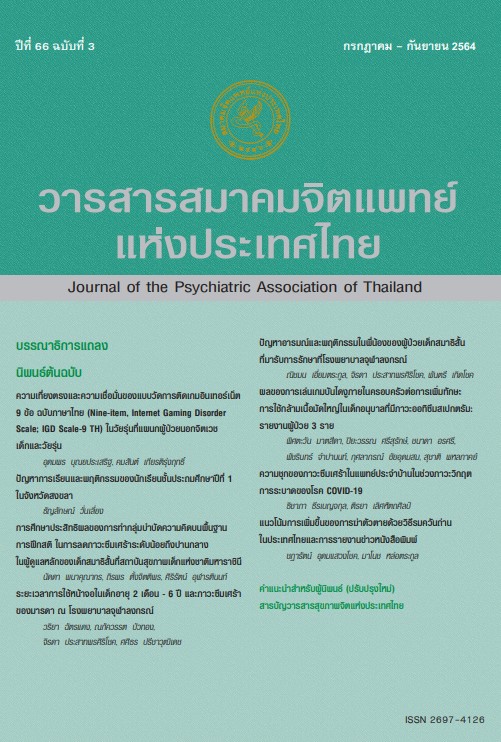
ปัญหาอารมณ์และพฤติกรรมในพี่น้องของผู้ป่วยเด็กสมาธิสั้นที่มารับการรักษาที่โรงพยาบาลจุฬาลงกรณ์
Article Sidebar
Main Article Content
บทคัดย่อ
บทคัดย่อ
วัตถุประสงค์ : เพื่อศึกษาความชุกและปัจจัยที่เกี่ยวข้องกับปัญหาอารมณ์และพฤติกรรมในพี่น้องของผู้ป่วยเด็กสมาธิสั้นที่มารับการรักษาที่โรงพยาบาลจุฬาลงกรณ์
วิธีการศึกษา : เป็นการศึกษาเชิงพรรณนาภาคตัดขวาง ศึกษาในพี่หรือน้องของผู้ป่วยสมาธิสั้นที่มารับการรักษาที่โรงพยาบาลจุฬาลงกรณ์ ระหว่างช่วงเดือนพฤศจิกายน 2562 ถึง พฤศจิกายน 2563 จำนวน 106 ราย โดยบิดาหรือมารดาของผู้ป่วยเป็นผู้ตอบแบบสอบถาม ซึ่งประกอบไปด้วยแบบสอบถามข้อมูลทั่วไป แบบประเมิน Swanson, Nolan, and Pelham IV Scale (SNAP-IV) ฉบับภาษาไทย แบบประเมิน Strengths and difficulties questionnaire ฉบับภาษาไทย และแบบวัด Chulalongkorn Family Inventory ร่วมกับการสืบค้นเวชระเบียนในส่วนข้อมูลการวินิจฉัยโรคและโรคร่วมของผู้ป่วย ใช้สถิติเชิงพรรณนาในการหาความถี่ ร้อยละ ค่าเฉลี่ย และสถิติเชิงอนุมาน ได้แก่ Fisher Exact test ในการหาความสัมพันธ์ระหว่างปัจจัยที่เกี่ยวข้องกับปัญหาอารมณ์และพฤติกรรมในพี่น้องของผู้ป่วยสมาธิสั้น
ผลการศึกษา : พี่น้องของผู้ป่วยมีปัญหาด้านอารมณ์ ร้อยละ 10.4 ปัญหาพฤติกรรมอยู่ไม่นิ่ง/สมาธิสั้น ร้อยละ 9.7 ปัญหาพฤติกรรมเกเร/ความประพฤติ ร้อยละ 12.3 และปัญหาความสัมพันธ์กับเพื่อน ร้อยละ 6.7 โดยปัจจัยที่สัมพันธ์กับปัญหาอารมณ์และพฤติกรรมในพี่น้องของผู้ป่วยเด็กสมาธิสั้นอย่างมีนัยสำคัญทางสถิติ ได้แก่ บิดามารดาที่อายุน้อยกว่าหรือเท่ากับ 40 ปี ผู้ป่วยสมาธิสั้นเป็นบุตรคนโต ผู้ป่วยมีโรคร่วม ผู้ป่วยมีคะแนน SNAP-inattention มากกว่าหรือเท่ากับ 16 คะแนน ผู้ป่วยมีคะแนน SNAP- hyperactivity/ impulsivity มากกว่าหรือเท่ากับ 14 คะแนน พี่น้องที่อายุน้อยกว่าหรือเท่ากับ 10 ปี ครอบครัวที่มีการปฏิบัติหน้าที่ไม่ดีในด้านการสื่อสารและการปฏิบัติหน้าที่ทั่วไป และครอบครัวที่มีรายได้ไม่เพียงพอต่อการดำรงชีพ
สรุป : พี่น้องของผู้ป่วยมีปัญหาด้านอารมณ์ พฤติกรรม และความสัมพันธ์กับเพื่อนมากกว่าประชากรทั่วไปในการศึกษาก่อนหน้า โดยพบว่ามีปัจจัยที่เกี่ยวข้องกับปัญหาทั้ง 3 ด้าน คือ อายุของบิดามารดา ลำดับการเกิดของผู้ป่วย และโรคร่วมของผู้ป่วย ความรุนแรงของอาการสมาธิสั้นของผู้ป่วย อายุของพี่น้อง การปฏิบัติหน้าที่ของครอบครัวในด้านการสื่อสารและการปฏิบัติหน้าที่ทั่วไป และความเพียงพอของรายได้ครอบครัว
Article Details
บทความที่ส่งมาเพื่อพิจารณา ต้องไม่เคยตีพิมพ์หรือได้รับการตอบรับให้ตีพิมพ์ในวารสารฉบับอื่น และต้องไม่อยู่ระหว่างการส่งไปพิจารณาในวารสารอื่น
เอกสารอ้างอิง
Thomas R, Sanders S, Doust J, Beller E, Glasziou P. Prevalence of attention-deficit/hyperactivity disorder: A systematic review and meta-analysis. J Pediatr 2015; 135(4): e994–e1001.
Visanuyothin T, Pavasuthipaisit C, Wachiradilok P, Arunruang P, Buranasuksakul T. The prevalence of attention deficit/hyperactivity disorder in Thailand. Journal of Mental Health of Thailand 2013; 21(2): 66-75.
Peasgood T, Bhardwaj A, Biggs K, Brazier JE, Coghill D, Cooper CL, et al. The impact of ADHD on the health and well-being of ADHD children and their siblings. Eur Child Adolesc Psychiatry 2016; 25(11): 1217-1231.
Cohen MW. The attention zone: a parent's guide to attention deficit/hyperactivity. London: Routledge; 2015.
Stone KL. An investigation of sibling relationships of children with AD/HD and their older siblings (dissertation): University of Kentucky; 1999.
Kendall J. Sibling Accounts of Attention Deficit Hyperactivity Disorder (ADHD). Fam Process 1999; 38(1): 117–136.
Harpin VA. The effect of ADHD on the life of an individual, their family, and community from preschool to adult life. Arch Dis Child 2005; 90(suppl_1): i2–i7.
Singer B. The psychological experience of siblings of children with ADHD (dissertation): Massachusetts School of Professional Psychology; 1998.
Listug-Lunde L, Zevenbergen AA, Petros TV. Psychological symptomatology in siblings of children with ADHD. J Atten Disord 2008; 12(3): 239-247.
Jurma A, Hogea L, Motoc A. Mental health symptoms in siblings of children with Attention Deficit/Hyperactivity Disorder and Autism Spectrum Disorder. European International Journal of Science and Technology 2015; 4: 56-64.
Mikami AY, Pfiffner LJ. Sibling relationships among children with adhd. J Atten Disord 2008; 11(4): 482–492.
Foley M. A comparison of family adversity and family dysfunction in families of children with attention deficit hyperactivity disorder (ADHD) and families of children without ADHD. J Spec Pediatr Nurs 2011; 16(1): 39–49.
Kotrlik J, Higgins C. Organizational research: Determining appropriate sample size in survey research appropriate sample size in survey research. Information Technology, Learning, and Performance Journal 2001; 19(1): 43-50.
Pityaratstian N BT, Juengsiragulwit D, Benyakorn S. ADHD Screening Properties of the Thai Version of Swanson, Nolan,Pelham IV Scale (SNAP-IV) and Strengths and Difficulties Questionnaire (SDQ). Journal of the Psychiatric Association of Thailand 2014; 59: 97-110.
Wongpiromsarn Y, Wipulakorn P, Nuanmanee S, Woener W, Mongkol A. Strengths and Difficulties Questionnaire (SDQ) Thai improved version: change and administration. Journal of Mental Health of Thailand 2011; 19(2) :128-134.
Woerner W, Nuanmanee S, Becker A, Wongpiromsarn Y, Mongkol A. Normative data and psychometric properties of the Thai version of the Strengths and Difficulties Questionnaire (SDQ). Journal of Mental Health of Thailand 2011; 19(1): 42-58.
Trangkasombat U. Family therapy and family counseling. Bangkok: Family Research and
Development Center; 2011.
Wanwa D. The effect of family mutual support group on family functioning as perceived by family caregivers of schizophrenic patients (thesis). Bangkok: Chulalongkorn University; 2012.
Chutha P, Chaninyuthwong V, Sooktup J. Prevalance and Risk Factors for Problematic Behaviors among Thai 1st Grade Primary School Students: Results from Thai National IQ and EQ Survey in 2016. Rajanukul Institute Journal 2018; 33(1): 1-18.
Mikkelsen SH, Olsen J, Bech BH, Obel C. Parental age and attention-deficit/hyperactivity disorder (ADHD). Int J Epidemiol 2016; 46(2): 409-420.
Hosain GM, Berenson AB, Tennen H, Bauer LO, Wu ZH. Attention Deficit Hyperactivity Symptoms and Risky Sexual Behavior in Young Adult Women. J Womens Health (Larchmt) 2012; 21(4): 463–468.
Miller M, Musser ED, Young GS, Olson B, Steiner RD, Nigg JT. Sibling Recurrence Risk and Cross-aggregation of Attention-Deficit/Hyperactivity Disorder and Autism Spectrum Disorder. JAMA Pediatr 2019; 173(2): 147-152.
Abram RS, Coie JD. Maternal reactions to problem behaviors and ordinal position of child. J Pers 1981; 49(4): 450-467.
Burt SA, Krueger RF, Mcgue M, Iacono WG. Sources of covariation among attention-deficit/hyperactivity disorder, oppositional defiant disorder, and conduct disorder: The importance of shared environment.
J Abnorm Psychol 2001; 110(4): 516–525.
Freitag CM, Rohde LA, Lempp T, Romanos M. Phenotypic and measurement influences on heritability estimates in childhood ADHD. Eur Child Adolesc Psychiatry 2010; 19(3): 311–323.
Thapar A, Harrington R, Mcguffin P. Examining the comorbidity of ADHD-related behaviours and conduct problems using a twin study design. Br J Psychiatry 2001; 179(3): 224–229.
Henderson CE, Dakof GA, Schwartz SJ, Liddle HA. Family Functioning, Self-Concept, and Severity of Adolescent Externalizing Problems. J Child Fam Stud 2006; 15(6): 721–731.
Alivernini F, Cavicchiolo E, Girelli L, Lucidi F, Biasi V, Leone L, et al. Relationships between sociocultural factors (gender, immigrant and socioeconomic background), peer relatedness and positive affect in adolescents. J Adolesc 2019; 76: 99–108.
