
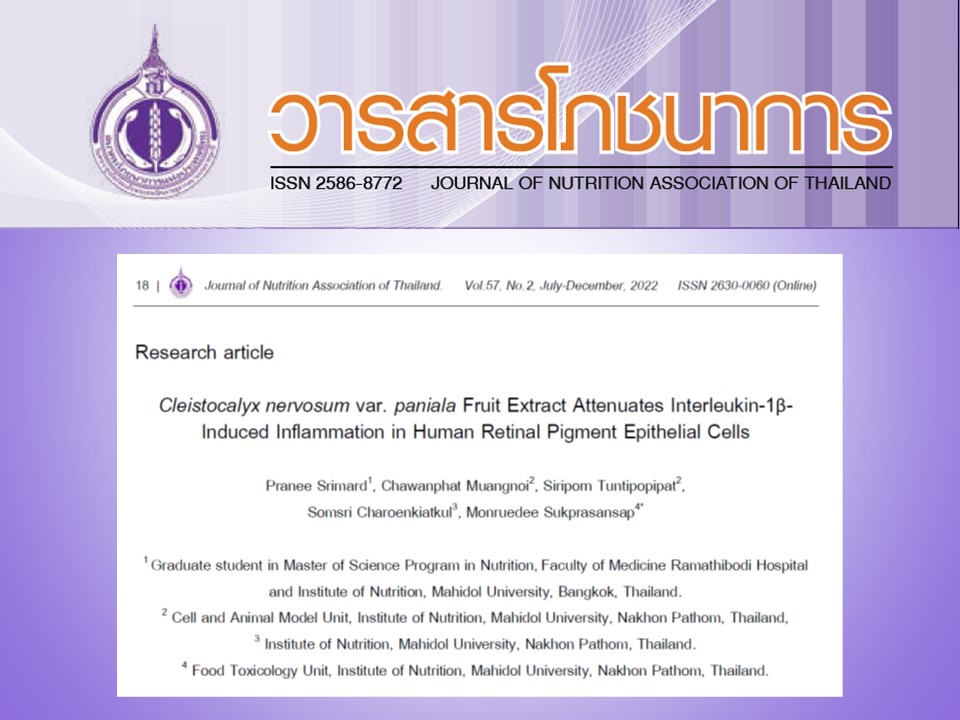
สารสกัดผลมะเกี๋ยงลดการอักเสบจากการเหนี่ยวนำด้วยอินเตอร์ลิวคิน-1 เบต้าในเซลล์จอประสาทตามนุษย์
คำสำคัญ:
มะเกี๋ยง, การต้านอักเสบ, เซลล์จอประสาทตามนุษย์ชนิด ARPE-19บทคัดย่อ
การอักเสบในเซลล์เยื่อบุจอตาชั้นนอก (จอประสาทตา) เป็นสาเหตุสำคัญเริ่มต้นนำไปสู่ภาวะจอตาเสื่อมหรือจุดรับภาพเสื่อมในผู้สูงอายุ ผลมะเกี๋ยงสุกอุดมไปด้วยสารพฤกษเคมีมากมายโดยเฉพาะสารแอนโทไซยานินซึ่งพบว่ามีฤทธิ์ต้านอนุมูลอิสระและต้านอักเสบได้ดี อย่างไรก็ตาม ยังไม่มีการศึกษาฤทธิ์ของผลมะเกี๋ยงสุกนี้ต่อเซลล์จอประสาทตา วัตถุประสงค์ของงานวิจัยนี้ คือ เพื่อศึกษาผลการยับยั้งของสารสกัดจากผลมะเกี๋ยงต่อการอักเสบที่ถูกเหนี่ยวนำด้วยอินเตอร์ลิวคิน-1 เบต้า ในเซลล์จอประสาทตามนุษย์ (ARPE-19) ผลมะเกี๋ยงสุกถูกสกัดด้วยเอทานอล (CEE) ปริมาณแอนโธไซยานินรวมของสารสกัดถูกวิเคราะห์โดยเทคนิคสเปกโตรโฟโตเมตรี ผลการศึกษาที่ได้พบว่าสารสกัดผลมะเกี๋ยงสุกมีปริมาณแอนโธไซยานินรวมสูง (31.54 ± 0.53 มิลลิกรัมไซยานิดิน-3-กลูโคไซด์ (C3G) เทียบเท่า/100 กรัมน้ำหนักแห้ง) สำหรับการทดสอบในระดับเซลล์นั้น เซลล์ ARPE-19 ถูกเลี้ยงด้วยอาหารเลี้ยงเซลล์ที่ผสม CEE (5-500 ไมโครกรัม/มิลลิลิตร) หรือ C3G ที่ 100 ไมโครโมลาร์ เป็นเวลา 1 ชั่วโมงก่อนนำมาเลี้ยงร่วมกับสภาวะที่มีหรือไม่มีอินเตอร์ลิวคิน-1 เบต้า (0.1 นาโนกรัม/มิลลิลิตร) เป็นเวลา 24 ชั่วโมง แล้วตรวจสอบการมีชีวิตอยู่รอดของเซลล์โดยวิธี MTT จากนั้นอาหารเลี้ยงเซลล์ ถูกเก็บเพื่อตรวจหาสารสื่ออักเสบชนิดต่างๆ ได้แก่ อินเตอร์ลิวคิน-6, อินเตอร์ลิวคิน-8 และโมโนไซต์เคโมแอดแทรกแตนท์โปรตีน-1 ทดสอบด้วยวิธี ELISA จากผลการทดสอบ พบว่า CEE และ C3G ในทุกความเข้มข้นไม่มีความเป็นพิษต่อเซลล์และมีศักยภาพที่ดีในการยับยั้งการหลั่งสารสื่ออักเสบต่างๆ ที่เกิดจากการเหนี่ยวนำด้วยอินเตอร์ลิวคิน-1 เบต้า ในเซลล์ ARPE-19 ได้อย่างมีนัยสำคัญทางสถิติ ดังนั้นข้อมูลที่ได้จากการค้นพบครั้งนี้ ชี้ให้เห็นว่าสารสกัดจากผลมะเกี๋ยงสุกและสารแอนโธไซยานินหลัก C3G มีศักยภาพออกฤทธิ์ต้านการอักเสบได้ดี ผลไม้นี้อาจถูกนำมาใช้เป็นผลิตภัณฑ์ทางเลือกจากธรรมชาติเพื่อป้องกันการเกิดภาวะจอประสาทตาเสื่อมซึ่งสัมพันธ์กับการอักเสบ
เอกสารอ้างอิง
Brooks P. Inflammation as an important feature of osteoarthritis. Bulletin of the World Health Organization. 2003;81(9):689-90.
Sun K, Tordjman J, Clément K, Scherer PE. Fibrosis and adipose tissue dysfunction. Cell metabolism. 2013;18(4):470-7.
Zou M, Zhang Y, Chen A, Young CA, Li Y, Zheng D, et al. Variations and trends in global disease burden of age‐related macular degeneration: 1990‐2017. Acta Ophthalmol. 2021;99(3):e330-e5.
Mitchell P, Liew G, Gopinath B, Wong TY. Age-related macular degeneration. The Lancet. 2018;392(10153):1147-59.
Nowak JZ. Age-related macular degeneration (AMD): pathogenesis and therapy. Pharmacol Rep. 2006;58(3):353.
Arya M, Sabrosa AS, Duker JS, Waheed NK. Choriocapillaris changes in dry age-related macular degeneration and geographic atrophy: a review. Eye and Vision. 2018;5(1):1-7.
Juhn SK, Jung M-K, Hoffman MD, Drew BR, Preciado DA, Sausen NJ, et al. The role of inflammatory mediators in the pathogenesis of otitis media and sequelae. Clin Exp Otorhinolaryngol. 2008;1(3):117-38.
Cheng S-C, Huang W-C, S. Pang J-H, Wu Y-H, Cheng C-Y. Quercetin inhibits the production of IL-1β-induced inflammatory cytokines and chemokines in ARPE-19 cells via the MAPK and NF-κB signaling pathways. Int J Mol Sci. 2019;20(12):2957.
Škrovánková S, Mišurcová L, Machů L. Antioxidant activity and protecting health effects of common medicinal plants. Adv Food Nutr Res. 2012;67:75-139.
Diniz do Nascimento L, Moraes AABd, Costa KSd, Pereira Galúcio JM, Taube PS, Costa CML, et al. Bioactive natural compounds and antioxidant activity of essential oils from spice plants: New findings and potential applications. Biomolecules. 2020;10(7):988.
Dzoyem JP, Eloff JN. Anti-inflammatory, anticholinesterase and antioxidant activity of leaf extracts of twelve plants used traditionally to alleviate pain and inflammation in South Africa. J Ethnopharmacol. 2015;160:194-201.
Azarpazhooh E, Sharayei P, Zomorodi S, Ramaswamy HS. Physicochemical and phytochemical characterization and storage stability of freeze-dried encapsulated pomegranate peel anthocyanin and in vitro evaluation of its antioxidant activity. Food Bioproc Tech. 2019;12(2):199-210.
Jezek M, Zörb C, Merkt N, Geilfus C-M. Anthocyanin management in fruits by fertilization. J Agr Food Chem. 2018;66(4):753-64.
Meydan I, Kizil G, Demir H, Ceken Toptanci B, Kizil M. In vitro DNA damage, protein oxidation protective activity and antioxidant potentials of almond fruit (Amygdalus trichamygdalus) parts (hull and drupe) using soxhlet ethanol extraction. Adv Trad Med. 2020;20(4):571-9.
Shahreza FD. Oxidative stress, free radicals, kidney disease and plant antioxidants. Immunopathologia Persa. 2016;3(2):e11.
Engwa GA. Free radicals and the role of plant phytochemicals as antioxidants against oxidative stress-related diseases. Phytochemicals: Source of Antioxidants and Role in Disease Prevention. BoD–Books on Demand. 2018.
Kizawa Y, Sekikawa T, Kageyama M, Tomobe H, Kobashi R, Yamada T. Effects of anthocyanin, astaxanthin, and lutein on eye functions: a randomized, double-blind, placebo-controlled study. J Clin Biochem Nutr. 2021:20-149.
Cherlet A. The disease-fighting power of berries. Life Extension magazine. 2008;9:1-2.
Yang J, Cui J, Chen J, Yao J, Hao Y, Fan Y, et al. Evaluation of physicochemical properties in three raspberries (Rubus idaeus) at five ripening stages in northern China. Scientia Horticulturae. 2020;263:109146.
Tantratian S, Balmuang N, Krusong W. Phenolic enrichment of Ma-Kieng seed extract using absorbent and this enriched extract application for safety control of fresh-cut cantaloupe. LWT. 2019;106:105-12.
Prasansuklab A, Brimson JM, Tencomnao T. Potential Thai medicinal plants for neurodegenerative diseases: A review focusing on the anti-glutamate toxicity effect. J Tradi Compl Med. 2020;10(3):301-8.
Prasanth MI, Brimson JM, Chuchawankul S, Sukprasansap M, Tencomnao T. Antiaging, stress resistance, and neuroprotective efficacies of Cleistocalyx nervosum var. paniala fruit extracts using Caenorhabditis elegans model. Oxidative Med Cell Long. 2019;2019.
Brimson JM, Prasanth MI, Isidoro C, Sukprasansap M, Tencomnao T. Cleistocalyx nervosum var. paniala seed extracts exhibit sigma-1 antagonist sensitive neuroprotective effects in PC12 cells and protects C. elegans from stress via the SKN-1/NRF-2 pathway. Nutr Healthy Aging. 2021;6(2):131-46.
Sukprasansap M, Chanvorachote P, Tencomnao T. Cleistocalyx nervosum var. paniala berry fruit protects neurotoxicity against endoplasmic reticulum stress-induced apoptosis. Food Chem Tox. 2017;103:279-88.
Nantacharoen W, Baek SJ, Plaingam W, Charoenkiatkul S, Tencomnao T, Sukprasansap M. Cleistocalyx nervosum var. paniala Berry Promotes Antioxidant Response and Suppresses Glutamate-Induced Cell Death via SIRT1/Nrf2 Survival Pathway in Hippocampal HT22 Neuronal Cells. Molecules. 2022;27(18):5813.
Abdel‐Aal ES, Hucl P. A rapid method for quantifying total anthocyanins in blue aleurone and purple pericarp wheats. Cereal Chem. 1999;76(3):350-4.
Da Cunha A, Zhang Q, Prentiss M, Wu X, Kainz V, Xu Y, et al. The hierarchy of proinflammatory cytokines in ocular inflammation. Curr Eye Res. 2018;43(4):553-65.
Beaudry-Richard A, Nadeau-Vallée M, Prairie É, Maurice N, Heckel É, Nezhady M, et al. Antenatal IL-1-dependent inflammation persists postnatally and causes retinal and sub-retinal vasculopathy in progeny. Sci Rep. 2018;8(1):1-13.
Jansom C, Bhamarapravati S, Itharat A. Major anthocyanin from ripe berries of Cleistocalyx nervosum var. paniala. Thammasat Med J. 2008;8(3):364-70.
Charoensin S, Taya S, Wongpornchai S, Wongpoomchai R. Assessment of genotoxicity and antigenotoxicity of an aqueous extract of Cleistocalyx nervosum var. paniala in in vitro and in vivo models. Interdiscip Toxicol. 2012;5(4):201.
Pipattanamomgkol P, Lourith N, Kanlayavattanakul M. The natural approach to hair dyeing product with Cleistocalyx nervosum var. paniala. Sustain Chem Pharm. 2018;8:88-93.
Chariyakornkul A, Juengwiroj W, Ruangsuriya J, Wongpoomchai R. Antioxidant Extract from Cleistocalyx nervosum var. paniala Pulp Ameliorates Acetaminophen-Induced Acute Hepatotoxicity in Rats. Molecules. 2022;27(2):553.
Prasanth MI, Sivamaruthi BS, Sukprasansap M, Chuchawankul S, Tencomnao T, Chaiyasut C. Functional properties and bioactivities of Cleistocalyx nervosum var. paniala berry plant: a review. Food Sci Technol. 2020;40:369-73.
Jonas JB, Wei WB, Xu L, Wang YX. Systemic inflammation and eye diseases. The Beijing Eye Study. PLoS One. 2018;13(10):e0204263.
Hu W-W, Huang Y-K, Huang X-G. Comparison of peripheral blood inflammatory indices in patients with neovascular age-related macular degeneration and haemorrhagic polypoidal choroidal vasculopathy. Ocul Immunol Inflamm. 2022:1-5.
Pan M, Zhou P, Liu Z, Guo J, Du L, Jin X. Peripheral complete blood cell count indices and serum lipid levels in polypoidal choroidal vasculopathy. Clin Exp Optom. 2022:1-6.
Yoshimura T. The production of monocyte chemoattractant protein-1 (MCP-1)/CCL2 in tumor microenvironments. Cytokine. 2017;98:71-8.
Osuka K, Ohmichi Y, Ohmichi M, Nakura T, Iwami K, Watanabe Y, et al. Sequential Expression of Chemokines in Chronic Subdural Hematoma Fluids after Trepanation Surgery. J Neurotrauma. 2021;38(14):1979-87.
Sato T, Takeuchi M, Karasawa Y, Enoki T, Ito M. Intraocular inflammatory cytokines in patients with neovascular age-related macular degeneration before and after initiation of intravitreal injection of anti-VEGF inhibitor. Sci Rep. 2018;8(1):1-10.
Terao N, Koizumi H, Kojima K, Yamagishi T, Yamamoto Y, Yoshii K, et al. Distinct aqueous humour cytokine profiles of patients with pachychoroid neovasculopathy and neovascular age-related macular degeneration. Sci Rep. 2018;8(1):1-10.
Tan W, Zou J, Yoshida S, Jiang B, Zhou Y. The role of inflammation in age-related macular degeneration. Int J Biol Sci. 2020;16(15):2989.
Shukla R, Pandey V, Vadnere GP, Lodhi S. Role of flavonoids in management of inflammatory disorders. Bioactive food as dietary interventions for arthritis and related inflammatory diseases: Elsevier; 2019. p. 293-322.
Valdez JC, Bolling BW. Anthocyanins and intestinal barrier function: A review. J Food Bioact. 2019;5:18-30.
Stromsnes K, Correas AG, Lehmann J, Gambini J, Olaso-Gonzalez G. Anti-inflammatory properties of diet: Role in healthy aging. Biomedicines. 2021;9(8):922.
Iwashima T, Kudome Y, Kishimoto Y, Saita E, Tanaka M, Taguchi C, et al. Aronia berry extract inhibits TNF-α-induced vascular endothelial inflammation through the regulation of STAT3. Food & Nutr Res. 2019;63.
Islam SU, Lee JH, Shehzad A, Ahn E-M, Lee YM, Lee YS. Decursinol angelate inhibits LPS-induced macrophage polarization through modulation of the NFκB and MAPK signaling pathways. Molecules. 2018;23(8):1880.
Jayasinghe AMK, Kirindage KGIS, Fernando IPS, Han EJ, Oh G-W, Jung W-K, et al. Fucoidan isolated from sargassum confusum suppresses inflammatory responses and oxidative stress in tnf-α/ifn-γ-stimulated hacat keratinocytes by activating nrf2/ho-1 signaling pathway. Mar Drugs. 2022;20(2):117.
Chen Y, Shou K, Gong C, Yang H, Yang Y, Bao T. Anti-inflammatory effect of geniposide on osteoarthritis by suppressing the activation of p38 MAPK signaling pathway. BioMed Rres Int. 2018;2018.
Qiu T, Sun Y, Wang X, Zheng L, Zhang H, Jiang L, et al. Drum drying-and extrusion-black rice anthocyanins exert anti-inflammatory effects via suppression of the NF-κB/MAPKs signaling pathways in LPS-induced RAW 264.7 cells. Food BioSci. 2021;41:100841.
Jung S, Lee M-S, Choi A-J, Kim C-T, Kim Y. Anti-inflammatory effects of high hydrostatic pressure extract of mulberry (Morus alba) fruit on LPS-stimulated RAW264. 7 cells. Molecules. 2019;24(7).
Amin FU, Shah SA, Badshah H, Khan M, Kim MO. Anthocyanins encapsulated by PLGA@ PEG nanoparticles potentially improved its free radical scavenging capabilities via p38/JNK pathway against Aβ1–42-induced oxidative stress. J Nanobiotechnol. 2017;15(1):1-16.
Aboonabi A, Aboonabi A. Anthocyanins reduce inflammation and improve glucose and lipid metabolism associated with inhibiting nuclear factor-kappaB activation and increasing PPAR-γ gene expression in metabolic syndrome subjects. Free Radical Biology and Medicine. 2020;150:30-9.
Khoo HE, Azlan A, Tang ST, Lim SM. Anthocyanidins and anthocyanins: Colored pigments as food, pharmaceutical ingredients, and the potential health benefits. Food Nutr Res. 2017;61(1):1361779.
Krga I, Tamaian R, Mercier S, Boby C, Monfoulet L-E, Glibetic M, et al. Anthocyanins and their gut metabolites attenuate monocyte adhesion and transendothelial migration through nutrigenomic mechanisms regulating endothelial cell permeability. Free Radic Biol Med. 2018;124:364-79.
ดาวน์โหลด
เผยแพร่แล้ว
รูปแบบการอ้างอิง
ฉบับ
ประเภทบทความ
สัญญาอนุญาต
บทความที่เผยแพร่ในวารสารโภชนาการ เป็นลิขสิทธิ์ของสมาคมโภชนาการแห่งประเทศไทยฯ

