
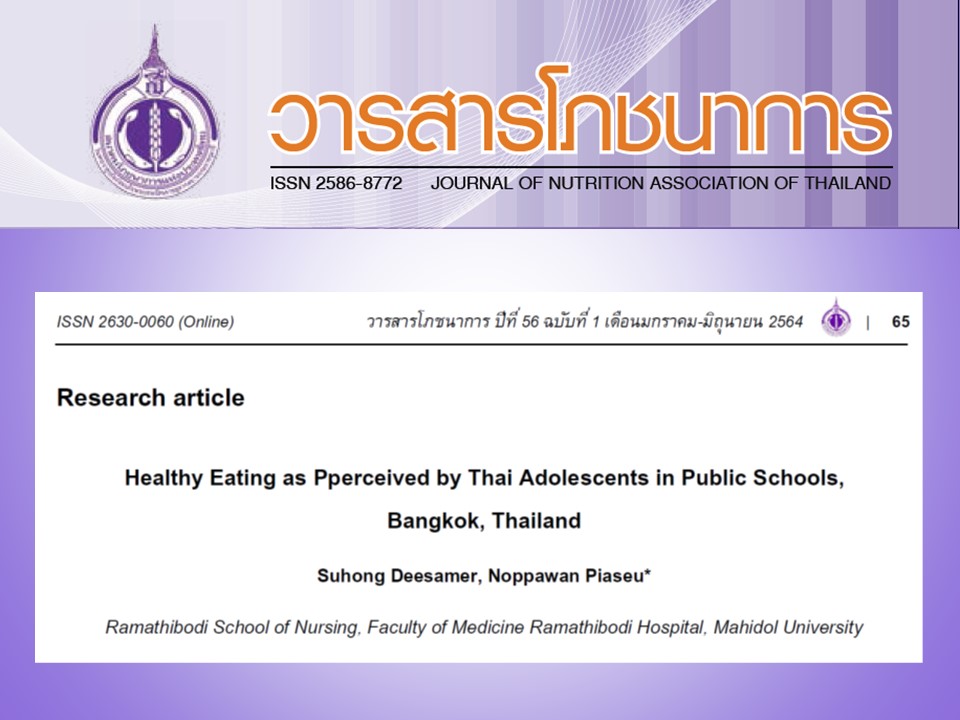
การบริโภคอาหารเพื่อสุขภาพในทัศนะของวัยรุ่นไทยในโรงเรียนรัฐบาล เขตกรุงเทพมหานคร ประเทศไทย
คำสำคัญ:
การบริโภคอาหารสุขภาพ, ประเทศไทย, วัยรุ่น, ทัศนะบทคัดย่อ
การบริโภคอาหารที่เป็นอันตรายต่อสุขภาพในช่วงวัยรุ่นเพิ่มความเสี่ยงต่อการเกิดโรคไม่ติดต่อเรื้อรัง และสามารถลดคุณภาพชีวิตในวัยผู้ใหญ่ การศึกษานี้ใช้การวิจัยเชิงคุณภาพเพื่ออธิบายความหมายของการบริโภคอาหารเพื่อสุขภาพในทัศนะของวัยรุ่นระดับมัธยมศึกษา ในโรงเรียนภาครัฐ เขตกรุงเทพมหานคร และการเลือกบริโภคอาหารสุขภาพ ใช้การเลือกแบบเจาะจง โดยเลือกวัยรุ่นจำนวน 30 คน ทำการสัมภาษณ์เชิงลึก วิเคราะห์ข้อมูลโดยการวิเคราะห์เชิงเนื้อหา ผลการศึกษาพบว่าความหมายของการบริโภคอาหารสุขภาพในทัศนะของวัยรุ่นไทย ประกอบด้วย 4 ประเด็นหลัก ประเด็นที่ 1) การบริโภคอย่างฉลาดหมายถึงการบริโภคผักและผลไม้เป็นส่วนใหญ่ การดื่มนมที่มีแคลเซี่ยมสูง หลีกเลี่ยงอาหารที่มีไขมันสูง น้ำตาล เกลือสูง รวมทั้งเครื่องดื่มชูกำลังและเครื่องดื่มที่มีส่วนผสมของแอลกอฮอล์ อาหารสุขภาพหนึ่ง “จาน” ประกอบด้วยเนื้อสัตว์ ข้าว ไขมันและผัก ไม่งดอาหารมื้อใดมื้อหนึ่ง ประเด็นที่ 2) การหลีกเลี่ยงอาหารที่รับรู้ว่าเป็นอันตราย โดยการบริโภคอาหารที่ปลอดภัย ประกอบด้วยอาหารเกษตรอินทรีย์ หลีกเลี่ยงอาหารที่ปนเปื้อนสารพิษ สารเคมี น้ำมันที่ใช้ซ้ำและอาหารไหม้ ความสมดุลของการบริโภคอาหารและการใช้พลังงานหมายถึงการบริโภคอาหารที่สอดคล้องกับการทำกิจกรรมในแต่ละวัน ประเด็นที่ 3) การเลือกอาหารโดยการอ่านฉลากโภชนาการ ความเข้าใจ และการตัดสินใจเลือกอาหาร รวมถึงการใช้ข้อมูลหน่วยบริโภค ส่วนของอาหาร ส่วนประกอบในอาหาร และวันหมดอายุ ประเด็นที่ 4) อาหารส่งเสริมสุขภาพโดยการได้รับสารอาหารที่จำเป็นจากอาหารเพื่อสุขภาพ ผลจากการศึกษาเสนอแนะเพื่อพัฒนาแนวปฏิบัติสำหรับวัยรุ่นไทยในโรงเรียนภาครัฐ ประกอบด้วยแบบแผนการรับประทานอาหาร ส่วนประกอบของอาหารและการอ่านฉลากโภชนาการเพื่อการบริโภคที่ดีต่อสุขภาพ
เอกสารอ้างอิง
Wu XY, Zhuang LH, Li W, Guo HW, Zhang JH, Zhao YK, Hu JW, Gao QQ, Luo S, Ohinmaa A, Veugelers PJ. The influence of diet quality and dietary behavior on health-related quality of life in the general population of children and adolescents: a systematic review and meta-analysis. Qual Life Res. 2019; 28(8):1989-2015.
Micali N, Ploubidis G, De Stavola B, Simonoff E, Treasure J. Frequency and patterns of eating disorder symptoms in early adolescence. J Adolesc Health. 2014; 54(5):574-81.
Bronfenbrenner U. Ecological models of human development. International Encyclopedia of Education. 1994; 3:1643-47.
Banna JC, Buchthal OV, Delormier T, Creed-Kanashiro HM, Penny ME. Influences on eating: a qualitative study of adolescents in a periurban area in Lima, Peru. BMC Public Health. 2016; 15;16:40.
Araújo J, Teixeira J, Gaio AR, Lopes C, Ramos E. Dietary patterns among 13-y-old Portuguese adolescents. Nutrition. 2015; 31(1):148-54.
Ochola S, Masibo PK. Dietary intake of schoolchildren and adolescents in developing countries. Ann Nutr Metab. 2014; 64 Suppl 2:24-40.
Harris JL, Heard A, Schwartz MB. Older but still vulnerable: All children need protection from unhealthy food marketing: Yale Rudd Center for food policy and Obesity; 2014 Available from: www. YaleRuddCenter.org.
World Health Organization. Obesity and overweight fact sheet. Geneva (Switzerland): World Health Organization, 2016.
Nonboonyawat T, Pusanasuwannasri W, Chanrat N, Wongthanavimok N, Tubngern D, Panutrakul P, et al. Prevalence and associates of obesity and overweight among school-age children in a rural community of Thailand. Korean J Pediatr. 2019; 62(5):179-86.
Rerksuppaphol L, Rerksuppaphol S. Prevalence of metabolic syndrome in Thai children: A cross-sectional Study. J Clin Diagn Res. 2014; 8(4):PC04-7.
GBD 2017 Diet Collaborators. Health effects of dietary risks in 195 countries, 1990-2017: a systematic analysis for the global burden of disease study 2017. Lancet. 2019; 393(10184):1958-1972.
O'Neil CE, Keast DR, Nicklas TA, Fulgoni VL 3rd. Out-of-hand nut consumption is associated with improved nutrient intake and health risk markers in US children and adults: National Health and Nutrition Examination Survey 1999-2004. Nutr Res. 2012; 32(3):185-94.
Mellendick K, Shanahan L, Wideman L, Calkins S, Keane S, Lovelady C. Diets rich in fruits and vegetables are associated with lower cardiovascular disease risk in adolescents. Nutrients. 2018; 10(2):136.
Donin AS, Nightingale CM, Owen CG, Rudnicka AR, Perkin MR, Jebb SA, Stephen AM, Sattar N, Cook DG, Whincup PH. Regular breakfast consumption and type 2 diabetes risk markers in 9- to 10-year-old children in the child heart and health study in England (CHASE): a cross-sectional analysis. PLoS Med. 2014; 11(9):e1001703.
Funtikova AN, Navarro E, Bawaked RA, Fíto M, Schröder H. Impact of diet on cardiometabolic health in children and adolescents. Nutr J. 2015; 14:118.
Deesamer S, Piaseu N, Maneesriwongul W, Orathai P, Schepp KG. Development and psychometric testing of the Thai-nutrition literacy assessment tool for adolescents. Pacific Rim Int J Nurs Res. 2020; 24(1):5-19.
Miles MB, Huberman AM, Saldana J. Qualitative Data Analysis: A Methods Sourcebook. 3 ed. California: SAGE; 2014.
Zhang Y, Wildemuth BM. Qualitative analysis of content. 2017. In: Applications of social research methods to questions in information and library science [Internet]. California: Libraries. 2nd. [318-29]. Available from: https://books.google.co.th/books?hl=th&lr=&id=uv98DQAAQBAJ&oi=fnd&pg=PA318&dq=related:5Ro4IZNraQImUM:scholar.google.com/&ots=VUNNF8N5hn&sig=imx5AUdRGvJnN6Jo0V_DKYMROwE&redir_esc=y#v=onepage&q&f=false.
Elo S, Kaariainen M, Kanste O, Polkki T, Utriainen K, Kyngas H. Qualitative content analysis: A focus on trustworthiness. SAGE journals. 2104; 1-10.
Silva DC, Frazão Ida S, Osório MM, Vasconcelos MG. Perception of adolescents on healthy eating. Cien Saude Colet. 2015; 20(11):3299-308.
Ward E. Addressing nutritional gaps with multivitamin and mineral supplements. Nutr J. 2014; 13(1):72.
Pedersen TP, Meilstrup C, Holstein BE, Rasmussen M. Fruit and vegetable intake is associated with frequency of breakfast, lunch and evening meal: cross-sectional study of 11-, 13-, and 15-year-olds. Int J Behav Nutr Phys Act. 2012; 9:9.
Rodrigues PRM, Luiz RR, Monteiro LS, Ferreira MG, Gonçalves-Silva RMV, Pereira RA. Adolescents' unhealthy eating habits are associated with meal skipping. Nutrition. 2017; 42:114-120.e1.
Boeing H, Bechthold A, Bub A, Ellinger S, Haller D, Kroke A, et al. Critical review: vegetables and fruit in the prevention of chronic diseases. Eur. J. Nutr. 2012; 51(6):637-63.
Amao I. Health benefits of fruits and vegetables: Review from Sub-Saharan Africa. 2018. Available from: http://dx.doi.org/10.5772/intechopen.74472.
Conner TS, Brookie KL, Carr AC, Mainvil LA, Vissers MC. Let them eat fruit! The effect of fruit and vegetable consumption on psychological well-being in young adults: A randomized controlled trial. PloS one. 2017; 12(2):e0171206.
Al-Otaibi H. Factors influencing fruit and vegetable intake in adolescents. In: Ostojic SM, editor. Human health and nutrition: New research. New York: Nova Science 2015. p.183-200.
Kakinami L, Houle-Johnson SA, Demissie Z, Santosa S, Fulton JE. Meeting fruit and vegetable consumption and physical activity recommendations among adolescents intending to lose weight. Prev Med Rep. 2018; 13:11-5.
Ma Z, Hample D. Modeling Parental Influence on Teenagers' food consumption: an analysis using the Family Life, Activity, Sun, Health, and Eating (FLASHE) Survey. J Nutr Educ Behav. 2018; 50(10):1005-1014.
Yadav B, Kaur M. Knowledge regarding health hazards of junk food and its prevention among adolescents. J Nurs Res. 2019; 1(2):57-64.
Iqbal MP. Trans fatty acids - A risk factor for cardiovascular disease. Pak J Med Sci. 2014; 30(1):194-7.
Rather IA, Koh WY, Paek WK, Lim J. The sources of chemical contaminants in food and their health implications. Front Pharmacol. 2017; 8:830.
Butler A. Nitrites and nitrates in the human diet: Carcinogens or beneficial hypotensive agents? J Ethnopharmacol. 2015; 167:105-7.
Ouhtit A, Al-Sharbati M, Gupta I, Al-Farsi Y. Potato chips and childhood: what does the science say? An unrecognized threat? Nutrition. 2014; 30(10):1110-2.
Haidar A, Carey FR, Ranjit N, Archer N, Hoelscher D. Self-reported use of nutrition labels to make food choices is associated with healthier dietary behaviours in adolescents. Public Health Nutr. 2017; 20(13):2329-2339.
Miller LM, Cassady DL. The effects of nutrition knowledge on food label use. A review of the literature. Appetite. 2015; 92:207-16.
Jun S, Cowan AE, Tooze JA, Gahche JJ, Dwyer JT, Eicher-Miller HA, Bhadra A, Guenther PM, Potischman N, Dodd KW, Bailey RL. Dietary supplement use among u.s. children by family income, food security level, and nutrition assistance program participation status in 2011-2014. Nutrients. 2018; 10(9):1212.
Vandevijvere S, Barquera S, Caceres G, Corvalán C, Karupaiah T, Kroker-Lobos M, et al. An 11-country study to benchmark the implementation of recommended nutrition policies by national governments using the Healthy Food Environment Policy Index, 2015-2018. Obes Rev. 2019; 20(Suppl 2): 57-66.
ดาวน์โหลด
เผยแพร่แล้ว
รูปแบบการอ้างอิง
ฉบับ
ประเภทบทความ
สัญญาอนุญาต
บทความที่เผยแพร่ในวารสารโภชนาการ เป็นลิขสิทธิ์ของสมาคมโภชนาการแห่งประเทศไทยฯ

