
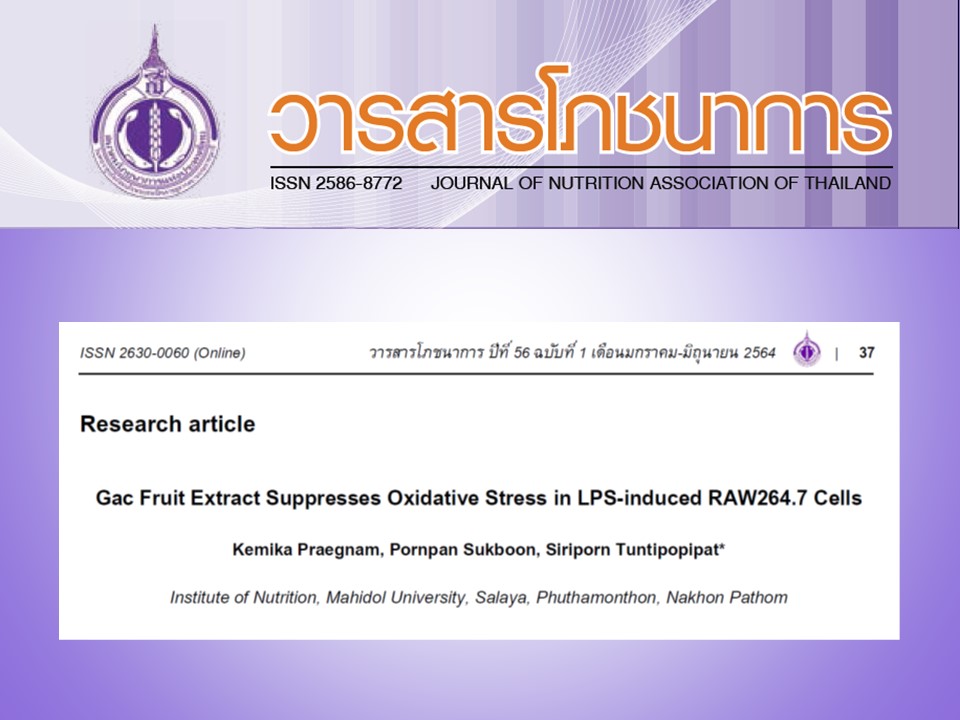
ผลของสารสกัดเอทานอลจากผลฟักข้าวสุกต่อการยับยั้งการเกิดภาวะเครียดออกซิเดชันในเซลล์เม็ดเลือดขาวหนูที่เหนี่ยวนำด้วยไลโปโพลิแซคคาไรด์
คำสำคัญ:
ผลฟักข้าว, เอนไซม์ต้านอนุมูลอิสระ, ภาวะเครียดออกซิเดชันบทคัดย่อ
ผลฟักข้าวสุก (Momordica cochinchinensis) ประกอบด้วยสารออกฤทธิ์ทางชีวภาพที่มีประโยชน์ต่อสุขภาพมากมายหลายชนิดรวมทั้งฤทธิ์ต้านอนุมูลอิสระ ในการศึกษานี้ประเมินประสิทธิภาพการต้านอนุมูลอิสระของสารสกัดจากฟักข้าวสุกด้วยเอทานอลในเซลล์แมคโครฟาจน์ของหนู (RAW 264.7 cell) ซึ่งเหนี่ยวนำให้เกิดภาวะเครียดออกซิเดชันด้วยไลโปโพลิแซคคาไรด์ แยกส่วนที่กินได้คือเนื้อและเยื่อหุ้มเมล็ดของฟักข้าวสุก นำไปปั่นและทำให้แห้งด้วยวิธี lyophilization ชั่งน้ำหนักของผงเนื้อและผงเยื่อหุ้มเมล็ดในอัตราส่วนที่เท่ากันผสมให้เข้ากันซึ่งเรียกส่วนนี้ว่า “ผงฟักข้าว” นำไปสกัดด้วยเอทานอลวิเคราะห์ด้วย HPLC พบว่าสารสกัดประกอบด้วย เบต้าแคโรทีน และ ไลโคปีน 206 และ 231 ไมโครกรัมต่อกรัมน้ำหนักแห้ง ตามลำดับ ใน 1 กรัมของผงฟักข้าวแห้ง มีฟลาโวนอยด์รวมเทียบเท่ากับเควอซิทิน 1.5 มิลลิกรัม และ ฟีนอลิกรวมเทียบเท่ากับกรดแกลลิก 3 มิลลิกรัม เมื่อเหนี่ยวนำเซลล์ RAW 264.7 ด้วยลิโพพอลิแซ็กคาร์ไรด์ (LPS) เซลล์ผลิตอนุมูลอิสระชนิดที่มีออกซิเจนเป็นองค์ประกอบ (ROS) เพิ่มขึ้น อย่างมีนัยสำคัญ (p<0.05) สารสกัดผงฟักข้าวที่ความเข้มข้น 0.5-2.0 มิลลิกรัมต่อมิลลิลิตร ทำให้เซลล์มีการผลิต ROS ลดลงอย่างมีนัยสำคัญ (p<0.05) นอกจากนี้สารสกัดผงฟักข้าวทำให้เซลล์ RAW264.7 ผลิตกลูตาไทโอนเพิ่มขึ้นอย่างมีนัยสำคัญ (p<0.05) และสามารถเพิ่มการทำงานของเอนไซม์ต้านอนุมูลอิสระ ชนิด superoxide dismutase และ catalase ในเซลล์ RAW264.7 ที่เหนี่ยวนำด้วย LPS ผลจากการศึกษาในเซลล์ต้นแบบนี้พบว่าสารสกัดจากผลฟักข้าวสุกมีประสิทธิภาพต้านการเกิดอนุมูลอิสระได้ปานกลาง
เอกสารอ้างอิง
Kubola J, Siriamornpun S. Phytochemicals and antioxidant activity of different fruit fractions (peel, pulp, aril and seed) of Thai gac (Momordica cochinchinensis Spreng). Food Chem. 2011; 127(3):1138-45.
Kubola J, Meeso N, Siriamornpun S. Lycopene and beta carotene concentration in aril oil of gac (Momordica cochinchinensis Spreng) as influenced by aril-drying process and solvents extraction. Food Res Int. 2013; 50(2):664-9.
Le Khac Lam Dien, Nguyen Phuoc Minh, Dong Thi Anh Dao. Investigation different pretreatment methods and ratio of carrier materials to maintain carotenoids in Gac (Momordica Cochinchinensis Spreng) powder in drying process. IJSTR. 2013; 2(12):360-71.
Sukboon P, Tuntipopipat S, Praengam K. Ethanol extract of aril and pulp from Momordica cochinchinensis fruit exhibits antiinflammatory effect in LPS-induced macrophage RAW264.7 cells. Thai J Toxicol. 2019; 34(1):71-90.
Saini RK, Nile SH, Park SW. Carotenoids from fruits and vegetables: Chemistry, analysis, occurrence, bioavailability and biological activities. Food Res Int. 2015; 76:735-50.
Rafi MM, Yadav PN, Reyes M. Lycopene inhibits LPS-Induced proinflammatory mediator inducible nitric oxide synthase in mouse macrophage cells. J Food Sci. 2007; 72(1):S069-S74.
Bai S-K, Lee S-J, Na H-J, Ha K-S, Han J-A, Lee H, et al. -Carotene inhibits inflammatory gene expression in lipopolysaccharide-stimulated macrophages by suppressing redox-based NF-B activation. Exp Mol Med. 2005; 37(4):323-34.
Mengoni ES, Vichera G, Rigano LA, Rodriguez-Puebla ML, Galliano SR, Cafferata EE, et al. Suppression of COX-2, IL-1B and TNF-α expression and leukocyte infiltration in inflamed skin by bioactive compounds from Rosmarinus officinalis L. Fitoterapia. 2011; 82(3):414-21.
Pendyala S, Natarajan V. Redox regulation of Nox proteins. Respir Physiol Neurobiol. 2010; 174(3):265-71.
Thannickal VJ, Fanburg BL. Reactive oxygen species in cell signaling. Am J Physiol Lung Cell Mol Physiol. 2000; 279(6):1005-28.
Dröge W. Free radicals in the physiological control of cell function. Physiol Rev. 2002; 82(1):47-95.
Griffith B, Pendyala S, Hecker L, Lee PJ, Natarajan V, Thannickal VJ. NOX enzymes and pulmonary disease. Antioxid Redox signal. 2009; 11(10):2505-16.
Richardson A, Schadt E. The role of macromolecular damage in aging and age-related dsease. J Gerontol A Bio Sci Med Sci. 2014; 69 Suppl 1:S28-32.
Mittal M, Siddiqui MR, Tran K, Reddy SP, Malik AB. Reactive oxygen species in inflammation and tissue injury. Antioxid Redox signal. 2014; 20(7):1126-67.
Edge R, McGarvey DJ, Truscott TG. The carotenoids as anti-oxidants - a review. J Photochem Photobiol B Biol. 1997; 41(3):189-200.
Kaurinovic B, Vastag G. Flavonoids and phenolic acids as potential natural antioxidants. 2019. doi/10.5772/intechopen. 83731.
Rafat Husain S, Cillard J, Cillard P. Hydroxyl radical scavenging activity of flavonoids. Phytochemistry. 1987; 26(9):2489-91.
Robak J, Gryglewski RJ. Flavonoids are scavengers of superoxide anions. Biochem Pharmacol. 1988; 37(5):837-41.
Jan-on G, Pakdeechote P, Kukongviriyapan V, Kongsaktrakoon B, Boonla O, Kukongviriyapan U. Alleviation of hypertension and oxidative stress by Momordica cochinchinensis aril extract in rats with nitric oxide deficiency. Srinagarind Med J. 2015; 30(3):229-35.
Failla ML, Chitchumroonchokchai C, Ishida BK. In vitro micellarization and intestinal cell uptake of cis isomers of lycopene exceed those of all-trans lycopene. J Nutr. 2008; 138(3):482-6.
Ainsworth EA, Gillespie KM. Estimation of total phenolic content and other oxidation substrates in plant tissues using Folin–Ciocalteu reagent. Nat Protocol. 2007; 2(4):875-7.
Bag GC, Devi Grihanjali P, Bhaigyabati T. Assessment of total flavonoid content and antioxidant activity of methanolic rhizome extract of three Hedychium species of Manipur valley. Int J Pharm Sci Rev Res. 2015; 30(1):154-9.
Vichai V, Kirtikara K. Sulforhodamine B colorimetric assay for cytotoxicity screening. Nat Protocol. 2006; 1(3):1112-6.
Zhang S, Wang P, Zhao P, Wang D, Zhang Y, Wang J, et al. Pretreatment of ferulic acid attenuates inflammation and oxidative stress in a rat model of lipopolysaccharide-induced acute respiratory distress syndrome. Int J Immunopathol Pharmacol. 2018; 32: 394632017750518.
Saokosol Y, Praengam K, Sukprasansap M, Tuntipopipat S. Antioxidant potential of ethanol extract from orange fleshed sweet potato (Ipomoea batatas) in murine macrophage RAW264.7 cell line. J Nutr Assoc Thailand. 2019; 54(1):37-54.
Rahman I, Kode A, Biswas SK. Assay for quantitative determination of glutathione and glutathione disulfide levels using enzymatic recycling method. Nat Protocol. 2006; 1(6):3159-65.
Vandeputte C, Guizon I, Genestie-Denis I, Vannier B, Lorenzon G. A microtiter plate assay for total glutathione and glutathione disulfide contents in cultured/isolated cells: performance study of a new miniaturized protocol. Cell Biol Toxicol. 1994; 10(5-6):415-21.
Pinthong S, Kunchit J, Tangsuphoom N, Jittinandana S and and Nakngamanong Y. Effect of different drying processes on physical properties and carotenoid content of Gac fruit (Momordica cochinchinensis Spreng). J Food Sci Agr Tech. 2019; 5:61-70.
Kubola J, Meeso N and Siriamornpun S. Lycopene and beta carotene concentration in aril oil of gac (Momordica cochinchinensis Spreng) as influenced by aril-drying process and solvents extraction. Food Res Int. 2013; 50(2);664-669.
Abdulqader A, Ali F, Ismail A, Esa N. Antioxidant compounds and capacities of Gac (Momordica cochinchinensis Spreng) fruits. Asian Pac J of Trop Biomed. 2019; 9(4):158-67.
Khan M, Qurashi N, Khan M, Jabeen F, Umar A, Yaqoob J, et al. Generation of reactive oxygen species and their impact on the health related parameters: A critical review. Int J Biosci. 2016; 9:303-23.
Halliwell B, Gutteridge JMC. Role of free radicals and catalytic metal ions in human disease: An overview. Methods Enzymol. 1990; 186:1-85.
Bai S-K, Lee S-J, Na H-J, Ha K-S, Han J-A, Lee H, et al. Beta-Carotene inhibits inflammatory gene expression in lipopolysaccharide-stimulated macrophages by suppressing redox-based NF-kappa-B activation. Exp Mol Med. 2005; 37:323-34.
Zou J, Feng D, Ling WH, Duan RD. Lycopene suppresses proinflammatory response in lipopolysaccharide-stimulated macrophages by inhibiting ROS-induced trafficking of TLR4 to lipid raft-like domains. J Nutr Biochem. 2013; 24(6):1117-22.
Manuja R, Sachdeva S, Jain A, Chaudhary J. A Comprehensive review on biological activities of p-hydroxy benzoic acid and its derivatives. Int J Pharm Sci Rev Res. 2013; 22(2):109-15.
Bouzaiene N, Jaziri S, Kovacic H, Chekir-Ghedira L, Luis J. The effects of caffeic, coumaric and ferulic acids on proliferation, superoxide production, adhesion and migration of human tumor cells in vitro. Eur J Pharmacol. 2015; 766:99-105.
Semwal D, Semwal R, Combrinck S, Viljoen A. Myricetin: A Dietary Molecule with Diverse Biological Activities. Nutrients. 2016; 8(90):1-31.
Ali F, Rahul, Naz F, Jyoti S, Siddique Y. Health Functionality of Apigenin: A Review. Int J Food Prop. 2017; 20(6):1197-238.
Lin W-T, Huang C-C, Lin T-J, Chen J, Shieh M-J, Peng H-C, et al. Effects of B-carotene on antioxidant status in rats with chronic alcohol consumption. Cell Biochem Funct. 2009; 27:344-50.
Joe B, Lokesh BR. Studies on the inactivation of superoxide dismutase activity by nitric oxide from rat peritoneal macrophages. Mol Cell Biochem. 1997; 168(1):87-93.
Dai C, Tang S, Deng S, Zhang S, Zhou Y, Velkov T, et al. Lycopene attenuates colistin-induced nephrotoxicity in mice via activation of the Nrf2/HO-1 pathway. Antimicrob Agents Chemother. 2015; 59(1):579.
Morakinyo F, Bolanle I, Oyelowo O, Nnaji J. Anti-oxidative and hepatoprotective effect of beta-carotene on acetaminophen-induced liver damage in rats. Biol Med. 2012; 4(3):134-40.
Hosseini F, Naseri MKG, Badavi M, Ghaffari MA, Shahbazian H, Rashidi I. Effect of beta carotene on lipid peroxidation and antioxidant status following renal ischemia/reperfusion injury in rat. Scand J Clin Lab Invest. 2010; 70(4):259-63.
Sheik Abdulazeez S, Thiruvengadam D. Effect of lycopene on oxidative stress induced during d-galactosamine/ lipopolysaccharide-sensitized liver injury in rats. Pharmaceut Biol. 2013; 51(12):1592-9.
Bose KSC, Agrawal BK. Effect of lycopene from tomatoes (cooked) on plasma antioxidant enzymes, lipid peroxidation rate and lipid profile in grade-I hypertension. Ann Nutr Metab. 2007; 51(5):477-81.
Bose KS, Agrawal BK. Effect of lycopene from cooked tomatoes on serum antioxidant enzymes, lipid peroxidation rate and lipid profile in coronary heart disease. Singapore Med J. 2007; 48(5):415-20.
ดาวน์โหลด
เผยแพร่แล้ว
รูปแบบการอ้างอิง
ฉบับ
ประเภทบทความ
สัญญาอนุญาต
บทความที่เผยแพร่ในวารสารโภชนาการ เป็นลิขสิทธิ์ของสมาคมโภชนาการแห่งประเทศไทยฯ

