
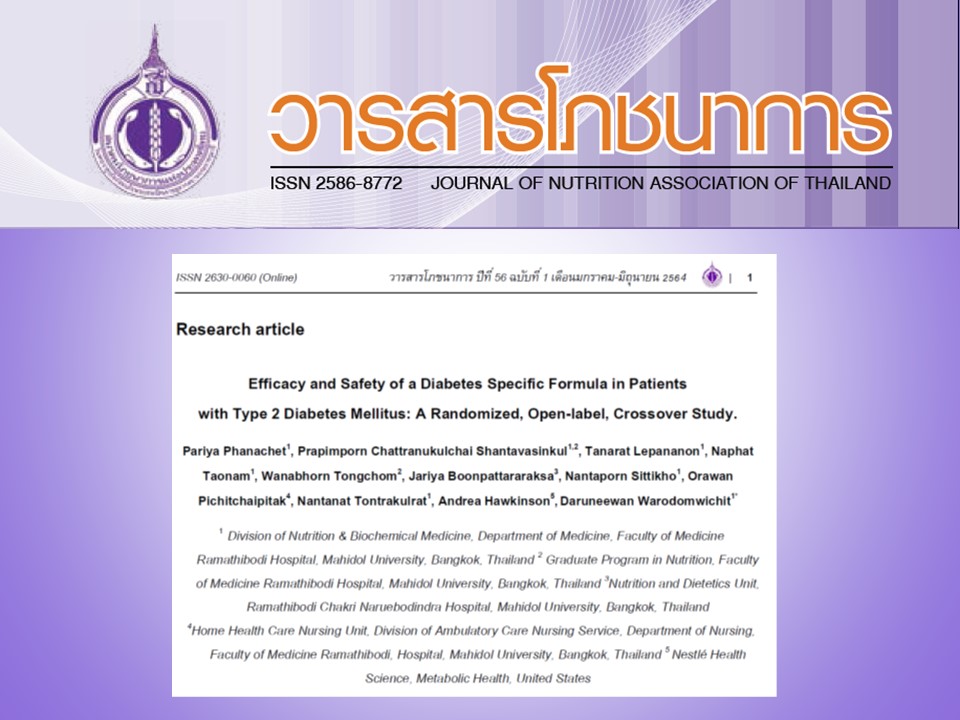
ประสิทธิผลและความปลอดภัยของอาหารสูตรเบาหวาน ในผู้ป่วยเบาหวานชนิดที่ 2 การศึกษาแบบสองระยะไขว้กัน แบบสุ่ม
คำสำคัญ:
ภาวะน้ำตาลในเลือดหลังอาหาร, โรคเบาหวาน, อาหารสูตรเบาหวาน, อินซูลิน, ดัชนีน้ำตาลบทคัดย่อ
ภาวะน้ำตาลในเลือดหลังอาหารสูงในผู้ป่วยเบาหวานชนิดที่ 2 เป็นปัญหาที่พบได้บ่อย แต่ข้อมูลเรื่องผลของการให้อาหารสูตรเบาหวานเทียบกับอาหารปกติที่ให้พลังงานเท่ากันต่อระดับน้ำตาลในเลือดหลังอาหารยังมีน้อย วัตถุประสงค์ของการศึกษานี้เพื่อศึกษาผลของอาหารทางการแพทย์สูตรเบาหวานเปรียบเทียบกับอาหารปกติที่ให้พลังงานเท่ากันต่อระดับน้ำตาลและอินซูลินในเลือดหลังอาหารรวมถึงศึกษาเรื่องความปลอดภัยในผู้ป่วยเบาหวานชนิดที่ 2 การศึกษานี้เป็นการศึกษาแบบสองระยะไขว้กัน มีผู้เข้าร่วมงานวิจัยจำนวน 30 คนซึ่งจะได้รับการสุ่มให้อยู่กลุ่ม A หรือ B โดยระยะแรก กลุ่ม A ได้รับอาหารทางการแพทย์ Nutren Diabetes และ กลุ่ม B ได้รับอาหารที่ให้พลังงานเท่ากัน หลังจากนั้น 1 สัปดาห์ ผู้เข้าร่วมงานวิจัยทั้ง 2 กลุ่มจะได้รับอาหารสลับชนิดกัน โดยทั้งสองระยะผู้เข้าร่วมงานวิจัยจะได้รับการตรวจ เลือดเพื่อวัดระดับน้ำตาลและอินซูลินในเลือดภายหลังรับประทานอาหารแต่ละชนิดที่เวลา 0, 30, 60 และ 120 นาที ผลการศึกษาพบว่าระดับน้ำตาลในเลือดหลังอาหาร และการเพิ่มขึ้นของพื้นที่ใต้กราฟของน้ำตาลของกลุ่ม A ต่ำกว่ากลุ่ม B อย่างมีนัยสำคัญ (P=0.007) ระดับอินซูลินในเลือดหลังอาหารที่เวลา 60 และ120 นาทีในกลุ่ม A มีแนวโน้มต่ำกว่ากลุ่ม B การศึกษานี้ไม่พบผลข้างเคียงรุนแรงจากการใช้อาหารทางการแพทย์สูตรเบาหวาน การศึกษานี้แสดงให้เห็นว่าการให้อาหารทางการแพทย์สูตรเบาหวานช่วยลดระดับน้ำตาลในเลือดหลังอาหารและเพิ่มการตอบสนองการทำงานของอินซูลินเมื่อเปรียบเทียบกับอาหารปกติที่พลังงานเท่ากัน การให้อาหารทางการแพทย์สูตรเบาหวานควรเป็นส่วนหนึ่งในการให้โภชนบำบัดในผู้ป่วยเบาหวานชนิดที่ 2
เอกสารอ้างอิง
International Diabetes Federation, 2017 [Internet]. IDF Diabetes Atlas, 8th edn. 2017 [Cited 10 April 2019]. Available from: https://www.diabetesatlas.org/upload/resources/previous/files/8/IDF_DA_8e-EN-final.pdf
Aekplakorn W, Chariyalertsak S, Kessomboon P, Assanangkornchai S, Taneepanichskul S, Putwatana P. Prevalence of Diabetes and Relationship with Socioeconomic Status in the Thai Population: National Health Examination Survey, 2004-2014. J Diabetes Res. 2018; 2018:1654530.
Strategy and Planning Division Ministry of Public Health [Internet]. Nonthaburi: Statistical Thailand 2017; 2017 [cited 2021 Feb 4]. Available from: http://www.hed.go.th/menuHome/file/529
Monnier L, Lapinski H, Colette C. Contributions of fasting and postprandial plasma glucose increments to the overall diurnal hyperglycemia of type 2 diabetic patients: variations with increasing levels of HbA(1c). Diabetes Care. 2003; 26(3):881-5.
Jenkins DJ, Wolever TM, Taylor RH, Barker H, Fielden H, Baldwin JM, et al. Glycemic index of foods: a physiological basis for carbohydrate exchange. Am J Clin Nutr. 1981; 34(3):362-6.
Lina BA, Jonker D, Kozianowski G. Isomaltulose (Palatinose): a review of biological and toxicological studies. Food Chem Toxicol. 2002; 40(10):1375-81.
Atkinson FS, Foster-Powell K, Brand-Miller JC. International tables of glycemic index and glycemic load values: 2008. Diabetes Care. 2008; 31(12):2281-3.
Wang Y, Chen J, Song YH, Zhao R, Xia L, Chen Y, et al. Effects of the resistant starch on glucose, insulin, insulin resistance, and lipid parameters in overweight or obese adults: a systematic review and meta-analysis. Nutr Diabetes. 2019; 9(1):19.
Ojo O, Ojo OO, Adebowale F, Wang XH. The Effect of Dietary Glycaemic Index on Glycaemia in Patients with Type 2 Diabetes: A Systematic Review and Meta-Analysis of Randomized Controlled Trials. Nutrients. 2018; 10(3):373.
Lifestyle Management: Standards of Medical Care in Diabetes-2019. Diabetes Care. 2019; 42(Suppl 1):S46-S60.
Elia M, Ceriello A, Laube H, Sinclair AJ, Engfer M, Stratton RJ. Enteral nutritional support and use of diabetes-specific formulas for patients with diabetes: a systematic review and meta-analysis. Diabetes Care. 2005; 28(9):2267-79.
Ojo O, Brooke J. Evaluation of the role of enteral nutrition in managing patients with diabetes: a systematic review. Nutrients. 2014; 6(11):5142-52.
Ojo O, Weldon SM, Thompson T, Crockett R, Wang XH. The Effect of Diabetes-Specific Enteral Nutrition Formula on Cardiometabolic Parameters in Patients with Type 2 Diabetes: A Systematic Review and Meta-Analysis of Randomised Controlled Trials. Nutrients. 2019; 11(8):1905.
Su HY, Tsang MW, Huang SY, Mechanick JI, Sheu WH, Marchetti A. Transculturalization of a diabetes-specific nutrition algorithm: Asian application. Curr Diab Rep. 2012; 12(2):213-9.
Mechanick JI, Marchetti AE, Apovian C, Benchimol AK, Bisschop PH, Bolio-Galvis A, et al. Diabetes-specific nutrition algorithm: a transcultural program to optimize diabetes and prediabetes care. Curr Diab Rep. 2012; 12(2):180-94.
Parillo M, Rivellese AA, Ciardullo AV, Capaldo B, Giacco A, Genovese S, et al. A high-monounsaturated-fat/low-carbohydrate diet improves peripheral insulin sensitivity in non-insulin-dependent diabetic patients. Metabolism. 1992; 41(12):1373-8.
Paniagua JA, de la Sacristana AG, Sanchez E, Romero I, Vidal-Puig A, Berral FJ, et al. A MUFA-rich diet improves posprandial glucose, lipid and GLP-1 responses in insulin-resistant subjects. J Am Coll Nutr. 2007; 26(5):434-44.
Kris-Etherton PM, Pearson TA, Wan Y, Hargrove RL, Moriarty K, Fishell V, et al. High-monounsaturated fatty acid diets lower both plasma cholesterol and triacylglycerol concentrations. Am J Clin Nutr. 1999; 70(6):1009-15.
Garg A, Bonanome A, Grundy SM, Zhang ZJ, Unger RH. Comparison of a high-carbohydrate diet with a high-monounsaturated-fat diet in patients with non-insulin-dependent diabetes mellitus. N Engl J Med. 1988; 319(13):829-34.
Cavalot F, Petrelli A, Traversa M, Bonomo K, Fiora E, Conti M, et al. Postprandial blood glucose is a stronger predictor of cardiovascular events than fasting blood glucose in type 2 diabetes mellitus, particularly in women: lessons from the San Luigi Gonzaga Diabetes Study. J Clin Endocrinol Metab. 2006; 91(3):813-9.
Hanefeld M, Fischer S, Julius U, Schulze J, Schwanebeck U, Schmechel H, et al. Risk factors for myocardial infarction and death in newly detected NIDDM: the Diabetes Intervention Study, 11-year follow-up. Diabetologia. 1996; 39(12):1577-83.
Gerich JE. Clinical significance, pathogenesis, and management of postprandial hyperglycemia. Arch Intern Med. 2003; 163(11):1306-16.
de Vegt F, Dekker JM, Ruhe HG, Stehouwer CD, Nijpels G, Bouter LM, et al. Hyperglycaemia is associated with all-cause and cardiovascular mortality in the Hoorn population: the Hoorn Study. Diabetologia. 1999; 42(8):926-31.
Garcia-Rodriguez, Mesa MD, Olza J, G Buccianti G, Pérez M, Moreno-Torres R, et al. Postprandial glucose, insulin and gastrointestinal hormones in healthy and diabetic subjects fed a fructose-free and resistant starch type IV-enriched enteral formula. Eur J Nutr. 2013; 52(6):1569-78.
Tsang MW. The management of type 2 diabetic patients with hypoglycaemic agents. ISRN Endocrinol. 2012; 2012: 478120.
ดาวน์โหลด
เผยแพร่แล้ว
เวอร์ชัน
- 08/08/2022 (2)
- 04/06/2021 (1)
รูปแบบการอ้างอิง
ฉบับ
ประเภทบทความ
สัญญาอนุญาต
บทความที่เผยแพร่ในวารสารโภชนาการ เป็นลิขสิทธิ์ของสมาคมโภชนาการแห่งประเทศไทยฯ

