
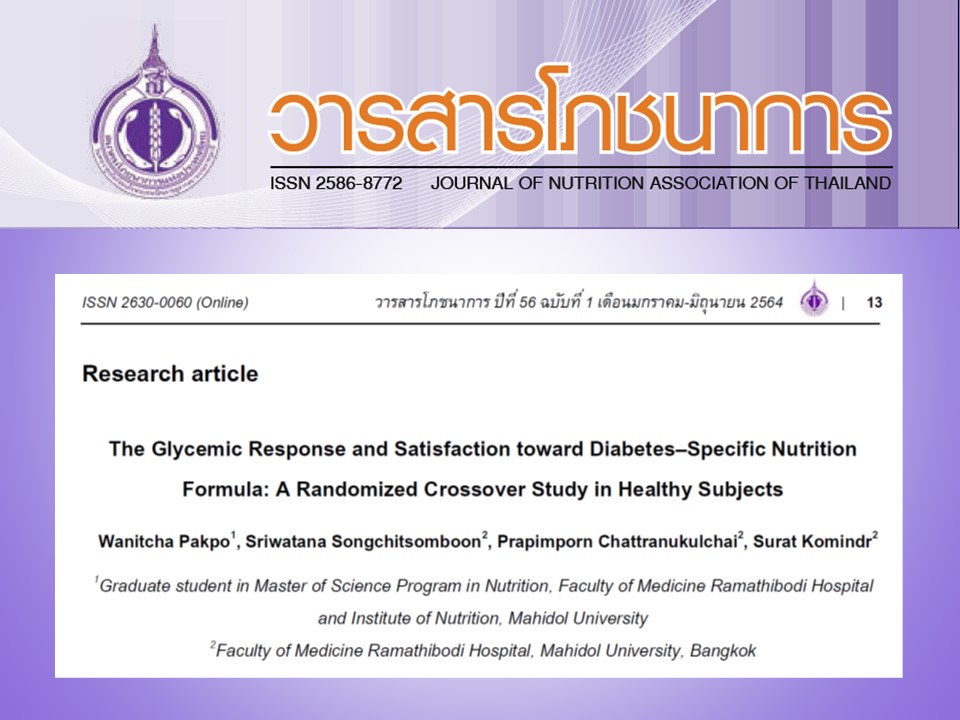
การตอบสนองของระดับน้ำตาลในเลือด และความพึงพอใจต่ออาหารทางการแพทย์ สำหรับผู้ป่วยเบาหวาน: การศึกษาแบบสุ่มสลับไขว้ในคนปกติ
คำสำคัญ:
การประเมินความพึงพอใจ, ค่าดัชนีน้ำตาล, อาหารทางการแพทย์สำหรับผู้ป่วยเบาหวานบทคัดย่อ
งานวิจัยนี้เป็นการใช้ maltodextrin และ resistance maltodextrin ที่ผลิตจากมันสำปะหลังที่ปลูกในประเทศไทยเป็นส่วนผสมหลักของคาร์โบไฮเดรตในอาหารทางการแพทย์สำหรับผู้ป่วยเบาหวานชื่อว่า อาหารเบาหวานสูตร 1 ผลิตด้วยนวัตกรรมใหม่ของคนไทย การศึกษาครั้งนี้มีวัตถุประสงค์เพื่อวิเคราะห์ค่าดัชนีน้ำตาล และความพึงพอใจของผู้บริโภคต่ออาหารเบาหวานสูตร 1 ในอาสาสมัครสุขภาพดี 12 คนโดยศึกษาแบบสุ่มสลับไขว้ อาสาสมัครดื่มอาหารเบาหวานสูตร 1 และสารละลายกลูโคส (สารละลายอ้างอิง) โดยมีคาร์โบไฮเดรต 50 กรัมเท่ากัน หลังบริโภคทำการเก็บตัวอย่างเลือดเป็นระยะตลอด 2 ชั่วโมง และประเมินความพึงพอใจต่ออาหารเบาหวานสูตร 1 ด้วยแบบทดสอบ Visual Analog Scale ผลการศึกษาพบว่า ระดับน้ำตาลในเลือดหลังดื่มอาหารเบาหวานสูตร 1 เพิ่มสูงขึ้นจากระดับน้ำตาลขณะอดอาหารแต่ต่ำกว่าของสารละลายกลูโคสอย่างมีนัยสำคัญตั้งแต่นาทีที่ 15 ถึงนาทีที่ 90 โดยมีพื้นที่ใต้กราฟที่เพิ่มขึ้นของระดับน้ำตาลในเลือดต่ำกว่าสารละลายกลูโคสอย่างมีนัยสำคัญ ผลการศึกษาทางคลินิกพบว่า อาหารเบาหวานสูตร 1 มีค่าดัชนีน้ำตาลต่ำเท่ากับ 16.5 ± 2.4 สำหรับคะแนนความพึงพอใจ แม้ว่าทุกด้านจะมีคะแนนผ่านเกณฑ์ (> 50) แต่มีกลุ่มตัวอย่างบางคนให้คะแนนระดับต่ำต่อรสชาติ รสชาติคงค้างในลำคอ และความอร่อย ซึ่งเป็นปัจจัยสำคัญ ดังนั้นจึงต้องพัฒนาอาหารเบาหวานสูตร 1 ต่อไปเพื่อให้ได้รับการยอมรับจากผู้บริโภคมากที่สุด
เอกสารอ้างอิง
FAO/WHO. Carbohydrates in human nutrition. Chapter 4 - The role of the glycemic index in food choice. FAO Food and Nutrition Paper - 66. 1998.
American Diabetes Association. Prevention or delay of type 2 diabetes: standards of medical care in diabetes. Diabetes Care 2018; 41:51-4.
Thomas D, Elliott EJ. Low glycaemic index, or low glycaemic load, diets for diabetes mellitus. Cochrane Database Syst Rev 2009; 2009(1):CD006296.
Wheeler ML, Dunbar SA, Jaacks LM, Karmally W, Mayer-Davis EJ, Wylie-Rosett J, et al. Macronutrients, food groups, and eating patterns in the management of diabetes: a systematic review of the literature, 2010. Diabetes Care. 2012; 35(2):434-45.
Eleazu CO. The concept of low glycemic index and glycemic load foods as panacea for type 2 diabetes mellitus; prospects, challenges and solutions. Afr J Health Sci 2016; 16(2):468-79.
Komindr S, Ingsriswang S, Lerdvuthisopon N, Boontawee A. Effect of long-term intake of Asian food with different glycemic indices on diabetic control and protein conservation in type 2 diabetic patients. J Med Assoc Thai 2001; 84(1):85-97.
Group UPDS. Effect of intensive blood-glucose control with metformin on complications in overweight patients with type 2 diabetes (UKPDS 34). Lancet 1998; 352(9131):854-65.
McMillan-Price J, Brand-Miller J. Low-glycaemic index diets and body weight regulation. Int J Obes 2006; 30:S40.
Nathan DM. Diabetes Control and Complications Trial/Epidemiology of Diabetes Interventions and Complications (DCCT/EDIC) Study Research Group: Intensive diabetes treatment and cardiovascular disease in patients with type 1 diabetes. N Engl J Med 2005; 353:2643-53.
Hise ME, Fuhrman MP. The effect of diabetes-specific enteral formulae on clinical and glycemic indicators. Prac Gastroenterology. 2009; 74:20-36.
Elia M, Ceriello A, Laube H, Sinclair AJ, Engfer M, Stratton RJ. Enteral nutritional support and use of diabetes-specific formulas for patients with diabetes: a systematic review and meta-analysis. Diabetes Care 2005; 28(9):2267-79.
Raben A. Should obese patients be counselled to follow a low‐glycaemic index diet? No. Obes Rev 2002; 3(4):245-56.
Flint A, Raben A, Blundell J, Astrup A. Reproducibility, power and validity of visual analogue scales in assessment of appetite sensations in single test meal studies. Int J Obes 2000; 24(1):38.
Shmueli A. The visual analog rating scale of health-related quality of life: an examination of end-digit preferences. Health Qual Life Outcome 2005; 3:71.
Brennan C, Tudorica C. The role of complex carbohydrates and non-starch polysaccharides in the regulation of postprandial glucose and insulin responses in cereal foods. J Nutraceuticals, Functional & Medical Foods 2002; 4:49-55.
Gourineni V, Stewart ML, Skorge R, Wolever T. Glycemic index of slowly digestible carbohydrate alone and in powdered drink-mix. Nutrients 2019; 11(6):1228.
Ojo O, Ojo OO, Adebowale F, Wang XH. The effect of dietary glycaemic index on glycaemia in patients with type 2 diabetes: a systematic review and meta-analysis of randomized controlled trials. Nutrients 2018; 10(3);373.
Institute of Food Technologists (IFT). Guidelines for the preparation and review of papers reporting sensory evaluation data. Sensory Evaluation Division, Institute of Food Technologists. 2019.
ดาวน์โหลด
เผยแพร่แล้ว
รูปแบบการอ้างอิง
ฉบับ
ประเภทบทความ
สัญญาอนุญาต
บทความที่เผยแพร่ในวารสารโภชนาการ เป็นลิขสิทธิ์ของสมาคมโภชนาการแห่งประเทศไทยฯ

