
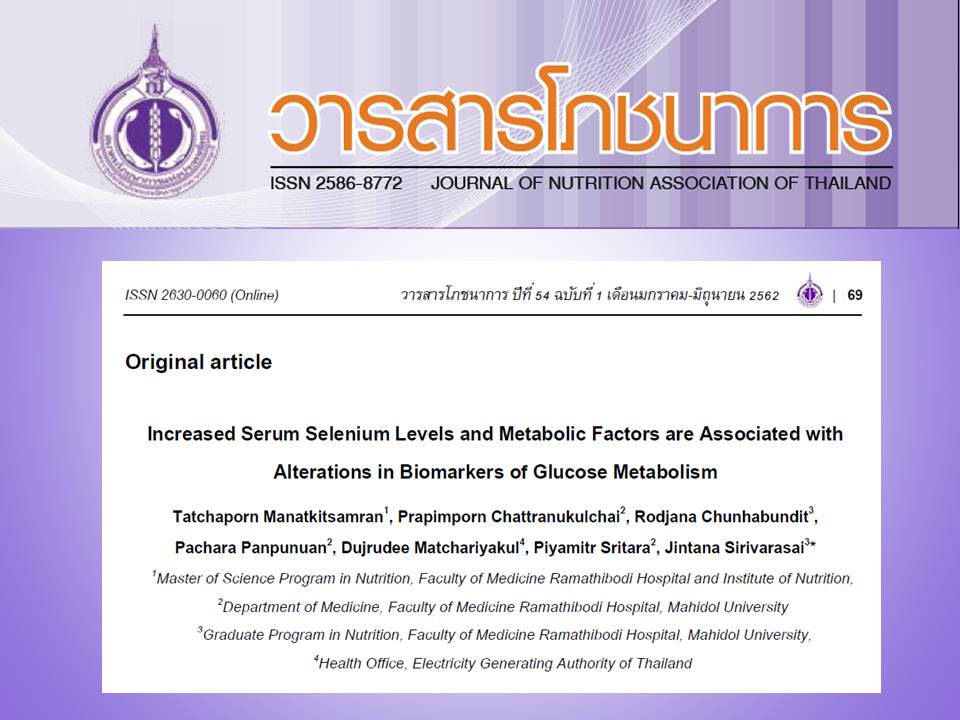
การเพิ่มขึ้นของระดับซีลีเนียมในเลือดและปัจจัยด้านเมแทบอลิค มีความสัมพันธ์กับการเปลี่ยนแปลงของตัวชี้วัดทางชีวภาพของ Glucose metabolism
คำสำคัญ:
ระดับซีลีเนียมในเลือด, โรคเบาหวานชนิดที่ 2บทคัดย่อ
ซีลีเนียม เป็นหนึ่งในกลุ่มแร่ธาตุปริมาณเล็กน้อยที่มีความจำเป็นต่อร่างกาย และมีรายงานความสัมพันธ์กับพยาธิสภาพของการเกิดโรคเบาหวานชนิดที่ 2 โดยเกี่ยวข้องกับกลไกการเกิดภาวะเครียดออกซิเดชันและการอักเสบ ดังนั้นวัตถุประสงค์ของการศึกษาครั้งนี้คือเพื่อศึกษาระดับซีลิเนียมในเลือด และปัจจัยต่างๆที่มีผลต่อระดับซีลิเนียมในเลือด รวมถึงศึกษาความสัมพันธ์ระหว่างซิลิเนียมในเลือดกับ fasting blood glucose, และ HbA1c ในเลือดที่มีผลต่อภาวะเสี่ยงต่อการเกิดโรคเบาหวาน ในกลุ่มศึกษาจำนวน 890 คน (อายุ 50-75 ปี) จากโครงการวิจัยระยะยาวที่เก็บข้อมูลทั่วไปและผลทางชีวเคมีในปี คศ. 2013 การวัดระดับของซีลีเนียมในเลือดโดยใช้เครื่องมือ ICP-MS ผลการศึกษาพบว่าปัจจัยเรื่องการสูบบุหรี่ การดื่มแอลกอฮอล์และรูปแบบการบริโภคอาหารไม่มีผลต่อระดับซิลีเนียมในเลือด การวิเคราะห์ทางสถิติโดยแบ่งเป็น 3 กลุ่มโดยใช้ระดับของ HbA1c พบว่ากลุ่มที่มีระดับ HbA1c ปกติ (<5.7%) ที่มีและไม่มีภาวะร่วมของของกลุ่มอาการเมตาบอลิค มีค่าเฉลี่ยระดับของซีลีเนียมในเลือด(124.3±14.3 µg/L และ 129.1±17.6 µg/L, ตามลำดับ) ต่ำกว่ากลุ่มเสี่ยงต่อการเกิดโรคเบาหวานชนิดที่ 2 ที่มีระดับ HbA1c ≥5.7% (132.2±17.1 µg/L) อย่างมีนัยสำคัญทางสถิติ นอกจากนี้พบว่าค่าเฉลี่ยของ SBP, DBP, triglyceride, total cholesterol และ LDL-cholesterol ของทั้ง 3 กลุ่มมีความแตกต่างกันอย่างมีนัยสำคัญ นอกจากนี้กลุ่มศึกษาที่มีระดับซีลิเนียมในเลือดอยู่ในช่วงของ third tertile มีความเสี่ยงต่อการเกิดโรคเบาหวานชนิดที่ 2 (ประเมินจากการเพิ่มขึ้นของระดับ FBG และ HbA1c) มากกว่ากลุ่มที่อยู่ในช่วง first tertile โดยสรุปจากงานวิจัยนี้พบว่าระดบซิลีเนียมในเลือดมีความสัมพันธ์กับความเสี่ยงต่อการเกิดโรคเบาหวาน การให้อาหารเสริมที่มีซิลีเนียมอาจนำไปสู่การเพิ่มขึ้นของซิลีเนียมในร่างกาย ที่อาจมีความเสี่ยงเสี่ยงต่อโรคเบาหวานชนิดที่ 2 รวมถึงกลไกระดับโมเลกุลที่เกี่ยวข้องกับซิลีเนียมกับโรคดังกล่าว ควรจะได้รับการศึกษาต่อไป
เอกสารอ้างอิง
2. Kieliszek MandBłażejak S. Current Knowledge on the Importance of Selenium in Food for Living Organisms: A Review. Molecules. 2016; 21(5): 609.
3. Thomson C. Assessment of requirements for selenium and adequacy of selenium status: a review. European journal of clinical nutrition. 2004; 58(3): 391-402.
4. Zhou J, Huang KandLei XG. Selenium and diabetes - evidence from animal studies. Free radical biology & medicine. 2013;65:10.1016/j.freeradbiomed.2013.07.012.
5. Wei J, Zeng C, Gong QY, Yang HB, Li XX, Lei GH, et al. The association between dietary selenium intake and diabetes: a cross-sectional study among middle-aged and older adults. Nutr J. 2015; 14: 18.
6. Wang X-l, Yang T-b, Wei J, Lei G-handZeng C. Association between serum selenium level and type 2 diabetes mellitus: a non-linear dose–response meta-analysis of observational studies. Nutrition Journal. 2016;15(1): 48.
7. Bleys J, Navas-Acien AandGuallar E. Serum selenium and diabetes in U.S. adults. Diabetes Care. 2007; 30(4): 829-34.
8. Laclaustra M, Navas-Acien A, Stranges S, Ordovas JMandGuallar E. Serum selenium concentrations and diabetes in U.S. adults: National Health and Nutrition Examination Survey (NHANES) 2003-2004. Environ Health Perspect. 2009; 117(9): 1409-13.
9. Stranges S, Galletti F, Farinaro E, D'Elia L, Russo O, Iacone R, et al. Associations of selenium status with cardiometabolic risk factors: an 8-year follow-up analysis of the Olivetti Heart study. Atherosclerosis. 2011; 217(1):274-8.
10. Flores CR, Puga MP, Wrobel K, Garay Sevilla MEandWrobel K. Trace elements status in diabetes mellitus type 2: possible role of the interaction between molybdenum and copper in the progress of typical complications. Diabetes Res Clin Pract. 2011; 91(3): 333-41.
11. Kornhauser C, Garcia-Ramirez JR, Wrobel K, Pérez-Luque E-L, Garay-Sevilla MEandWrobel K. Serum selenium and glutathione peroxidase concentrations in type 2 diabetes mellitus patients. Primary Care Diabetes. 2008; 2(2): 81-5.
12. Whiting PH, Kalansooriya A, Holbrook I, Haddad FandJennings PE. The relationship between chronic glycaemic control and oxidative stress in type 2 diabetes mellitus. Br J Biomed Sci. 2008; 65(2): 71-4.
13. Zhao C, Wang H, Zhang JandFeng L. [Correlations of trace elements, glucose and body compositions in type 2 diabetics]. Wei Sheng Yan Jiu. 2008; 37(5): 600-1, 5.
14. Thomas B, Ramesh A, Suresh SandPrasad BR. A comparative evaluation of antioxidant enzymes and selenium in the serum of periodontitis patients with diabetes mellitus type 2. Contemp Clin Dent. 2013; 4(2): 176-80.
15. ADA. Standards of Medical Care in Diabetesd. Diabetes Care. CLINICAL AND APPLIED RESEARCH AND EDUCATION. 2016; 39(supplement),: S14-S6.
16. Singh PP, Mahadi F, Roy AandSharma P. Reactive oxygen species, reactive nitrogen species and antioxidants in etiopathogenesis of diabetes mellitus type-2. Indian journal of clinical biochemistry: IJCB. 2009; 24(4): 324-42.
17. Stapleton SR. Selenium: an insulin-mimetic. Cell Mol Life Sci. 2000; 57(13-14): 1874-9.
18. Wang XD, Vatamaniuk MZ, Wang SK, Roneker CA, Simmons RAandLei XG. Molecular mechanisms for hyperinsulinae mia induced by overproduction of selenium-dependent glutathione peroxida se-1 in mice. Diabetologia. 2008; 51(8): 1515-24.
19. Ogawa-Wong AN, Berry MJandSeale LA. Selenium and Metabolic Disorders: An Emphasis on Type 2 Diabetes Risk. Nutrients. 2016; 8(2): 80.
20. Wang X, Zhang W, Chen H, Liao N, Wang Z, Zhang X, et al. High selenium impairs hepatic insulin sensitivity through opposite regulation of ROS. Toxicol Lett. 2014; 224(1): 16-23.
21. Singhatas P SA, Sumritpradit P, Thampongsa T, Krutsri C, Lertsithichai P. Prospective Cohort Study of Serum Selenium in Surgical ICU Patients. J Med Assoc Thai. 2017; 100: 59.
22. Letsiou S, Nomikos T, Panagiotakos D, Pergantis SA, Fragopoulou E, Antonopoulou S, et al. Serum total selenium status in Greek adults and its relation to age. The ATTICA study cohort. Biol Trace Elem Res. 2009; 128(1): 8-17.
23. Luty-Frackiewicz A, Jethon ZandJanuszew ska L. Effect of smoking and alcohol consumption on the serum selenium level of Lower Silesian population. Sci Total Environ. 2002; 285(1-3): 89-95.
24. Chiba MandMasironi R. Toxic and trace elements in tobacco and tobacco smoke. Bull World Health Organ. 1992; 70(2): 269-75.
25. Rossi G. [Diagnosis and classification of diabetes mellitus]. Recenti Prog Med. 2010; 101(7-8): 274-6.
26. Aekplakorn W, Chariyalertsak S, Kessomboon P, Sangthong R, Inthawong R, Putwatana P, et al. Prevalence and management of diabetes and metabolic risk factors in Thai adults: the Thai National Health Examination Survey IV, 2009. Diabetes Care. 2011; 34(9): 1980-5.
27. Aekplakorn W, Chariyalertsak S, Kessom boon P, Assanangkornchai S, Taneepa nichskul SandPutwatana P. Prevalence of Diabetes and Relationship with Socioeconomic Status in the Thai Population: National Health Examination Survey, 2004-2014. J Diabetes Res. 2018; 2018: 1654530.
28. Wan Nazaimoon WM, Md Isa SH, Wan Mohamad WB, Khir AS, Kamaruddin NA, Kamarul IM, et al. Prevalence of diabetes in Malaysia and usefulness of HbA1c as a diagnostic criterion. Diabet Med. 2013; 30(7): 825-8.
29. Disease Burden. Diabetes Prevalence in Singapore. Singapore Ministry of Health,” 2015, 2015 [updated 7 Aug 2016. Available from: https://www.moh.gov.sg/ content/moh_web /home/statistics/Health_ Facts_Singapore/Disease_Burden.htm
ดาวน์โหลด
เผยแพร่แล้ว
รูปแบบการอ้างอิง
ฉบับ
ประเภทบทความ
สัญญาอนุญาต
บทความที่เผยแพร่ในวารสารโภชนาการ เป็นลิขสิทธิ์ของสมาคมโภชนาการแห่งประเทศไทยฯ

