
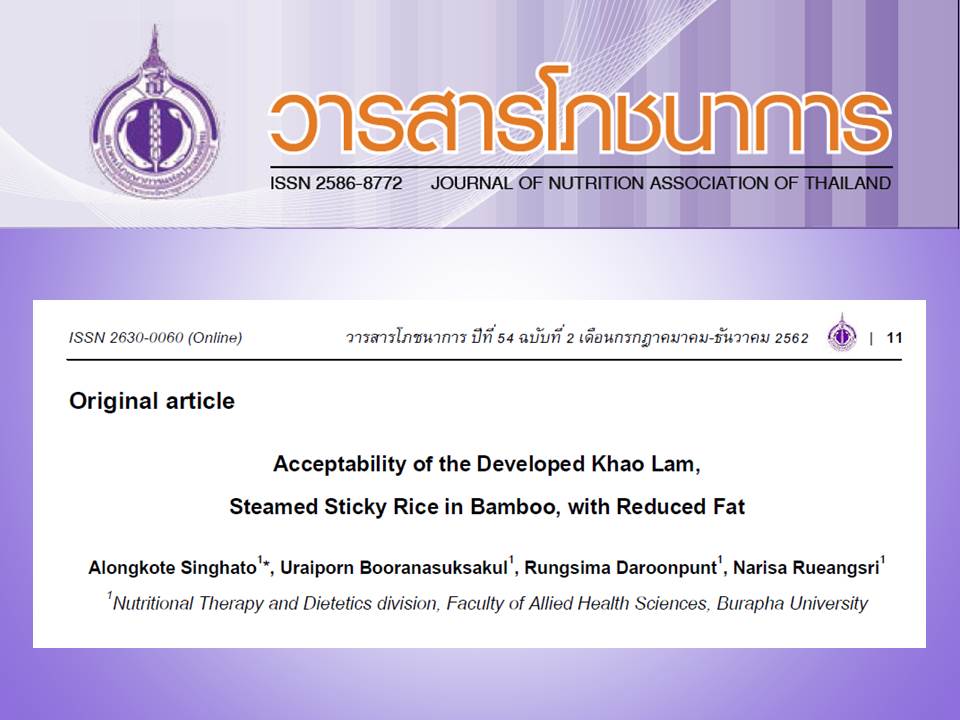
การยอมรับความพึงพอใจต่อตำรับข้าวหลามหนองมนสูตรลดไขมันที่ได้รับการพัฒนาขึ้น
คำสำคัญ:
ภาวะไขมันในเลือดสูง, ข้าวหลาม, อาหารว่าง, ไขมันบทคัดย่อ
ภาวะไขมันในเลือดสูงเป็นปัญหาทางสุขภาพสำคัญที่พบอุบัติการณ์เกิดภาวะนี้ในคนไทยในอัตราที่สูง พฤติกรรมการรับประทานอาหารที่มีไขมันมากเป็นปัจจัยสำคัญในการก่อให้เกิดภาวะดังกล่าว งานวิจัยชิ้นนี้จึงมีวัตถุประสงค์ในการพัฒนาตำรับข้าวหลามหนองมนซึ่งเป็นอาหารว่างท้องถิ่นของชาวชุมชนตลาดหนองมน จังหวัดชลบุรีโดยปรับลดปริมาณไขมันลงจากสูตรต้นตำรับ ข้าวหลาม 3 สูตรได้รับการพัฒนาขึ้น (สูตรต้นตำรับสูตรกะทิธัญพืช และสูตรนมสดพร่องมันเนย) เพื่อใช้เป็นตัวอย่างอาหารสำหรับการประเมินความพึงพอใจทางประสาทสัมผัสของอาสาสมัครจำนวน 30 คนในด้านต่างๆ ได้แก่ ด้านลักษณะที่ปรากฏ ด้านเนื้อสัมผัส ด้านรสชาติ ด้านกลิ่น ด้านสี และความพึงพอใจโดยภาพรวม ผลที่ได้พบว่า ข้าวหลามหนองมนสูตรลดไขมันโดยใช้นมสดพร่องมันเนยมีคะแนนความพึงพอใจเฉลี่ยน้อยกว่าสูตรต้นตำรับและสูตรที่ใช้กะทิธัญพืชในด้านรสชาติ กลิ่น เนื้อสัมผัส และความพึงพอใจโดยภาพรวมอย่างมีนัยสำคัญทางสถิติ (p<0.05) นอกจากนี้ผลที่ได้พบว่า ข้าวหลามหนองมันสูตรกะทิธัญพืชมีคะแนนความพึงพอใจโดยภาพรวมเฉลี่ยอยู่ในระดับที่อาสาสมัครให้การยอมรับ แต่สูตรที่ใช้นมสดพร่องมันเนยมีคะแนนความพึงพอใจโดยภาพรวมเฉลี่ยไม่อยู่ในระดับที่อาสาสมัครพึงพอใจ จากผลที่ได้สามารถสรุปได้ว่า ข้าวหลามหนองมนสูตรลดไขมันโดยใช้กะทิธัญพืชได้รับการยอมรับจากอาสาสมัคร
เอกสารอ้างอิง
Gowshall M, Taylor-Robinson SD. The increasing prevalence of non-communicable diseases in low-middle income countries: the view from Malawi. Int J Gen Med. 2018; 11:255-64.
Islam SMS, Purnat DT, Phuong NTA, Mwingira U, Schacht K, Fröschl G. (2014). Non‐Communicable Diseases (NCDs) in developing countries: a symposium report. J Glob Health. 2014; 10:81.
Menet R, Bernard M, El Ali A. Hyperlipidemia in Stroke Pathobiology and Therapy: Insights and Perspectives. Front Physiol. 2018; 9:488.
Miller M. Dyslipidemia and cardiovascular risk: the importance of early prevention. QJM. 2009; 102(9):657–67.
Garcez MR, Pereira JL, Fontanelli MM, Marchioni DML, Fisberg RM. Prevalence of Dyslipidemia According to the Nutritional Status in a Representative Sample of São Paulo. Arq Bras Cardiol. 2014; 103(6):476–84.
Hinton W, McGovern A, Coyle R, Han TS, Sharma P, Correa A, Ferreira F, de Lusignan S. Incidence and prevalence of cardiovascular disease in English primary care: a cross-sectional and follow-up study of the Royal College of General Practitioners (RCGP) Research and Surveillance Centre (RSC). BMJ open. 2018; 8(8):e020282.
Suwanwela NC. Stroke Epidemiology in Thailand. J Stroke. 2014; 16(1):1–7.
Kang YJ, Wang HW, Cheon SY, Lee HJ, Hwang KM, Yoon HS. Associations of Obesity and Dyslipidemia with Intake of Sodium, Fat, and Sugar among Koreans: a Qualitative Systematic Review. Clin Nutr Res. 2016; 5(4):290–304.
Nettleton JA, Brouwer IA, Geleijnse JM, Hornstra G. Saturated Fat Consumption and Risk of Coronary Heart Disease and Ischemic Stroke: A Science Update. Ann Nutr Metab. 2017; 70(1):26–33.
Azari-Anpar M, Khomeiri M, Ghafouri-Oskuei M, Aghajani N. Response surface optimization of low-fat ice cream production by using resistant starch and maltodextrin as a fat replacing agent. J Food Sci Technol. 2017; 54(5):1175–83.
Nelson BK, Barbano DM. Reduced-fat cheddar cheese manufactured using a novel fat removal process. J Dairy Sci. 2004; 87(4):841-53.
Singhato A, Booranasuksakul U, Rueangsri N. Effectiveness of Therapeutic Lifestyle Change diet to improve blood lipid profiles among people living with HIV. Journal of Medicine and Health Sciences. 2018; 25(1):93-105.
Horadakun P, Lamsan J, Wittayacom K, Singhato A. Daily sugar intake and its relationship on body mass index among Burapha University students. In proceedings of the 6th Burapha University International Conference 2017; August 3-4; Holiday Inn Pattaya, Chonburi: Burapha University; 2017: 338-44.
Wichchukit S, O'Mahony M. The 9-point hedonic scale and hedonic ranking in food science: some reappraisals and alternatives. J Sci Food Agric. 2015; 95(11):2167-78.
Manickavasagan A, Abbas I, Cork L, Khan MA, Al-Rahbi S, Subramanian K, et al. Acceptability of reformulated whole-grain products using net acceptance score (NAS) and relative acceptance score (RAS). IJNPND. 2016; 6(1):12-22.
Hertzog MA. Considerations in determining sample size for pilot studies. Res Nurs Health. 2008; 31(2):180-91.
Singh-Ackbarali D, Maharaj R. Sensory Evaluation as a Tool in Determining Acceptability of Innovative Products Developed by Undergraduate Students in Food Science and Technology at The University of Trinidad and Tobago. J Curric Teach. 2014; 3(1):10-27.
Chaikate S, Morakotjindaand P, Thongrod W. The Development of Healthy Thai Dessert: A Case Study of Thong Ake. J Res Unit Sci Technol Environ Learning, 2017; 8(2):261-70.
Sanon W, Limsuwan T, Ingsrisawang L. Development of reduced calorie and improved fatty acid proportion Thai styled egg custard with sucralose and cereal cream. In: Proceedings of the 47th Kasetsart University Annual Conference; 2009 March 17-20; Kasetsart University; Bangkok; 2009. p. 16-24.
Hamley S. The effect of replacing saturated fat with mostly n-6 polyunsaturated fat on coronary heart disease: a meta-analysis of randomised controlled trials. Nutr J. 2017; 16(1):30.
Bayarri S, Taylor AJ, Hort J. The Role of Fat in Flavor Perception: Effect of Partition and Viscosity in Model Emulsions. J Agric Food Chem. 2006; 54(23):8862–8.
Bolhuis DP, Newman LP, Keast RSJ. Effects of Salt and Fat Combinations on Taste Preference and Perception. Chem Senses. 2016; 41(3):189–95.
Drewnowski A, Almiron-Roig E. Human Perceptions and Preferences for Fat-Rich Foods. In: Montmayeur JP, le Coutre J, editors. SourceFat Detection: Taste, Texture, and Post Ingestive Effects. Boca Raton (FL): CRC Press/Taylor & Francis; 2010.
Stroebele N, de Castro JM, Stuht J, Catenacci V, Wyatt HR, Hill JO. A Small-Changes Approach Reduces Energy Intake in Free-Living Humans. J Am Coll Nutr. 2009; 28(1):63–8.
Kelishadi R, Pour MH, Zadegan NS, Kahbazi M, Sadry G, Amani A, Ansari R, Alikhassy H, Bashardoust N. Dietary fat intake and lipid profiles of Iranian adolescents: Isfahan Healthy Heart Program--Heart Health Promotion from Childhood. Prev Med. 2004; 39(4):760-6.
Chan-o-cha P. Thailand's commitment to global cooperation on NCDs: acting together now. Lancet. 2019; 393(10166):11-13.
Hruska KA, Mathew S, Lund R, Qiu P, Pratt R. Hyperphosphatemia of Chronic Kidney Disease. Kidney Int. 2008; 74(2):148–157.
Rippe JM, Angelopoulos TJ. Relationship between Added Sugars Consumption and Chronic Disease Risk Factors: Current Understanding. Nutrients. 2016; 8(11):697.
ดาวน์โหลด
เผยแพร่แล้ว
รูปแบบการอ้างอิง
ฉบับ
ประเภทบทความ
สัญญาอนุญาต
บทความที่เผยแพร่ในวารสารโภชนาการ เป็นลิขสิทธิ์ของสมาคมโภชนาการแห่งประเทศไทยฯ

