
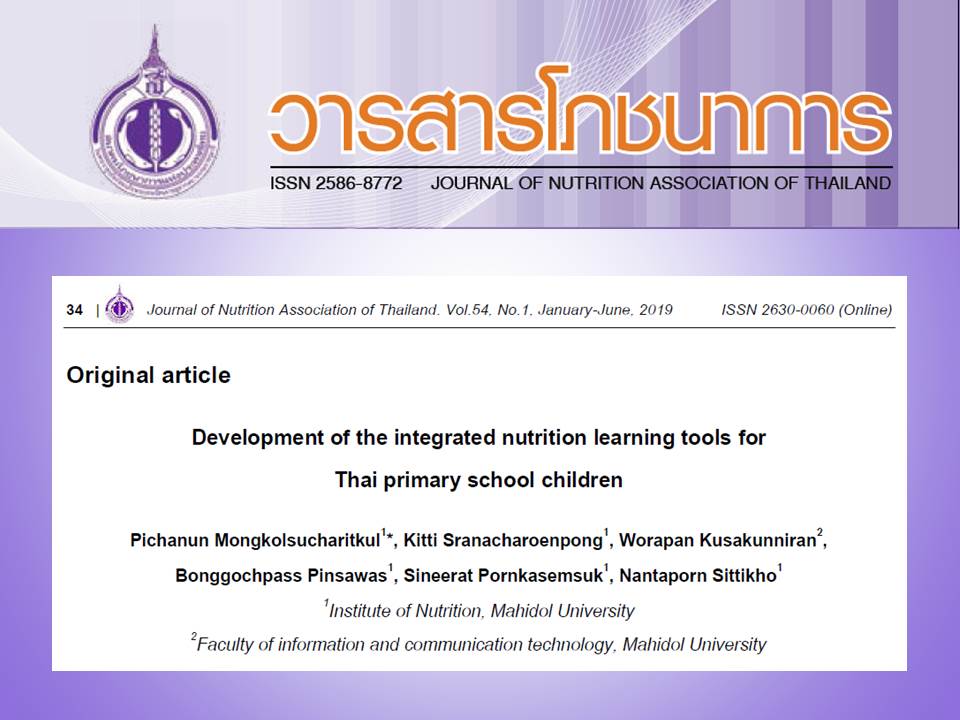
การพัฒนาเครื่องมือบูรณาการการส่งเสริมความรู้โภชนาการสำหรับเด็กประถมศึกษา
คำสำคัญ:
โรคอ้วนในเด็ก, การให้ความรู้โภชนาการ, การบูรณาการการเรียนรู้บทคัดย่อ
ในปัจจุบันความชุกเด็กอ้วนในไทยเพิ่มขึ้นอย่างต่อเนื่อง การให้ความรู้โภชนาการจัดเป็นส่วนสำคัญของกลยุทธ์ในป้องกันโรคอ้วนในเด็ก การวิจัยนี้มีวัตถุประสงค์เพื่อพัฒนาเครื่องมือบูรณาการการเรียนรู้โภชนาการ สำหรับคุณครูเพื่อใช้ในการให้ความรู้โภชนาการแก่นักเรียนชั้นประถมศึกษาปีที่ 1-3 งานวิจัยนี้แบ่งออกเป็น 2 ส่วน ได้แก่ ส่วนการพัฒนาเครื่องมือ และส่วนการศึกษานำร่อง ซึ่งในบทความวิจัยนี้จะรายงานในส่วนของการพัฒนาเครื่องมือบนพื้นฐานของสะเต็มศึกษา และทฤษฎีการเรียนรู้ต่าง ๆ เนื้อหาโภชนาการแบ่งออกเป็น 3 บทเรียน ได้แก่ 1) โภชนบัญญัติ ธงโภชนาการ อาหารแลกเปลี่ยน และอาหารห้าหมู่ 2) ลดหวานมันเค็ม และ 3) ฉลากโภชนาการ ฉลาก GDA และสัญลักษณ์ทางเลือกสุขภาพ โดยแต่ละบทเรียนถูกออกแบบให้บูรณาการเข้ากับวิชาสุขศึกษา คณิตศาสตร์ และภาษาอังกฤษ โดยคุณครูจะใช้เวลา 15 นาที ท้ายคาบเรียนในการใช้เครื่องมือนี้เพื่อสอดแทรกเนื้อหาโภชนาการเข้าไปในชั้นเรียนแต่ละวิชา 1 ครั้งต่อสัปดาห์ เป็นเวลา 4 สัปดาห์ ผลการประเมินค่าดัชนีความเที่ยงตรงเชิงเนื้อหาของเครื่องมือ (0.98) และแบบสอบถาม (0.97) ได้รับการยอมรับโดยผู้เชี่ยวชาญ เครื่องมือนี้ได้ถูกนำไปทดลองใช้ในการศึกษานำร่องเกี่ยวกับการให้ความรู้โภชนาการ เพื่อประเมินผลลัพธ์ของความรู้ทางโภชนาการและการเปลี่ยนแปลงพฤติกรรมการบริโภคอาหารในเด็กนักเรียนระดับประถมศึกษา
เอกสารอ้างอิง
Department of Health: Ministry of Public Health. The annual report of the Department of Health in 2014. Bangkok: Ministry of Public Health; 2014.
Biro FM, Wien M. Childhood obesity and adult morbidities. Am J Clin Nutr. 2010;91(5):1499S-505S.
Steinbeck K. Childhood Obesity: Consequences and Complications. Clinical Obesity in Adults and Children: Wiley-Blackwell; 2010.
Choudhary AK, Donnelly LF, Racadio JM, Strife JL. Diseases Associated with Childhood Obesity. Am J Roentgenol. 2007;188(4):1118-30.
National Center for Chronic Disease Prevention and Health Promotion. Childhood Obesity Causes & Consequences. 2015. [cited 2016 Apr 7]. Available from:
https://www.cdc.gov/obesity/childhood/causes.html
National Health Examination Survey Office. The report of dietary intake of Thai people. The 4th Thailand national health examination survey in 2008-2009. Bangkok: National Health Examination Survey Office; 2011.
National Health Examination Survey Office. The report of child health. The 4th Thailand national health examination survey in 2008-2009. Bangkok: National Health Examination Survey Office; 2011.
Ministry of Education. Basic Education Core Curriculum B.E. 2551 (A.D. 2008). 2008.
Subbian V, editor. Role of MOOCs in integrated STEM education: A learning perspective. 2013 IEEE Integrated STEM Education Conference (ISEC); 2013.
Sorden S. The cognitive theory of multimedia learning. Handbook of educational theories. NC: Information Age Publishing; 2012.
Clark RC, Lyons C. Graphics for learning: Proven guidelines for planning, designing, and evaluating visuals in training materials. New York: John Wiley & Sons; 2010.
Davidson N, Major CH. Boundary crossings: Cooperative learning, collaborative learning, and problem-based learning. J Excell Coll Teach. 2014;25:20-30.
Koster R. Theory of fun for game design. O'Reilly Media, Inc.; 2013.
Polit DF, Beck CT. The content validity index: are you sure you know what's being reported? Critique and recommendations. Res Nurs Health. 2006;29(5):489-97.
Spiegel SA, Foulk D. Reducing Overweight through a Multidisciplinary School-based Intervention. Obesity (Silver Spring). 2006;14(1):88-96.
Sirikulchayanonta C, Pavadhgul P, Chongsuwat R, Klaewkla J. Participatory Action Project in Reducing Childhood Obesity in Thai Primary Schools. Asia Pac J Public Health. 2011;23(6):917-27.
Perera T, Frei S, Frei B, Wong S, Bobe G. Improving Nutrition Education in U.S. Elementary Schools: Challenges and Opportunities. J Educ Pract. 2015;30(6):41-50.
Dudley DA, Cotton WG, Peralta LR. Teaching approaches and strategies that promote healthy eating in primary school children: a systematic review and meta-analysis. Int J Behav Nutr Phys Act. 2015;28(12):1-26.
Contento IR, Randell JS, Basch CE. Review and analysis of evaluation measures used in nutrition education intervention research. J Nutr Educ Behav. 2002;34(1):2-25.
Manger WM, Manger LS, Minno AM, Killmeyer M, Holzman RS, Schullinger JN, et al. Obesity prevention in young schoolchildren: results of a pilot study. J Sch Health. 2012;82(10):462-8.
Kanyamee M, Fongkaew W, Chotibang J, Aree P, Kennedy C. An intervention study of changing eating behaviors and reducing weight in thai children aged 10-12. Pac Rim Int J Nurs Res Thail. 2013;17(4):317-28.
ดาวน์โหลด
เผยแพร่แล้ว
รูปแบบการอ้างอิง
ฉบับ
ประเภทบทความ
สัญญาอนุญาต
บทความที่เผยแพร่ในวารสารโภชนาการ เป็นลิขสิทธิ์ของสมาคมโภชนาการแห่งประเทศไทยฯ

