
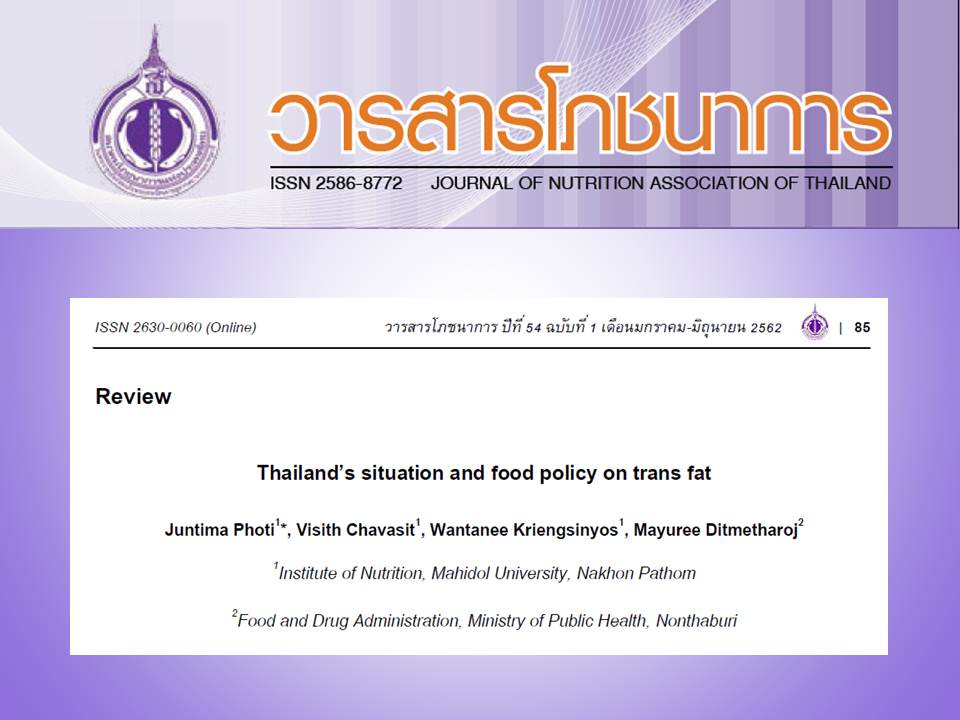
การปนเปื้อนของกรดไขมันทรานส์ในอาหารและการกำกับดูแลของประเทศไทย
คำสำคัญ:
trans fatty acid, partially hydrogenated oil, bakeryบทคัดย่อ
กรดไขมันทรานส์เกิดจากกระบวนการเติมไฮโดรเจนบางส่วน (Partial hydrogenation) เพื่อปรับปรุงคุณสมบัติทางกายภาพของไขมันเป็นหลัก สามารถพบได้ในธรรมชาติเล็กน้อยจากผลิตภัณฑ์ของสัตว์เคี้ยวเอื้อง เช่น นมโค เนื้อโค และเนย การบริโภคอาหารที่มีการปนเปื้อนของกรดไขมันทรานส์ เพิ่มโอกาสเสี่ยงต่อการเกิดโรคหัวใจและหลอดเลือด เนื่องจากกรดไขมันชนิดทรานส์มีผลต่อการเพิ่มขึ้นของระดับโคเลสเตอรอลชนิดแอลดีแอล (LDL-cholesterol) และมีผลต่อการลดระดับโคเลสเตอรอลชนิดเอชดีแอล (HDL-cholesterol) ในเลือด การศึกษาสถานการณ์ของไขมันทรานส์ในอาหารกลุ่มที่อาจพบการปนเปื้อน พบว่าปัจจุบันกรดไขมันทรานส์มิใช่สาเหตุของปัญหาโภชนาการที่สัมพันธ์กับการบริโภคไขมันในประเทศไทย หากแต่มาจากกรดไขมันอิ่มตัว เนย เนยขาว มาการีน และอาหารในกลุ่มโดนัททอด พาย พัฟ เพสตรี บางยี่ห้อเท่านั้น ที่มีกรดไขมันทรานส์เกินกว่าปริมาณที่แนะนำขององค์การอาหารและเกษตรแห่งสหประชาชาติ (FAO) และองค์การอนามัยโลก (WHO) หรือประมาณ 0.5 กรัมต่อหน่วยบริโภค อย่างไรก็ตาม กระบวนการผสมน้ำมัน (oil blending) ที่มีความอิ่มตัวแตกต่างกัน ตั้งแต่ 2 ชนิดขึ้นไปเข้าด้วยกัน ถูกนำมาใช้ปรับปรุงลักษณะทางกายภาพของไขมันให้มีลักษณะที่ต้องการ เพื่อทดแทนการใช้น้ำมันหรือไขมันที่ผ่านการเติมไฮโดรเจนบางส่วน และมีการออกประกาศกระทรวงสาธารณสุข ให้น้ำมันที่ผ่านกระบวนการเติมไฮโดรเจนบางส่วนและอาหารที่มีน้ำมันที่ผ่านกระบวนการเติมไฮโดรเจนบางส่วนเป็นส่วนประกอบ เป็นอาหารที่ห้ามผลิต นำเข้า หรือจำหน่าย โดยมีผลบังคับใช้ตั้งแต่ 10 ธันวาคม พ.ศ. 2561
เอกสารอ้างอิง
2. Talbot G. Specialty oils and fats in food and nutrition: properties, processing and applications. Cambridge: Wood head Publishing; 2015.
3. Gupta M. Practical guide to vegetable oil processing. Urbana: AOCS press; 2017.
4. Lai OM, Tan CP, Akoh CC, editor. Palm oil: production, processing, characterization, and uses. Urbana: AOCS press; 2012.
5. Dijkstra AJ, Hamilton RJ, Hamm W. Trans fatty acids. Iowa: Blackwell; 2008.
6. Alfaia C, Alves S, Martins S, Costa A, Fontes C, Lemos J, et al. Effect of feeding system on intramuscular fatty acids and conjugated linoleic acid isomers of beef cattle, with emphasis on their nutritional value and discriminatory ability. Food Chem. 2009;114:939-946.
7. Kuhnt K, Baehr M, Rohrer C, Jahreis G. Trans fatty acid isomers and the trans-9/trans-11 index in fat containing foods. Eur J Lipid Sci Technol. 2011;113(10):1281–1292.
8. WHO. Replace trans fat: Frequently asked question [document on the internet]. Geneva: WHO; 2018 [updated 2018 May; cited 2018 Sep 25]. Available from: https://www.who.int/docs /default-source/documents/replace-trans fats/replace-trans-fat-faqs.pdf?Status= Temp&sfvrsn=956d171 f_6
9. วิสิฐ จะวะสิต, วันทนีย์ เกรียงสินยศ, จันทิมา โพธิ, ทิพย์วรรณ ปริญญาศิริ, มยุรี ดิษย์เมธาโรจน์. โครงการประเทศไทยปล อดไขมันทรานส์. รายงานการวิจัยการ เกษตร (ฉบับสมบูรณ์).กรุงเทพมหานคร: สำนักงานพัฒนาการวิจัยการเกษตร; 2561.
10. Przybylski O, Aladedunye FA. Forma tion of trans fats during food prepara tion. Can J Diet Pract Res. 2012;73 (2):98-101.
11. Bhardwaj S, Passi SJ, Misra A, Pant KK, Anwar K, Pandey RM, et al. Effect of heating/reheating of fats/oils, as used by Asian Indians, on trans fatty acid formation. Food Chem. 2016; 212:663-670.
12. Chen , Yang Y, Nie S, Yang X, Wang Y, Yang M, Chang Li, et al. The analysis of trans fatty acid profiles in deep frying palm oil and chicken fillets with an improved gas chromatography method. Food Control. 2014;4:191-197.
13. WHO. Diet, Nutrition and the Prevention of Chronic Diseases. Report of a Joint WHO/FAO Expert Consulta tion. WHO Technical Report Series 916. Geneva: WHO; 2003.
14. Dhaka V, Gulia N, Ahlawat KS, Khatkar SB. Trans fats—sources, health risks and alternative approach - A review. J Food Sci Technol. 2011;48(5):534–541.
15. Mozaffarian D, Katan MB, Ascherio A, Stampfer MJ, Willett WC. Trans fatty acids and cardiovascular disease. N Engl J Med. 2006;354:1601-1613.
16. Mozaffarian D, Aro A, Willett WC. Health effects of trans-fatty acids: experimental and observational evid ence. Eur J Clin Nutr. 2009;63 (S2):S5-21.
17. วิสิฐ จะวะสิต, สมเกียรติ โกศัลวัฒน์, ธีรชัย ว่องเมทินี, ศศิอำไพ พฤฒิพรธานี, ดารณี หมู่ขจรพันธ์, ทิพย์วรรณ ปริญญาศิริ และคณะ. การสำรวจสถานการณ์การปนเปื้อนของกรดไขมันชนิดทรานส์ในผลิตภัณฑ์อาหารในประเทศไทย. มูลนิธิสาธารณสุขแห่งชาติ และสำนักงานกองทุนสนับสนุนการวิจัย; 2550.
18. นันทยา จงใจเทศ, ภัทธิรา ยิ่งเลิศรัตนะกุล, ปิยนันท์ เผ่าม่วง, วารีทิพย์ พึ่งพันธ์. ปริมาณไขมันทรานส์ในอาหารอบและทอด. รายงานการศึกษาวิจัย. นนทบุรี: กองโภชนาการ กรมอนามัย กระทรวงสาธารณสุข; 2550.
19. กมลกาญจน์ จิญกาญจน์, บังอร บุญชู, วิภาวรรณ ศรีมุข.การสำรวจเบื้องต้น: ปริมาณไขมันทรานส์ในอาหารทอด ขนมอบ ไขมันและนํ้ามันสำหรับบริโภค นมและผลิตภัณฑ์นม. Bulletin of Applied Sciences. 2014;3(3):81-87.
20. รัฐธรรมนูธแห่งราชอาณาจักรไทย พ.ศ. 2541. ราชกิจจานุเบกษา เล่ม 115 ตอน 47 ง, 11 มิถุนายน 2541.
21. USFDA. Trans Fat [document on the internet]. Maryland: USFDA; 2018 [updated 2018 May 18; cited 2018 Sep 25]. Available from: https://www.fda.gov /food/ucm292278.htm
22. รัฐธรรมนูธแห่งราชอาณาจักรไทย พ.ศ. 2561. ราชกิจจานุเบกษา เล่ม 135 ตอนพิเศษ 166 ง, 13 กรกฏาคม 2561.
23. Codex Alimentarius Commission. Discussion paper on claim for “free” of trans fatty acids [document on the internet]. Berlin: Codex Alimentarius Commission; 2017 [cited 2018 Sep 25].Available from: https://www.fao.org /fao-who-codexalimentarius/sh-proxy/es /?lnk =1&url=https%253A%252F%252 Fwork space.fao.org%252Fsites%252F codex%252FMeetings%252FCX-720-39 %252Fnf 39_09e.pdf.
24. USFDA. Guidance for industry: Trans fatty acids in nutrition labeling, nutrient content claims, health Claims; small entity compliance guide [document on the internet]. Maryland: USFDA; 2003 [updated 2018 Sep 20; cited 2018 Sep 25]. Available from: https://www.fda.gov /Food/ GuidanceRegulation/Guidance DocumentsRegulatoryInformation/ucm053479.htm
25. Canadian Food Inspection Agency. Specific nutrient content claim requirements: Trans fatty acid claims [document on the internet]. Ontario: Canadian Food Inspection Agency; 2016 [updated 2018 May 11; cited 2018 Sep 25]. Available from: https://www.inspection.gc.ca/food/ label ling/food-labelling-for-industry/nutrient-content/specific-claim-requirements/eng /13899077 70176/1389907817577? chap=6
ดาวน์โหลด
เผยแพร่แล้ว
รูปแบบการอ้างอิง
ฉบับ
ประเภทบทความ
สัญญาอนุญาต
บทความที่เผยแพร่ในวารสารโภชนาการ เป็นลิขสิทธิ์ของสมาคมโภชนาการแห่งประเทศไทยฯ

