
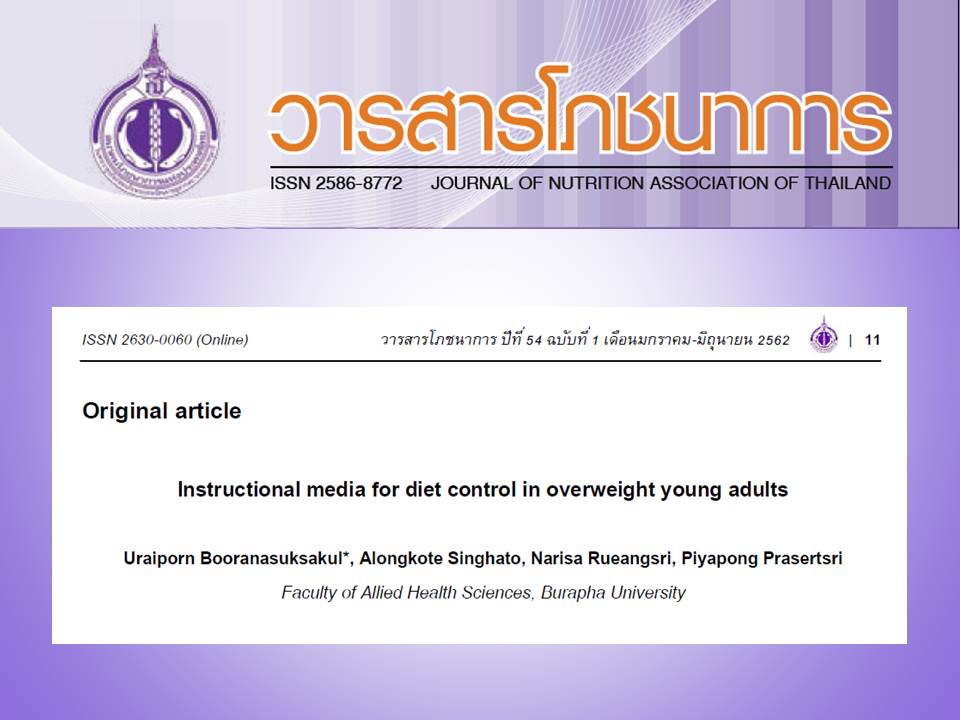
สื่อการสอนด้านการควบคุมอาหารสำหรับผู้ใหญ่ตอนต้นที่มีภาวะน้ำหนักเกิน
คำสำคัญ:
Overweight, Instructional media, Diet controlบทคัดย่อ
ปัญหาภาวะน้ำหนักเกินและโรคอ้วนเป็นปัจจัยเสี่ยงด้านสุขภาพที่สำคัญอันดับต้นของประชากรโลก สาเหตุหนึ่งของโรคอ้วนคือการที่ได้รับพลังงานเข้าไปในร่างกายมากกว่าพลังงานที่ร่างกายใช้ไปในแต่ละวัน การผลิตสื่อการสอนในการนับพลังงานและสารอาหารเพื่อเพิ่มความรู้ความเข้าใจให้แก่บุคคลที่มีภาวะน้ำหนักเกินเป็นแนวทางในการควบคุมพลังงานที่ได้จากอาหารต่อวันได้และเป็นแนวทางป้องกันการเกิดโรคอ้วนได้งานวิจัยนี้เป็นการศึกษาเชิงทดลองในนิสิตมหาวิทยาลัยบูรพาที่มีอายุ 18-22 ปี จำนวน 30 คน ที่มีภาวะน้ำหนักเกิน (ดัชนีมวลกายอยู่ในระหว่าง 22.9-24.9 กก./ตร.ม.) โดยแบ่งการศึกษาออกเป็น 3 ช่วง ได้แก่ ช่วงที่ 1 สำรวจอาหารยอดนิยม ช่วงที่ 2 สร้างสื่อการสอนจากแบบสำรวจอาหารยอดนิยม และตรวจสอบสื่อการสอน และช่วงที่ 3 ทดสอบสื่อการสอนโดยให้อาสาสมัครตอบแบบทดสอบความรู้ทางโภชนาการทั้งก่อนและหลังทดสอบสื่อการสอน และติดตามผลหลังการทดสอบสื่อ 1 สัปดาห์ รวมทั้งประเมินความพึงพอใจหลังจากที่ได้รับสื่อการสอนจากผลการวิจัยพบว่าการทดสอบความรู้ด้านอาหาร ก่อนได้รับสื่อ หลังได้รับสื่อ และติดตามผล 1 สัปดาห์ พบว่า หลังได้รับสื่ออาสาสมัครมีความรู้เพิ่มขึ้นอย่างมีนัยสำคัญทางสถิติ (p<0.05) และความรู้ยังคงอยู่หลังติดตามผลเป็นเวลา 1 สัปดาห์ (p<0.05) จากการประเมินความพึงพอใจต่อสื่อการสอนพบว่าอาสาสมัครมีระดับความพึงพอใจต่อสื่อมาก สรุปได้ว่าสื่อการสอนที่ผลิตขึ้นในการให้ความรู้เรื่องการควบคุมพลังงานด้านอาหารสำหรับผู้ใหญ่ตอนต้นที่มีภาวะน้ำหนักเกิน มีผลสัมฤทธิ์หลังการได้รับสื่อการสอนสูงกว่าก่อนได้รับสื่อการสอนและความรู้ยังคงอยู่หลังติดตามผลเป็นเวลา 1 สัปดาห์
เอกสารอ้างอิง
2. Ng M, Fleming T, Robinson M, Thomson B, Graetz N, Margono C, et al. Global, regional, and national prevalence of overweight and obesity in children and adults during 1980-2013: a systematic analysis for the Global Burden of Disease Study 2013. The Lancet. 2014;384(9945): 766-81.
3. Pengpid S, Peltzer K. Prevalence of overweight and underweight and its associated factors among male and female university students in Thailand. HOMO-Journal of Comparative Human Biology. 2015;66(2):176-86.
4. Hudthagosol C, Chusak C. Sugar and diabetes. Journal of Nutrition Association of Thailand. 2015;50(2):26-35.
5. Crino M, Sacks G, Wu JH. A review of population-level actions targeting reductions in food portion sizes to address obesity and related non-communicable diseases. Current Nutrition Reports. 2016; 5(4):323-32.
6. de Mutsert R, Sun Q, Willett WC, Hu FB, van Dam RM. Overweight in early adulthood, adult weight change, and risk of type 2 diabetes, cardiovascular diseases, and certain cancers in men: a cohort study. American Journal of Epidemiology. 2014;179(11):1353-65.
7. Worsley A. Nutrition knowledge and food consumption: can nutrition knowledge change food behavior?. Asia Pacific Journal of Clinical Nutrition. 2002;11:579-85.
8. Wardle J, Parmenter K, Waller J. Nutrition knowledge and food intake. Appetite. 2000;34(3):269-75.
9. Grosso G, Mistretta A, Turconi G, Cena H, Roggi C, Galvano F. Nutrition knowledge and other determinants of food intake and lifestyle habits in children and young adolescents living in a rural area of Sicily, South Italy. Public Health Nutrition. 2013;16(10):1827-36.
10. Jung H, Chung K. Knowledge-based dietary nutrition recommendation for obese management. Information Technology and Management.2016;17(1):29-42.
11. Boonju W, Chulakarangka S, Utaipatana-cheep A. Nutrition education to encourage school children’s behavior on Thai food consumption. Journal of Community Development Research. 2008;2(2):8391.
12. Wongsawat S. Integrating Posters and Actual-Sized Fruit Models in Health Education on Fruit Diets for Elderly Patients. International Journal of Arts & Sciences. 2015;8(3):717-24.
13. Cho JH, Juon HS. Assessing overweight and obesity risk among Korean Americans in California using World Health Organization body mass index criteria for Asians. CDC. 2006;3:1–11.
14. Carnell S, Benson L, Pantazatos SP, Hirsch J, Geliebter A. A modal brain activation and functional connectivity in response to high‐energy‐density food cues in obesity. Obesity. 2014;22(11): 2370-8.
15. Sharma SV, Gernand AD, Day RS. Nutrition knowledge predicts eating behavior of all food groups except fruits and vegetables among adults in the Pasodel Norte region: QuéSabrosa Vida. Journal of Nutrition Education and Behavior. 2008;40(6):361-8.
16. Klohe-Lehman DM, Freeland-Graves J, Anderson ER, McDowell T, Clarke KK, Hanss-Nuss H, Cai G, Puri D, Milani TJ. Nutrition knowledge is associated with greater weight loss in obese and overweight low-income mothers. Journal of the American Dietetic Association. 2006; 106(1):65-75.
17. Pirouznia M. The association between nutrition knowledge and eating behavior in male and female adolescents in the US. International Journal of Food Sciences and Nutrition. 2001;52(2):127-32.
18. Shin EK, Lee HS, Lee YK. Effect of Nutrition Education Program in Obese Children and Their Parents (II): Focus on Nutrition Knowledge, Eating Behaviors, Food Habit and Nutrient Intakes. Korean Journal of Community Nutrition. 2004;9(5): 578-88.
19. Weiss EM, Kemmler G, Deisenhammer EA, Fleischhacker WW, Delazer M. Sex differences in cognitive functions. Personality and individual differences. 2003;35(4):863-7ใ
ดาวน์โหลด
เผยแพร่แล้ว
รูปแบบการอ้างอิง
ฉบับ
ประเภทบทความ
สัญญาอนุญาต
บทความที่เผยแพร่ในวารสารโภชนาการ เป็นลิขสิทธิ์ของสมาคมโภชนาการแห่งประเทศไทยฯ

