
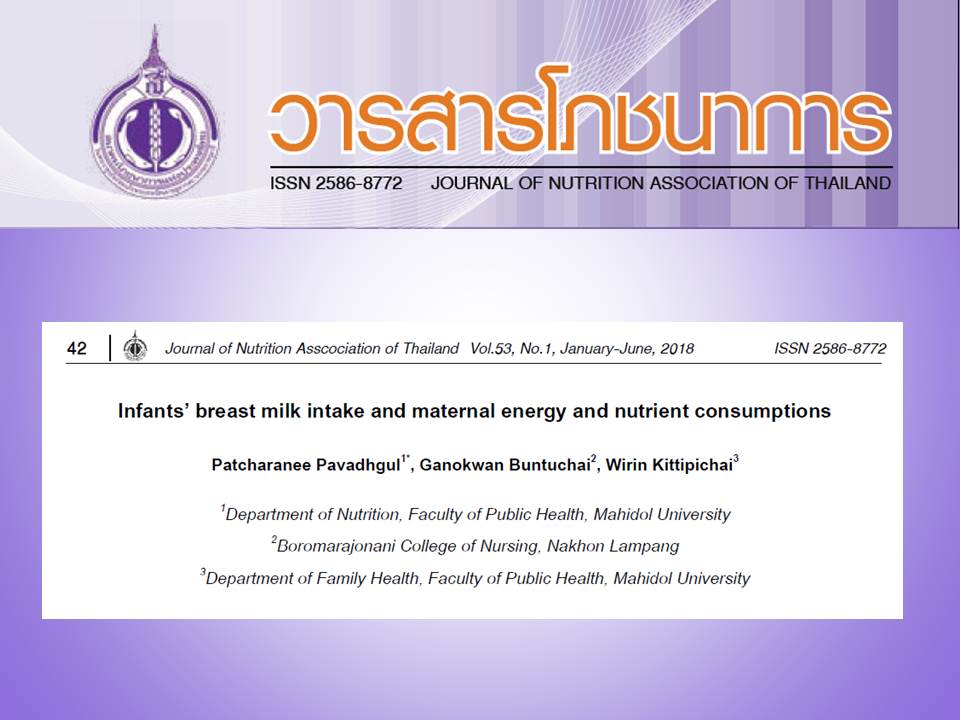
ปริมาณน้ำนมที่ทารกได้รับกับพลังงานและสารอาหารที่มารดาบริโภค
คำสำคัญ:
ปริมาณน้ำานมที่ทารกได้รับ, พลังงาน, โปรตีนบทคัดย่อ
การวิจัยเชิงสำรวจแบบภาคตัดขวางนี้มีวัตถุประสงค์เพื่อศึกษาความสัมพันธ์ระหว่างปริมาณน้ำนม กับพลังงานและสารอาหารของมารดาที่เลี้ยงบุตรด้วยนมแม่เพียงอย่างเดียว กลุ่มตัวอย่างเป็นมารดาและบุตรจำนวน 36 คู่ซึ่งบุตรอายุ 1 - 3 เดือนในจังหวัดลำปาง เก็บข้อมูลโดยสัมภาษณ์การบริโภคอาหารย้อนหลัง24 ชั่วโมง และแบบสอบถามความถี่การบริโภคอาหารโปรตีน ประเมินปริมาณน้ำนมโดยการชั่งน้ำหนักทารก (Test-weighing method)ทดสอบความสัมพันธ์ระหว่างปริมาณน้ำนมและอาหารที่มารดาบริโภคโดยใช้สถิติสหสัมพันธ์แบบแยกส่วน (Partial correlation) ด้วยการควบคุมปัจจัยน้ำหนักทารกแรกเกิด และน้ำหนักปัจจุบัน ผลการศึกษาพบว่ามารดามีปริมาณน้ำนมเฉลี่ย 616.6 ± 187.9 กรัมต่อวันค่าเฉลี่ยของพลังงาน คาร์โบไฮเดรต โปรตีนและไขมันที่มารดาบริโภคคือ 1,668 กิโลแคลอรี 235.6 กรัม 70.2 กรัม และ49.8 กรัมต่อวันตามลำดับพลังงานและคาร์โบไฮเดรตที่มารดาบริโภคสัมพันธ์กับปริมาณน้ำนมที่ทารกได้รับอย่างมีนัยสำคัญ (p<0.05) นอกจากนี้การบริโภคอาหารโปรตีนบางประเภทมีความสัมพันธ์กับปริมาณน้ำนมอย่างมีนัยสำคัญ (p<0.05) ได้แก่ เต้าหู้ไข่ ปลานิล ปลาช่อน ปลาทู ลูกชิ้นปลา กุ้ง และเต้าหู้ขาว มารดาให้นมบุตรควรได้รับการส่งเสริมให้ได้รับพลังงานและสารอาหารให้เพียงพอต่อความต้องการ และได้รับโปรตีนที่มีคุณภาพเพื่อเพิ่มปริมาณน้ำนมที่ทารกจะได้รับ
เอกสารอ้างอิง
2. Keamer MS, Kakuma R. The optimal duration of exclusive breastfeeding: a systematic review. Adv Exp Med Biol. 2004;554:63-77.
3. Ip S, Chung M, Raman G, Chew P, Magula N, DeVine D, et al. Breastfeeding and maternal and infant health outcomes in developed countries. Evid Rep Technol Assess (Full Rep). 2007;(153):1-186.
4. World Health Organization. Global strategy for infant and young child feeding [online]. 2003 [cited 2015 May 7]. Available from: https://www.who.int/nutrition/topics/global_strategy/en.
5. สำนักงานสถิติแห่งชาติ. การสำรวจสถานการณ์เด็กและสตรีในประเทศไทย 2555. กรุงเทพฯ: สำนักงานสถิติแห่งชาติ; 2555.
6. สำนักงานพัฒนานโยบายสุขภาพระหว่างประเทศ. ทำอย่างไร เด็กไทยถึงกินนมแม่ครบ 6 เดือน = Breastfeeding Boosting for the Best. นนทบุรี: สำนักงานพัฒนานโยบายสุขภาพระหว่างประเทศ; 2557.
7. กองโภชนาการ กรมอนามัย กระทรวงสาธารณสุข. ปริมาณสารอาหารอ้างอิงที่ควรได้รับประจำวันสำหรับคนไทย พ.ศ.2546. นนทบุรี: โรงพิมพ์องค์การรับส่งสินค้าและครุภัณฑ์; 2546.
8. Jelliffe DB, Jelliffe EF. The volume and composition of human milk in poorly nourished communities. a review. Am J Clin Nutr. 1978;31:492-515.
9. Institute of Medicine. Nutrition during lactation. Washington, DC: National Academy Press; 1991.
10. มณฑารพ จักกะพาก, สุภา สุขสงวน. ปัจจัยที่มีอิทธิพลต่อปริมาณน้ำนมมารดาและภาวะโภชนาการของทารกในเขตชนบทยากจนภาคกลาง. การประชุมทางวิชาการมหาวิทยาลัยเกษตรศาสตร์ ครั้งที่ 30; 29 มกราคม - 1 กุมภาพันธ์ 2535; มหาวิทยาลัยเกษตรศาสตร์. กรุงเทพฯ: มหาวิทยาลัยเกษตรศาสตร์; 2535. หน้า 307-15.
11. Chaiobhas P, Rotjananirunkit N, Boonprasert C. The effect of whole milk supplement on breast milk volume in 48-hour postpartum mothers in Ramathibodi Hospital. Rama Nurs J. 2005;15:25-35.
12. กองโภชนาการ กรมอนามัย กระทรวงสาธารณสุข. รายงานการสำรวจภาวะอาหารและโภชนาการของประเทศไทย ครั้งที่ 5. กรุงเทพฯ: องค์การรับส่งสินค้าและพัสดุภัณฑ์; 2546.
13. กองโภชนาการ กรมอนามัย กระทรวงสาธารณสุข. รายงานภาวะอาหารและโภชนาการแห่งชาติ ครั้งที่ 4 พ.ศ. 2538 [อินเตอร์เน็ต]. 2538 [เข้าถึงเมื่อ 1 มีนาคม 2561].เข้าถึงได้จาก https://nutrition.anamai.moph. go.th /images/file/survey_thailand_1995.pdf.
14. Daniel WW. Biostatistics: a foundation for analysis in the health sciences. 4th ed. Singapore: John Wiley & Sons; 1987.
15. Michaelsen KF, Larsen PS, Thomsen BL, Samuelson G. The Copenhagen cohort study on infant nutrition and growth: breast-milk intake, human milk macronutrient content, and influencing factors. Am J Clin Nutr. 1994;59:600-11.
16. Institute of Nutrition, Mahidol University. Nutrient calculation computer software INMUCAL-Nutrients V1 database NB1. Nakornpathom, 2007.
17. Kent JC, Hepworth AR, Sherriff JL, Cox DB, Mitoulas LR, Hartmann PE. Longitudinal changes in breastfeeding patterns from 1 to 6 months of lactation. Breastfeed Med. 2013;8:401-7.
18. Institute of Medicine. Nutrition during lactation. Washington, DC: National Academy Press; 1991.
19. WHO. The quantity and quality of breast milk report on the WHO collaborative study on breast-feeding. Geneva: WHO; 1985.
20. Nimmannun K. Assessment of vitamin a status in lactating Thai women [Master's Thesis]. Bangkok: Mahidol University; 2016.
21. Hoffman JR, Falvo MJ. Protein-which is best? J Sports Sci Met. 2014;3:118-30.
22. Wu G, Bazer FW, Dai Z, Li D, Wang J, Wu Z. Amino acid nutrition in animals: protein synthesis and beyond. Annu Rev Anim Biosci. 2014;2:387-417.
23. Tarrant M, Dodgson JE, Choi VWV. Becoming a role model: the breastfeeding trajectory of Hong Kong women breastfeeding longer than 6 months. Int J Nurs Stud. 2003;41:535-46.
24. Deb AK, Haque CE. Every mother is a mini-dortor: ethnomedicinal uses of fish, shellfish and some other aquatic animals in Bangladesh. J Ethnopharmacol. 2011;134:259-67.
25. วีระ ทองเนตร, ถวิล ชนะบุญ, กันต์กนิษฐ์ หาญวงษา. อยู่ไฟไทบ้าน ภูมิปัญญาพื้นบ้านอีสานกับการดูแลมารดาและบุตรหลังคลอด. กรุงเทพฯ: มูลนิธิสุขภาพไทย; 2555.
26. อารีย์ ประจันสุวรรณ, วันทนีย์ เกรียงสินยศ. โปรตีน:ความสำคัญและการประเมินคุณภาพ. วารสารโภชนาการ. 2559;51:27-38.
27. Bequette BJ, Hanigan MD, Calder GA, Reynolds CK, Lobley GE, MacRae JC. Amino acid exchange by the mammary gland of lactating goats when histidine limits milk production. J Dairy Sci. 2000;83:765-75.
28. Strucken EM, Laurenson YC, Brockmann GA. Go with the flow-biology and genetics of the lactation cycle. Front Genet. 2015;6:118.
ดาวน์โหลด
เผยแพร่แล้ว
รูปแบบการอ้างอิง
ฉบับ
ประเภทบทความ
สัญญาอนุญาต
บทความที่เผยแพร่ในวารสารโภชนาการ เป็นลิขสิทธิ์ของสมาคมโภชนาการแห่งประเทศไทยฯ

