
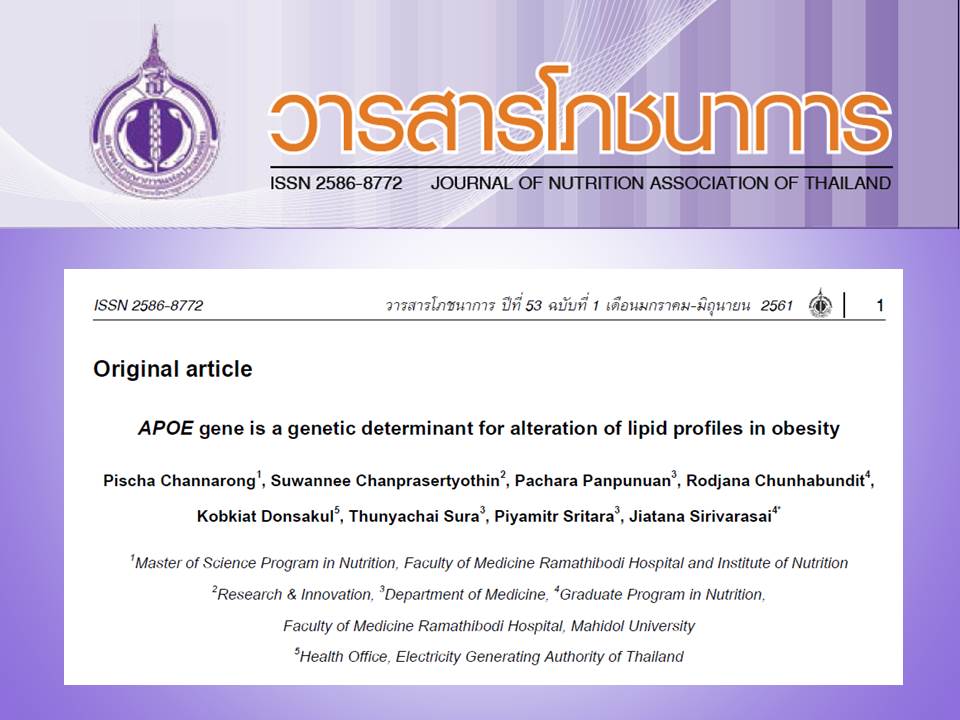
อะโปไลโปโปรตีนอีจีนเป็นตัวกำหนดทางพันธุกรรมสำหรับการเปลี่ยนแปลง ของระดับไขมันในเลือดในกลุ่มโรคอ้วน
คำสำคัญ:
อะโปไลโปโปรตีนอีจีน, ความหลากหลายทางพันธุกรรม, ภาวะโรคอ้วน, ภาวะไขมันในเลือดผิดปกติบทคัดย่อ
อะโปไลโปโปรตีนอี (ApoE) เป็นองค์ประกอบของไลโปโปรตีนในกระบวนการเมแทบอลิซึมของไขมันโดยทำหน้าที่เป็นตัวกลางในการจับกันของไลโปโปรตีนกับตัวรับที่ผิวของเซลล์ตับเพื่อกำจัดchylomicrons และVLDL การศึกษาทางพันธุกรรมแสดงว่า ApoE จีน (APOE) มีความสัมพันธ์กับภาวะไขมันในเลือดสูงและโรคหลอดเลือดหัวใจเพื่อศึกษาความสัมพันธ์ของความหลากหลายทางพันธุกรรมของ APOE (rs7412 และrs429358) กับระดับไขมันในเลือดในคนไทย คนปกติ 93 คนและคนโรคอ้วน 314 คนอายุระหว่าง 45-65 ปีจากโครงการวิจัยระยะยาวเกี่ยวกับอิทธิพลของปัจจัยเสี่ยงต่อการเกิดโรคหัวใจหลอดเลือดและเมแทบอลิซึมในพนักงานการไฟฟ้าฝ่ายผลิตแห่งประเทศไทย (EGAT Cohort study) ในปี ค.ศ. 2013 ได้รับการวิเคราะห์APOE polymorphism ด้วยวิธี TaqMan real-time PCR ในกลุ่มควบคุมพบว่ามีความถี่จีโนไทป์ ε2/ε2, ε2/ε3, ε3/ε3, ε2/ε4, ε3/ε4 และε4/ε4 เท่ากับ 2.2%, 17.2%, 62.4%, 3.2%, 15.1% และ 0% ตามลำดับ และมีความถี่อัลลีน ε2, ε3 และε4 เท่ากับ 0.12, 0.79 และ 0.09 ตามลำดับ ส่วนในกลุ่มคนโรคอ้วนพบว่ามีความถี่จีโนไทป์ ε2/ε2, ε2/ε3, ε3/ε3, ε2/ε4, ε3/ε4 และε4/ε4 เท่ากับ 1.3%, 18.8%, 55.4%, 5.4%, 17.8% และ 1.3% ตามลำดับ และมีความถี่อัลลีน ε2, ε3 และε4 เท่ากับ 0.13, 0.74 และ 0.13 ตามลำดับAPOE polymorphism มีผลต่อระดับไขมันในเลือดในกลุ่มคนโรคอ้วนโดยพบว่าผู้ที่มีจีโนไทป์ ε4/ε4 มีระดับคอเลสเตอรอลมากกว่าผู้ที่มีจีโนไทป์ ε2/ε4 และมีระดับ LDL-C มากกว่าผู้ที่มีจีโนไทป์ ε2/ε3, ε3/ε3 และε2/ε4 นอกจากนี้ยังพบว่าผู้ที่มีจีโนไทป์ ε3/ε4 มีระดับ LDL-C มากกว่าผู้ที่มีจีโนไทป์ ε2/ε4 โดยสรุปพบว่ามีความสัมพันธ์ระหว่างความหลากหลายทางพันธุกรรมของ APOE กับระดับของไขมันในเลือดในคนโรคอ้วน และบ่งชี้ว่าจีนนี้น่าจะเป็นหนึ่งในปัจจัยทางพันธุกรรมที่กำหนดความเสี่ยงต่อการเกิดภาวะโรคอ้วนและไขมันในเลือดสูงรวมทั้งโรคหลอดเลือดหัวใจในคนไทย
เอกสารอ้างอิง
2. Klop B, Elte JWF, Cabezas MC. Dyslipidemia in obesity: mechanisms and potential targets. Nutrients. 2013;5(4):1218-40.
3. Hales CM, Carroll MD, Fryar CD, Ogden CL. Prevalence of obesity among adults and youth: United States, 2015-2016. NCHS Data Brief. 2017;288.
4. Global Health Observatory. Global Health Observatory data [internet]. 2016 [cited 2017 May 15]. Available from: https://www.who.int/gho/ncd/risk_ factors/overweight/en/.
5. Aekplakorn W, Mo-suwan L. National prevalence of obesity: prevalence of obesity in Thailand. Obes Rev. 2009;10:589-92.
6. Heller DA, de Faire U, Pedersen NL, Dahlén G, McClearn GE. Genetic and environmental influences on serum lipid levels in twins. N Engl J Med. 1993;328:1150-6.
7. Mahley RW, Huang Y, Rall SC Jr. Pathogenesis of type III hyperlipoproteinemia (dysbetalipoproteinemia).Questions, quandaries, and paradoxes. J Lipid Res. 1999;40(11):1933-49.
8. Kolovou GD, Anagnostopoulou KK, Kostakou P, Giannakopoulou V, Mihas C, Hatzigeorgiou G, et al. Apolipoprotein E gene polymorphism and obesity status in middle-aged men with coronary heart disease. In Vivo. 2009;23(1):33-9.
9. Huang Y, Mahley RW. Apolipoprotein E: structure and function in lipid metabolism, neurobiology, and Alzheimer's diseases. Neurobiol Dis. 2014;72:3-12.
10. Cahua-Pablo G, Cruz M, Moral-Hernández OD, Leyva-Vázquez MA, Antúnez-Ortiz DL, Cahua-Pablo JA, et al. Elevated levels of LDL-C are associated with ApoE4 but not with the rs688 polymorphism in the LDLR gene. Clin Appl Thromb Hemost. 2016;22(5):465-70.
11. Marques-Vidal P, Bongard V, Ruidavets JB, Fauvel J, Hanaire-Broutin H, Perret B, et al. Obesity and alcohol modulate the effect of apolipoprotein E polymorphism on lipids and insulin. Obes Res. 2003;11(10):1200-6.
12. Klop B, Elte JW, Cabezas MC. Dyslipidemia in obesity: mechanisms and potential targets. Nutrients. 2013;5(4):1218–40.
13. Decharatkulchai N, Settasatian C, Settasatian N, Komanasin N, Leelayuwat N, Sirijaichingkul S, et al. Apolipoprotein E polymorphism and dyslipidemia in Thais. J Med Tech Phy Ther. 2009;21:141-52.
14. WHO/IOTF/IASO. The Asia-Pacific perspective: redefining obesity and its treatment. Australia: World Health Organization Regional Office for the Western Pacific; 2000.
15. National Cholesterol Education Program (NCEP) Expert Panel on Detection, Evaluation, and Treatment of High Blood Cholesterol in Adults (Adult Treatment Panel III). Third report of the National Cholesterol Education Program (NCEP) expert panel on detection, evaluation, and treatment of high blood cholesterol in adults (Adult Treatment Panel III) final report. Circulation. 2002;106(25):3143-421.
16. Rashid S, Genest J. Effect of obesity on high-density lipoprotein metabolism. Obesity. 2007;15(12):2875-88.
17. Brinton EA, Terry JG. Increased intra-abdominal fat maylower HDL levels by increasing the fractional catabolic rate of lipoprotein A-I in postmenopausal women. Circulation. 1996;94(Suppl):I-266.
18. Opie LH. Metabolic syndrome. Circulation. 2007;115(3):32-5.
19. Wilson PW, D'Agostino RB, Sullivan L, Parise H, Kannel WB. Overweight and obesity as determinants of cardiovascular risk: the Framingham experience. Arch Intern Med. 2002;162(16):1867-72.
20. Agrawal N, Agrawal MK, Kumari T, Kumar S. Correlation between Body Mass Index and Blood Glucose Levels in Jharkhand Population. IJCMR. 2017;4(8):1633-6.
21. Belfort R, Mandarino L, Kashyap S, Wirfel K, Pratipanawatr T, Berria R, et al. Dose-response effect of elevated plasma free fatty acid on insulin signalling. Diabetes. 2005;54:164-8.
22. Capurso C, Capurso A. From excess adiposity to insulin resistance: the role of free fatty acids. Vascul Pharmacol. 2012;57:91-7.
23. Chanprasertyothin S, Ongphiphadhanakul B, Rajatanavin R, Piaseu N, Chailurkit LO, Puavilai G. Correlation of apolipoprotein E gene polymorphism to serum lipid concentrations in healthy Thais. J Med Assoc Thai. 2000;83(10):1233-9.
24. Chaudhary R, Likidlilid A, Peerapatdit T, Tresukosol D, Srisuma S, Ratanamaneechat S, et al. Apolipoprotein E gene polymorphism: effects on plasma lipids and risk of type 2 diabetes and coronary artery disease. Cardiovasc Diabetol. 2012;11(36):1-11.
25. Boulenouar H, Mediene Benchekor S, Meroufel DN, Lardjam Hetraf SA, Ouhaib iDjellouli H, Hermant X, et al. Impact of APOE gene polymorphisms on the lipid profile in an Algerian population. Lipids Health Dis. 2013;12(155):1-8.
26. Davignon J, Gregg RE, Sing CF. Apolipoprotein E polymorphism and atherosclerosis. Arteriosclerosis. 1988;8(1):1-21.
27. Schaefer EJ, Lamon-Fava S, Jenner JL, McNamara JR, Ordovas JM, Davis CE, et al. Lipoprotein(a) levels and risk of coronary heart disease in men. JAMA. 1994;271(13):999-1003.
28. Phillips MC. Apolipoprotein E isoforms and lipoprotein metabolism. IUBMB Life. 2014;66(9):616-23.
29. Chaichanawongsaroj N, Yingsiwapat W, Chaingchong W. The effect of exercise on plasma lipid concentrations varies with Apo E genotype: a study in Thais subject. J Med Tech Assoc Thailand. 2006;34(3):1655-66.
30. Shin MH, Kim HN, Cui LH, Kweon SS, Park KS, Heo H. The effect of apolipoprotein E polymorphism on lipid levels in Korean adults. J Korean Med Sci. 2005;20(3):361-6.
ดาวน์โหลด
เผยแพร่แล้ว
รูปแบบการอ้างอิง
ฉบับ
ประเภทบทความ
สัญญาอนุญาต
บทความที่เผยแพร่ในวารสารโภชนาการ เป็นลิขสิทธิ์ของสมาคมโภชนาการแห่งประเทศไทยฯ

