
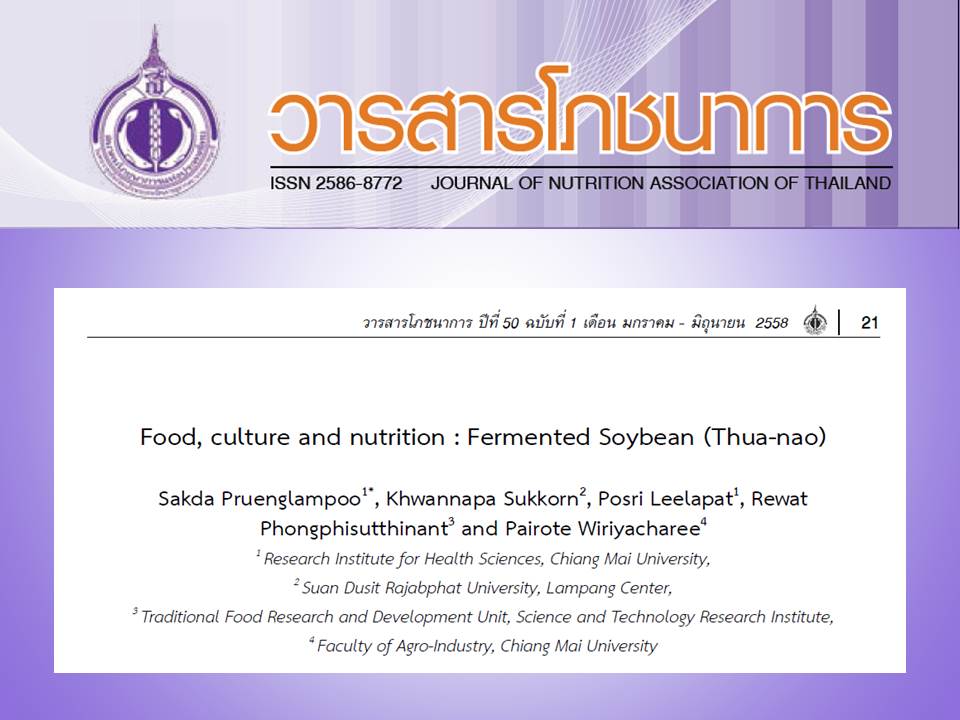
อาหาร วัฒนธรรม และโภชนาการ: ถั่วเหลืองหมัก (ถั่วเน่า)
บทคัดย่อ
ถั่วเน่า คือผลิตภัณฑ์ถั่วเหลืองหมักซึ่งนิยมรับประทานกันมากในชุมชนทางภาคเหนือของประเทศไทย อาหารหมักจากถั่วเหลืองของชนชาติอื่นที่มีกรรมวิธีการผลิตที่คล้ายคลึงกับถั่วเน่า แต่อาจมีลักษณะผลิตภัณฑ์ที่ต่างกันพบได้ในหลายประเทศ ถั่วเน่ามี 2 ประเภท คือแบบเปียก (ถั่วเน่าเมอะ) และแบบแห้ง (ถั่วเน่าแผ่น) วิธีการทำถั่วเน่าประกอบด้วย การแช่ถั่วเหลืองดิบในน้ำค้างคืน ก่อนนำไปต้มในน้ำเดือดประมาณ 3 ถึง 4 ชั่วโมง และทำการหมักตามธรรมชาติ 3 ถึง 4 วัน เชื้อแบคทีเรียที่เกิดขึ้นในการหมัก คือ Bacillus subtilis var. thuanao การได้ทราบข้อมูลพื้นฐานเกี่ยวกับคุณค่าทางโภชนาการของถั่วเหลืองดิบและถั่วเน่า ที่ผลิตได้ในภาคเหนือของประเทศไทย ไม่เพียงจะนำไปสู่การพัฒนาผลิตภัณฑ์ของถั่วเน่าให้มีการสุขาภิบาลดีขึ้น และมีคุณค่าทางโภชนาการสูงขึ้นแล้ว แต่ยังเป็นการรักษาวัฒนธรรมอาหารท้องถิ่นให้ยั่งยืนต่อไปอีกด้วย
เอกสารอ้างอิง
2. อารี ชูวิสิฐกุล, ปิติ กาลธิยานันท์. ถั่วเน่า…อาหารพื้นเมือง ภูมิปัญญาของคนไทยเมืองเหนือ. วารสารกรมวิทยาศาสตร์การบริการ. 2550;55(173):33-4.
3. จุฑารัตน์ สุภาษี. การผลิตและการบริโภคถั่วเน่าของกลุ่มไทยใหญ่ อำเภอแม่สะเรียง จังหวัดแม่ฮ่องสอน [วิทยานิพนธ์ปริญญาวิทยาศาสตร์มหาบัณฑิต]. เชียงใหม่: มหาวิทยาลัยเชียงใหม่; 2544.
4. ปฐมาภรณ์ วิโรจน์พันธุ์. ถั่วเน่าปรุงรสและกลิ่นหอมให้อาหาร. นิตยสารครัว. 2548;12(136):82-7.
5. ศักดา พรึงลำภู, ขวัญนภา สุขคร, ไพโรจน์ วิริยจารี และคณะ. โครงการพัฒนาคุณค่าทางโภชนาการของอาหารพื้นบ้านตามหลักปรัชญาเศรษฐกิจพอเพียง: ถั่วเน่า. เชียงใหม่: มหาวิทยาลัยเชียงใหม่; 2551.
6. Sneath PHA. Endospore-forming gram-positive rods and cocci. In: Sneath PHA, Mair NS, Sharpe MS, Holt JG, editors. Bergey’s manual of systematic bacteriology. 9th ed. Baltimore, MD: Williams & Wikins; 1986.
7. Steinkraus. Indigenous fermented foods involving an alkaline fermentation. 2nd ed. NY: Marcel Dekker; 1955.
8. Messina M. Role of soy in promoting health. Food focus Thailand industry focused magazine for F&B professionals. 2007;2(12):24-7.
9. Murphy PA, Barua K, Hauck CC. Solvent extraction selection in the determination of Isoflavones in soy foods. J Chromatogr B Analyt Technol Biomed Life Sci. 2002;777(1-2):129-38.
10. Carrao-Panizzi MC, Bordingnon JR. Activity of beta-glucosidase and levels of isoflavone glucosidases in soybean cultivars affected by the environment. Pesq Agropec Bras. 2000;35(5):873-8.
11. Choi YB, Kim KS, Rhee JS. Hydrolysis of soybean isoflavone glucosides by lactic acid bacteria. Biotechnol Letters. 2002;24:2113-6.
12. Anderson RL, Wolf WJ. Compositional changes in trypsin inhibitors, phytic acid, saponins and isoflavones related to soybean processing. J Nutr. 1995;125(suppl):581-8.
13. Xinhua Y, Vyn TJ. Relationships of isoflavones, oil, and protein in seed with yield of soybean. Agron J. 2005;97:1314-21.
14. Nelson KA, George ER, Teak EN. Effect of Lactofen application timing on yield and isoflavone concentration in soybean seed. Agron J. 2007;99:645-9.
15. Arthur CE, William FK. Soybean isoflavones: effect of environment and variety on composition. J Agric Food Chem. 1983;31:394-6.
16. Hong K, Lee C, Kim SW. Asperillus oryzae GB-107 fermentation improves nutritional quality of food soybean and feed soybean meals. J Medicinal food. 2004;7(4):430-6.
17. Chukeatirote E, Thakang P. Chemical composition of thua nao-a fermented soybean food of northern Thailand. Chiang Mai J Sci. 2006;33(2):243-5.
18. Sarkar PK, Tamang JP, Cook PE, Owens JD. Kinema-a traditional soybean fermented food: proximate composition and microflora. Food Microbiology. 1994;11(1):47-55.
ดาวน์โหลด
เผยแพร่แล้ว
รูปแบบการอ้างอิง
ฉบับ
ประเภทบทความ
สัญญาอนุญาต
บทความที่เผยแพร่ในวารสารโภชนาการ เป็นลิขสิทธิ์ของสมาคมโภชนาการแห่งประเทศไทยฯ

