
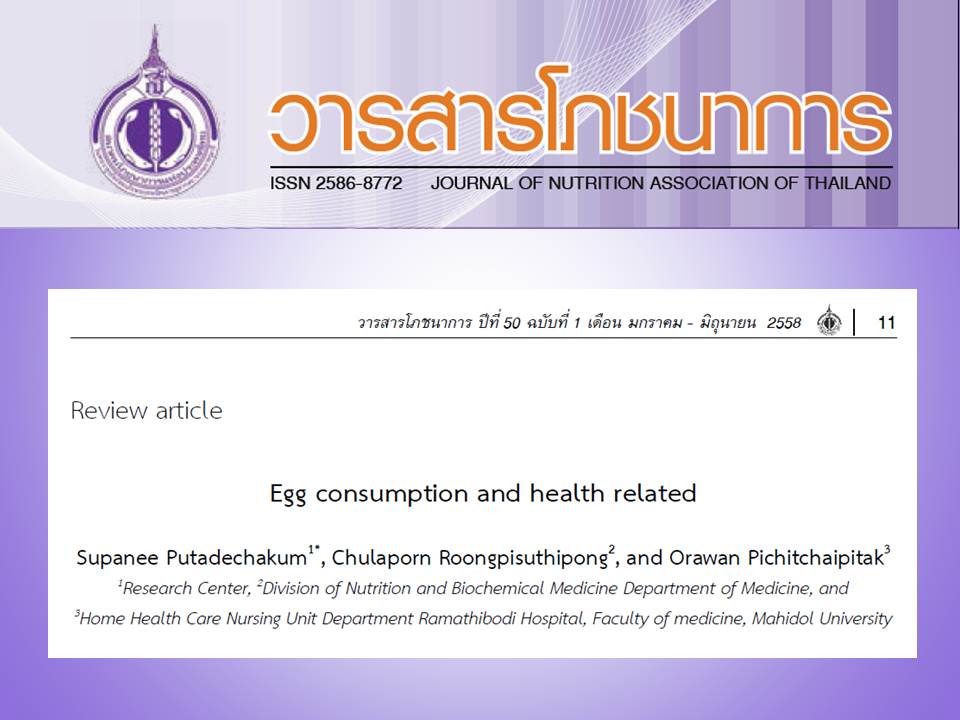
การบริโภคไข่กับสุขภาพ
บทคัดย่อ
ไข่เป็นอาหารที่มีการบริโภคได้ตลอดทั้งปี ราคาไม่แพงมาก ทั้งยังมีคุณค่าทางโภชนาการสูง ไข่จึงเป็นอาหารที่มีประโยชน์ต่อร่างกาย โดยให้สารอาหารที่จำเป็นหลายชนิด แม้ว่าในไข่แดงจะมีปริมาณโคเลสเตอรอลค่อนข้างสูงแต่ประโยชน์ของโคเลสเตอรอล คือเป็นส่งนประกอบที่สำคัญของเซลล์ และเป็นสารที่สังเคราะห์สาระสำคัญหลายชนิดในร่างกาย ในไข่ 1 ฟองมีโคเลสเตอรอลประมารณ 205 มิลลิกรัม คิดเป็นร้อยละ 68 ของโคเลสเตอรอลที่แนะนำให้รับประทานได้ต่อวัน โคเลสเตอรอลในอาหารที่เรารับประทานไม่ได้เปลี่ยนเป็นโคเลสเตอรอลในเลือดโดยตรง ปริมาณโคเลสเตอรอลในเลือดส่วนใหญ่ร่างกายสร้างขึ้นเองจากการทำงานของตับ ถ้าเราได้รับโคเลสเตอรอลจากอาหารมาก ร่างกายจะปรับตัวให้ตับสร้างโคเลสเตอรอลลดลง นอกจากนี้ชนิดของไขมันในอาหารที่เรารับประทาน เช่น ไขมันชนิดอิ่มตัว (Saturated Fat) และไขมันชนิดทรานส์ (Trans Fatty Acid) มีส่วนสัมพันธ์กับการเพิ่มปริมาณของโคเลสเตอรอลในเลือด ทำให้เพิ่มความเสี่ยงของโรคหัวใจและหลอดเลือด โดยเฉพาะอย่างยิ่งถ้าการเพิ่มของระดับโคเลสเตอรอลในเลือดเป็นชนิด Low Density Lipoprotein Cholesterol (LDL-C) จากการศึกษาทั้งทาง epidemiological และ clinical studies แสดงให้เห็นว่าโคเลสเตอรอลจากอาหารที่บริโภคไม่มีนัยสำคัญต่อการเกิดภาวะ atherosclerosis และความเสี่ยงต่อโรคหัวใจและหลอดเลือด ในผู้ป่วยเบาหวานที่มีการควบคุมน้ำหนักตัวและอาหารไขมันที่บริโภคอย่างเคร่งครัดพบว่าไม่มีผลต่อการเปลี่ยนแปลงระดับไขมันในเลือดจึงไม่เพิ่มความเสี่ยงต่อโรคหัวใจและหลอดเลือด การรู้จักรับประทานไข่ให้เป็นจะเกิดประโยชน์ต่อร่างกาย โดยรับประทานร่วมกับอาหารในหมวดอื่น ๆ ให้หลากหลาย ในปริมาณที่เหมาะสม หลีกเลี่ยงไขมันอิ่มตัว และกรดไขมันชนิดทรานส์ ข้อควรระวังในการรับประทานไข่ คือควรทำความสะอาดไข่ก่อนปรุงอาหารเพราะเปลือกไข่อาจปนเปื้อนเชื้อแบคทีเรียซึ่งเป็นสาเหตุของโรคลำไส้อักเสบได้
เอกสารอ้างอิง
2. พูนศรี เลิศลักขณวงศ์. การบริโภคไข่ [อินเตอร์เน็ต]. 2548 [เข้าถึงเมื่อ 10 มกราคม 2558]. เข้าถึงได้จาก: https:// nutrition. anamai.moph.go.th/temp/main/view.php?group=1&id=599.
3. Kris G. Eggs and cholesterol – how many eggs can you safely eat? [internet]. 2014 [cited 2015 Feb 3]. Available from: https://authoritynutrition.com/how-many-eggsshould-you-eat/.
4. Kresser C. Cholesterol doesn’t cause heart disease [internet]. 2014 [cited 2015 Feb 10]. Available from: https://chriskresser.com/cholesterol-doesnt-cause-heart-disease.
5. Kendrick M. Why the cholesterol-heart disease theory is wrong [internet]. 2002 [cited 2015 Jan 20]. Available from: https://www.thincs.org/Malcolm. choltheory.htm.
6. Rong Y, Chen L, Zhu T, et al. Egg consumption and risk of coronary heart disease and stroke: Dose-response metaanalysis of prospective cohort studies [internet]. 2013 [cited 2015 Jan 10]. Available from: https://dx.doi.org/10.1136/bmj.e8539.
7. Hu FB, Stampfer MJ, Rimm EB, Manson JE, Ascherio A, Colditz GA, et al. A prospective study of egg consumption and risk of cardiovascular disease in men and women. JAMA. 1999;281(15):1387-94.
8. McNamara DJ. Dietary cholesterol and atherosclerosis. BBA. 2000;1529(1-3):310-20.
9. The Nutrition Source. Eggs and heart disease [internet]. 2014 [cited 2015 Mar 10]. Available from: https://www.hsph.harvard.edu/nutrition source/eggs/.
10. Fernandez ML. Dietary cholesterol provided by eggs and plasma lipoproteins in healthy populations. Curr Opin Clin Nutr Metab Care. 2006;9:8-12.
11. Djousse L, Gaziano JM. Egg consumption and risk of heart failure in the physicians’ health study. Circulation. 2008;117:512-6.
12. Djoussé L, Gaziano JM. Egg consumption in relation to cardiovascular disease and mortality: the physicians' health study. Am J Clin Nutr. 2008;87(4):964-9.
13. Fuller NR, Caterson ID, Sainsbury A, Denyer G, Fong M, Gerofi J, et al. The effect of a high-egg diet on cardiovascular risk factors in people with type 2 diabetes: the diabetes and egg (DIABEGG) study-a 3-mo randomized controlled trial. Am J Clin Nutr. 2015;101(4):705-13.
14. Roongpisuthipong C, Klangjareonchai T, Roongpisuthipong W, Putadechakum S, Sritara P. Effect of egg consumption in overweight and obese hypercholesterolemic women. J Nutr Food Sci [internet]. 2012 [cited 2015 Mar 18];2:163. Available from: https://ajcn.nutrition.org/content/early/2015/02/11/ ajcn.114. 096925.full.pdf+html.
15. Klangjareonchai T, Putadechakum S, Sritara P, Roongpisuthipong C. The Effect of egg consumption in hyperlipidemic subjects during treatment with lipid-lowering drugs. J Lipid [internet]. 2012 [cited 2015 Mar 8];2012:672720. Available from: https://www.hindawi.com/journals/jl/ 2012/672720/.
16. Putadechakum S, Phanachet P, Pakpeankitwattana V, Klangjareonchai T, Roongpisuthipong C. Effect of daily egg ingestion with Thai food on serum lipids in hyperlipidemic adults. ISRN Nutr [internet]. 2013 [cited 2015 Mar 18];2013:580213. Available from:https://www.hindawi.com/journals/isrn/2013/ 580213/.
17. Techakriengkrai T, Klangjareonchai T, Pakpeankitwattana V, Sritara P, Roongpisuthipong C. The effect of ingestion of egg and low density lipoprotein (LDL) oxidation on serum lipid profiles in hypercholesterolemic women. Songklanakarin J Sci Technol. 2012;34(2):173-8.
18. Blessoa CN, Andersena CJ, Barona J, Volek JS, Fernandez ML. Whole egg consumption improves lipoprotein profiles and insulin sensitivity to a greater extent than yolk-free egg substitute in individuals with metabolic syndrome. Metabolism. 2013;62(3):400–10.
19. ดร.พรศรี เหล่ารุจิสวัสดิ์. ภาพรวมอุตสาหกรรม ไข่ไก่ของโลกและไทย 2552-2556 [อินเตอร์เน็ต]. 2557 [เข้าถึงเมื่อ 22 มีนาคม 2558]. เข้าถึงได้จาก: https://www.egg-thailand.com/upload/images/Document/สถิติ/ภาพรวมปศุสัตว์โลกและไทย_2557_ไข่.pdf.
ดาวน์โหลด
เผยแพร่แล้ว
รูปแบบการอ้างอิง
ฉบับ
ประเภทบทความ
สัญญาอนุญาต
บทความที่เผยแพร่ในวารสารโภชนาการ เป็นลิขสิทธิ์ของสมาคมโภชนาการแห่งประเทศไทยฯ

