
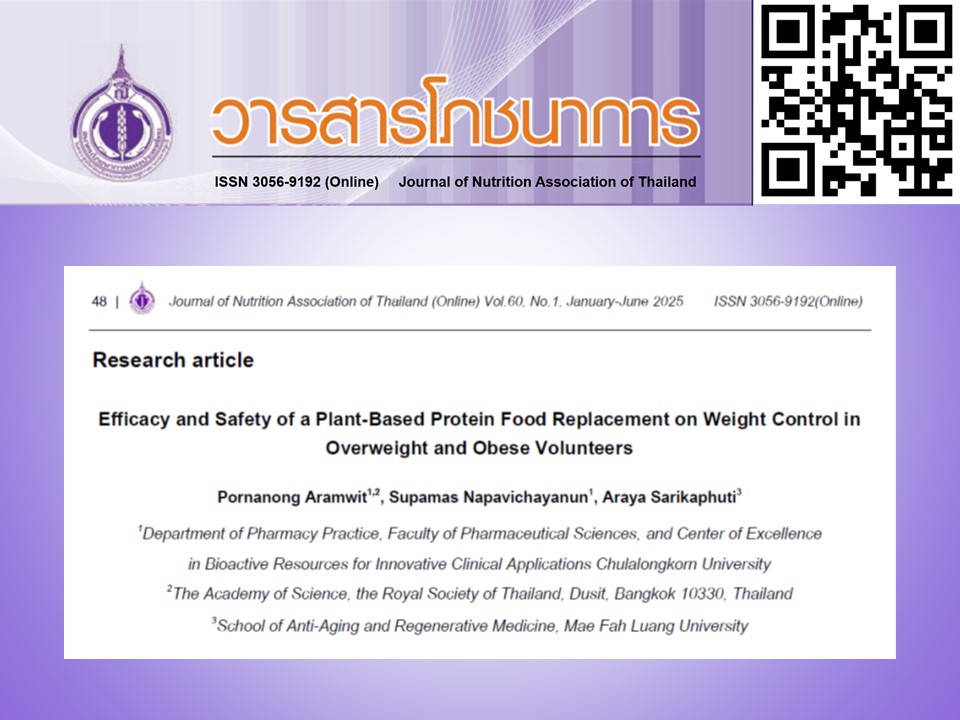
Efficacy and Safety of a Plant-Based Protein Food Replacement on Weight Control in Overweight and Obese Volunteers
Keywords:
อาหารทดแทน, โปรตีนจากพืช, น้ำหนักเกิน, อ้วนAbstract
Obesity and being overweight are public health problems. They are also causes of other diseases. The development of an alternative food replacement may be another option for weight control. This study evaluates the efficacy and safety of a plant-based protein meal replacement product for weight control in overweight and obese individuals. A total of 48 participants were divided into two groups: an intervention group receiving the meal replacement (1 sachet mixed with 250 mL water, consumed once daily as a dinner substitute for 8 weeks) and a control group maintaining their regular diet. The results showed significant reductions in body weight and body mass index in the intervention group compared to controls after at least two weeks (p < 0.05). Additionally, hip circumference decreased more significantly in the intervention group after at least four weeks (p < 0.05), and the product demonstrated potential anti-aging effects by delaying cellular senescence. The plant-based protein meal replacement was found to be safe, with no serious adverse reactions reported, although some participants experienced mild bloating and abdominal tightness. Overall, this product proved effective for short-term weight management in overweight and obese individuals.
References
Clinical Guidelines on the Identification, Evaluation, and Treatment of Overweight and Obesity in Adults--The Evidence Report. National Institutes of Health. Obes Res. 1998;6 Suppl 2:51s-209s.
Yumuk V, Tsigos C, Fried M, Schindler K, Busetto L, Micic D, et al. European Guidelines for Obesity Management in Adults. Obes Facts. 2015;8(6):402-24.
WHOExpertConsultation. Appropriate body-mass index for Asian populations and its implications for policy and intervention strategies. Lancet. 2004;363(9403):157-63.
WorldHealthOrganization. Obesity and overweight [Internet]. [cited. March, 29, 2025. Available from: https://www.who.int/news-room/fact-sheets/detail/obesity-and-overweight
Hoffman JR, Falvo MJ. Protein - Which is Best? J Sports Sci Med. 2004;3(3):118-30.
Tiekou Lorinczova H, Deb S, Begum G, Renshaw D, Zariwala MG. Comparative Assessment of the Acute Effects of Whey, Rice and Potato Protein Isolate Intake on Markers of Glycaemic Regulation and Appetite in Healthy Males Using a Randomised Study Design. Nutrients. 2021;13(7).
Babault N, Païzis C, Deley G, Guérin-Deremaux L, Saniez M-H, Lefranc-Millot C, et al. Pea proteins oral supplementation promotes muscle thickness gains during resistance training: a double-blind, randomized, Placebo-controlled clinical trial vs. Whey protein. Journal of the International Society of Sports Nutrition. 2015;12(1):3.
Tharrey M, Mariotti F, Mashchak A, Barbillon P, Delattre M, Fraser GE. Patterns of plant and animal protein intake are strongly associated with cardiovascular mortality: the Adventist Health Study-2 cohort. Int J Epidemiol. 2018;47(5):1603-12.
Kahleova H, Fleeman R, Hlozkova A, Holubkov R, Barnard ND. A plant-based diet in overweight individuals in a 16-week randomized clinical trial: metabolic benefits of plant protein. Nutr Diabetes. 2018;8(1):58.
Mudgil D, Barak S, Khatkar BS. Guar gum: processing, properties and food applications-A Review. J Food Sci Technol. 2014;51(3):409-18.
Keskin SO, Sumnu G, Sahin S. A study on the effects of different gums on dielectric properties and quality of breads baked in infrared-microwave combination oven. Eur Food Res Technol. 2007;224(3):329-34.
Zambrano F, Despinoy P, Ormenese RCSC, Faria EV. The use of guar and xanthan gums in the production of ‘light’ low fat cakes. Int J Food Sci Technol. 2004;39(9):959-66.
Gujral HS, Sharma A, Singh N. Effect of hydrocolloids, storage temperature, and duration on the consistency of tomato ketchup. Int J Food Prop. 2002;5(1):179-91.
Andrès S, Zaritzky N, Califano A. The effect of whey protein concentrates and hydrocolloids on the texture and colour characteristics of chicken sausages. Int J Food Sci Technol. 2006;41(8):954-61.
Yasukawa Z, Inoue R, Ozeki M, Okubo T, Takagi T, Honda A, et al. Effect of Repeated Consumption of Partially Hydrolyzed Guar Gum on Fecal Characteristics and Gut Microbiota: A Randomized, Double-Blind, Placebo-Controlled, and Parallel-Group Clinical Trial. Nutrients. 2019;11(9).
Okubo T, Ishihara N, Takahashi H, Fujisawa T, Kim M, Yamamoto T, et al. Effects of Partially Hydrolyzed Guar Gum Intake on Human Intestinal Microflora and Its Metabolism. Biosci Biotechnol Biochem. 1994;58(8):1364-9.
Kapoor MP, Sugita M, Fukuzawa Y, Okubo T. Impact of partially hydrolyzed guar gum (PHGG) on constipation prevention: A systematic review and meta-analysis. J Funct Foods. 2017;33:52-66.
Homann HH, Kemen M, Fuessenich C, Senkal M, Zumtobel V. Reduction in diarrhea incidence by soluble fiber in patients receiving total or supplemental enteral nutrition. JPEN J Parenter Enteral Nutr. 1994;18(6):486-90.
Todd PA, Benfield P, Goa KL. Guar gum. A review of its pharmacological properties, and use as a dietary adjunct in hypercholesterolaemia. Drugs. 1990;39(6):917-28.
Nimbkar S, Leena MM, Moses JA, Anandharamakrishnan C. Medium chain triglycerides (MCT): State-of-the-art on chemistry, synthesis, health benefits and applications in food industry. Compr Rev Food Sci Food Saf. 2022;21(2):843-67.
St-Onge MP, Bosarge A. Weight-loss diet that includes consumption of medium-chain triacylglycerol oil leads to a greater rate of weight and fat mass loss than does olive oil. Am J Clin Nutr. 2008;87(3):621-6.
Han JR, Deng B, Sun J, Chen CG, Corkey BE, Kirkland JL, et al. Effects of dietary medium-chain triglyceride on weight loss and insulin sensitivity in a group of moderately overweight free-living type 2 diabetic Chinese subjects. Metabolism. 2007;56(7):985-91.
St-Onge M-P, Bosarge A. Weight-loss diet that includes consumption of medium-chain triacylglycerol oil leads to a greater rate of weight and fat mass loss than does olive oil2. Am J Clin Nutr 2008;87(3):621-6.
Chong PW, Beah ZM, Grube B, Riede L. IQP-GC-101 reduces body weight and body fat mass: a randomized, double-blind, placebo-controlled study. Phytother Res. 2014;28(10):1520-6.
Bays HE, Fitch A, Christensen S, Burridge K, Tondt J. Anti-Obesity Medications and Investigational Agents: An Obesity Medicine Association (OMA) Clinical Practice Statement (CPS) 2022. Obes Pillars. 2022;2:100018.
Volek JS, Gómez AL, Love DM, Weyers AM, Hesslink R, Jr., Wise JA, et al. Effects of an 8-week weight-loss program on cardiovascular disease risk factors and regional body composition. Eur J Clin Nutr. 2002;56(7):585-92.
Porter KN, Johnson MA. Obesity is more strongly associated with inappropriate eating behaviors than with mental health in older adults receiving congregate meals. J Nutr Gerontol Geriatr. 2011;30(4):403-15.
Micha R, Peñalvo JL, Cudhea F, Imamura F, Rehm CD, Mozaffarian D. Association Between Dietary Factors and Mortality From Heart Disease, Stroke, and Type 2 Diabetes in the United States. JAMA. 2017;317(9):912-24.
Rizzo NS, Jaceldo-Siegl K, Sabate J, Fraser GE. Nutrient profiles of vegetarian and nonvegetarian dietary patterns. J Acad Nutr Diet. 2013;113(12):1610-9.
Fraser GE. Vegetarian diets: what do we know of their effects on common chronic diseases? Am J Clin Nutr. 2009;89(5):1607s-12s.
Dong Z, Sinha R, Richie JP, Jr. Disease prevention and delayed aging by dietary sulfur amino acid restriction: translational implications. Ann N Y Acad Sci. 2018;1418(1):44-55.
Jenkins DJ, Kendall CW, Marchie A, Faulkner D, Vidgen E, Lapsley KG, et al. The effect of combining plant sterols, soy protein, viscous fibers, and almonds in treating hypercholesterolemia. Metabolism. 2003;52(11):1478-83.
Lin Y, Bolca S, Vandevijvere S, De Vriese S, Mouratidou T, De Neve M, et al. Plant and animal protein intake and its association with overweight and obesity among the Belgian population. Br J Nutr. 2011;105(7):1106-16.
Tahavorgar A, Vafa M, Shidfar F, Gohari M, Heydari I. Whey protein preloads are more beneficial than soy protein preloads in regulating appetite, calorie intake, anthropometry, and body composition of overweight and obese men. Nutr Res. 2014;34(10):856-61.
Krotkiewski M. Effect of guar gum on body-weight, hunger ratings and metabolism in obese subjects. Br J Nutr. 1984;52(1):97-105.
Dall'Alba V, Silva FM, Antonio JP, Steemburgo T, Royer CP, Almeida JC, et al. Improvement of the metabolic syndrome profile by soluble fibre – guar gum – in patients with type 2 diabetes: a randomised clinical trial. Br J Nutr. 2013;110(9):1601-10.
Rego Costa AC, Rosado EL, Soares-Mota M. Influence of the dietary intake of medium chain triglycerides on body composition, energy expenditure and satiety: a systematic review. Nutr Hosp. 2012;27(1):103-8.
St-Onge MP, Bosarge A, Goree LL, Darnell B. Medium chain triglyceride oil consumption as part of a weight loss diet does not lead to an adverse metabolic profile when compared to olive oil. J Am Coll Nutr. 2008;27(5):547-52.
Han JR, Deng B, Sun J, Chen CG, Corkey BE, Kirkland JL, et al. Effects of dietary medium-chain triglyceride on weight loss and insulin sensitivity in a group of moderately overweight free-living type 2 diabetic Chinese subjects. Metabolism. 2007;56(7):985-91.
Sawicki T, Jabłońska M, Danielewicz A, Przybyłowicz KE. Phenolic Compounds Profile and Antioxidant Capacity of Plant-Based Protein Supplements. Molecules. 2024;29(9).
Downloads
Published
How to Cite
Issue
Section
License
Upon acceptance of an article, copyright is belonging to the Nutrition Association of Thailand.

