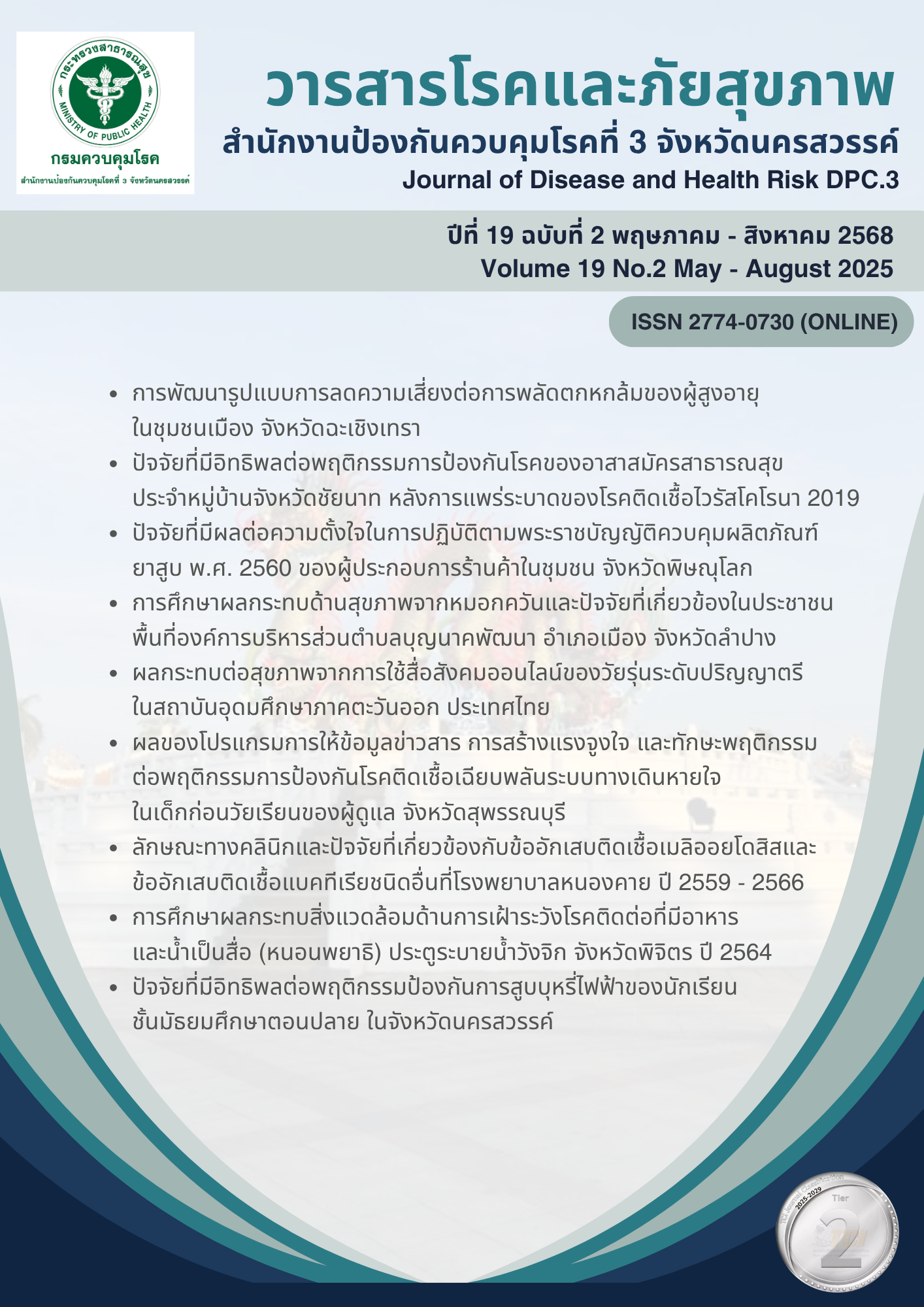
ผลกระทบต่อสุขภาพจากการใช้สื่อสังคมออนไลน์ของวัยรุ่นระดับปริญญาตรี ในสถาบันอุดมศึกษาภาคตะวันออก ประเทศไทย
คำสำคัญ:
สื่อสังคมออนไลน์, ผลกระทบต่อสุขภาพ, วัยรุ่นบทคัดย่อ
วัยรุ่นไทยมีแนวโน้มการใช้สื่อสังคมออนไลน์เพิ่มสูงขึ้น ซึ่งสื่อสังคมออนไลน์เป็นปัจจัยสำคัญที่มีผลกระทบต่อสุขภาพ การวิจัยนี้มีวัตถุประสงค์เพื่อศึกษาผลกระทบต่อสุขภาพ และปัจจัยที่มีความสัมพันธ์กับผลกระทบต่อสุขภาพจากการใช้สื่อสังคมออนไลน์ของวัยรุ่นระดับปริญญาตรีในสถาบันอุดมศึกษา ภาคตะวันออกประเทศไทย เป็นการวิจัยพรรณนาภาคตัดขวาง กลุ่มตัวอย่างคือวัยรุ่นสถาบันอุดมศึกษาภาคตะวันออก จำนวน 379 คน สุ่มตัวอย่างแบบกลุ่มหลายขั้นตอน เครื่องมือที่ใช้เป็นแบบสอบถามออนไลน์ วิเคราะห์ข้อมูลด้วยสถิติพรรณนาในรูปจำนวน ร้อยละ ค่าเฉลี่ย ส่วนเบี่ยงเบนมาตรฐาน วิเคราะห์หาความสัมพันธ์ด้วยสถิติสัมประสิทธิ์สหสัมพันธ์แบบเพียร์สันที่ความเชื่อมั่นร้อยละ 95 ผลการวิจัยพบว่า กลุ่มตัวอย่างส่วนมากเข้าใช้สื่อสังคมออนไลน์ ร้อยละ 99.8 โดยในหนึ่งวันเข้าใช้สื่อสังคมออนไลน์มากกว่า 7 ชั่วโมง ร้อยละ 42.5 และผลกระทบต่อสุขภาพจากการใช้สื่อสังคมออนไลน์โดยรวมอยู่ในระดับต่ำ ร้อยละ 49.7 ปัจจัยที่สัมพันธ์กับผลกระทบต่อสุขภาพจากการใช้สื่อสังคมออนไลน์ อย่างมีนัยสำคัญทางสถิติที่ 0.05 ได้แก่ ทัศนคติเกี่ยวกับการใช้สื่อสังคมออนไลน์ (r=0.455, p<0.001) ความรู้เกี่ยวกับการใช้สื่อสังคมออนไลน์ (r=-0.214, p<0.001) ระยะเวลาในการใช้สื่อสังคมออนไลน์ (r=0.133, p=0.010) และจำนวนประเภทสื่อสังคมออนไลน์ที่ใช้ (r=-0.105, p=0.041) การศึกษา พบความรู้ ทัศนคติ และการใช้สื่อสังคมออนไลน์มีความสัมพันธ์กับผลกระทบต่อสุขภาพของวัยรุ่นไทย ดังนั้นควรส่งเสริมการเข้าถึงสื่อสังคมออนไลน์ที่เหมาะสม โดยเฉพาะการส่งเสริมทัศนคติและความรู้เกี่ยวกับผลกระทบต่อสุขภาพจากการใช้สื่อสังคมออนไลน์ รวมถึงส่งเสริมพัฒนาทักษะการจัดการตนเองเพื่อลดผลกระทบต่อสุขภาพจากการใช้สื่อสังคมออนไลน์ต่อไป
เอกสารอ้างอิง
Faculty of Education, Ramkhamhaeng University. Knowledge management guide: using technology to promote learning in a diverse approach [Internet]. 2019 [cited 2024 May 23]. Available from: http://www.edu.ru.ac.th/images/edu_KM/km-poster-2562-03.pdf (in Thai).
National Statistical Office, Ministry of Digital Economy and Society. The 2018 household survey on the use of information and communication technology (quarter4) [Internet]. 2018 [cited 2024 May 23]. Available from: https://www.nso.go.th/nsoweb/storage/survey_detail (in Thai).
Arumachutee T, Jongasayakul W. Video streaming application usage of generation X, generation Y and generation Z. Journal of Modern Learning Development. 2022;7:34-48. (in Thai).
Kemp S. Digital 2022: October global stat shot report [Internet]. 2022 [cited 2024 May 23]. Available from: https://datareportal.com/reports/digital-2022-thailand.
Senawong N. A study of behavior for using of social media of generation Z in the new normal era in Bangkok [Thesis]. Bangkok: Siam University; 2021. (in Thai).
Thomée S, Härenstam A, Hagberg M. Mobile phone use and stress, sleep disturbances, and symptoms of depression among young adults-a prospective cohort study. BMC Public Health. 2011;11: 1-11.
Hwang KH, Yoo YS, Cho OH. Smartphone overuse and upper extremity pain, anxiety, depression and interpersonal relationships among college students. Korea Content Assoc. 2012;12: 365-75.
Intolo P, Sirininlakul N, Saksanit N, Kongdontree P, Thuwatorn P. Pain and muscle activity of neck, shoulder, upper back and arm during smartphone use in women aged 18-25 years old. J Health Syst Res. 2016;10: 351-60. (in Thai).
Chuemongkon W, Inthitanon T, Wangsate J. Impact of smartphone and tablet use on health and academic performance of pharmacy students at Srinakharinwirot University. Srinagarind Med J. 2019;34: 90-8. (in Thai).
Suppharakornsaku Y. Phetchabun high school student’s behaviors in using online social networks and their impact. Humanity and Social Science Journal. 2017;8: 53-71. (in Thai).
Vannucci A, and Ohannessian CM. Social media use subgroups differentially predict psychosocial well-being during early adolescence. Journal of youth adolescence 2019;48: 1469-93.
Hou Y, Xiong D, Jiang T, Song L, and Wang Q. Social media addiction: Its impact, mediation, and intervention. Cyberpsychology: Journal of Psychosocial Research on Cyberspace. 2019; 13. doi:10.5817/CP2019-1-4.
Lau W. Effects of social media usage and social media multitasking on the academic performance of university students. Computers in Human Behavior. 2017;68: 286-91.
Thamduengsri S. Social network usage behaviors of Rajabhat Maha Sarakham University’s students [Thesis]. Maha Sarakham: Rajabhat Maha Sarakham University; 2019. (in Thai).
Krejcie RV, Morgan DW. Determining sample size for research activities. EPM 1970;30: 607-10.
Clark-Carter D. Percentiles. In: Everitt BS, Howell D, editors. Encyclopedia of Statistics in Behavioral Science. 3rd ed. Hoboken, NJ: Wiley; 2005. p.1539-40.
Ketverapong R. Online media usage behavior, media literacy and cyberbullying awareness of youth in Chiang Mai Province. Ganesha Journal. 2021;17: 143-60. (in Thai).
Klapper JT. The effects of mass communication. New York: The Free Press; 1960.
Chuekuna S, and Suwannaphant K. Factors associated social media networks usage impact among Sirindhorn College of Public Health students, Khon Kaen Province. Thai Health Science Journal and community public health. 2020;3: 70-82. (in Thai).
Sarawanawong J, Fyeted K, Ngernpoolsap D, Chantrdee W. Online social media usage behaviors of undergraduate students, Kasetsart University. Journal of Library and Information Science Srinakharinwirot University 2017;10: 16-31. (in Thai).
White CM. Social media, crisis communication, and emergency management: leveraging web 2.0 technologies. Boca Raton, FL: CRC Press; 2012.
Thamaduengsri S. Behaviors in accessing social media of Rajabhat Maha Sarakham University students. Journal of Social Science for Local Rajabhat Mahasarakham University. 2021;5: 142-50. (in Thai).
Wonginchan A, Tangpukdee J, Wonginchan S, Kearttiwongkru S, Khonggungong S. Association of online media use and holistic health problems of school-aged children in Thailand 4.0 era. Songklanagarind Journal of Nursing. 2022;42: 61-72. (in Thai)
Thummakul D, Pumtha-it T. Relationship between health literacy and health behavior of the elderly in Bang Phlat district, Bangkok. Journal of health science research 2021;15: 106-118.
ดาวน์โหลด
เผยแพร่แล้ว
รูปแบบการอ้างอิง
ฉบับ
ประเภทบทความ
สัญญาอนุญาต
ลิขสิทธิ์ (c) 2025 วารสารโรคและภัยสุขภาพ สำนักงานป้องกันควบคุมโรคที่ 3 จังหวัดนครสวรรค์

อนุญาตภายใต้เงื่อนไข Creative Commons Attribution-NonCommercial-NoDerivatives 4.0 International License.
ประกาศเกี่ยวกับลิขสิทธิ์
|
บทความที่เผยแพร่ในวารสารโรคและภัยสุขภาพสำนักงานป้องกันควบคุมโรคที่ 3 จังหวัดนครสวรรค์ ถือว่าเป็นผลงานทางวิชาการหรือการวิจัย และวิเคราะห์ ตลอดจนเป็นความเห็นส่วนตัวของผู้เขียน ไม่ใช่ความเห็นของสำนักงานป้องกันควบคุมโรคที่ 3 จังหวัดนครสวรรค์ หรือกองบรรณาธิการแต่ประการใด ผู้เขียนต้องรับผิดชอบต่อบทความของตน |
นโยบายความเป็นส่วนตัว
|
ชื่อและที่อยู่ อีเมล์ ที่ระบุในวารสารโรคและภัยสุขภาพสำนักงานป้องกันควบคุมโรคที่ 3 จังหวัดนครสวรรค์ จะใช้เพื่อระบุตามวัตถุประสงค์ของวารสารเท่านั้น และจะไม่นำไปใช้สำหรับวัตถุประสงค์อื่น หรือต่อบุคคลอื่น |