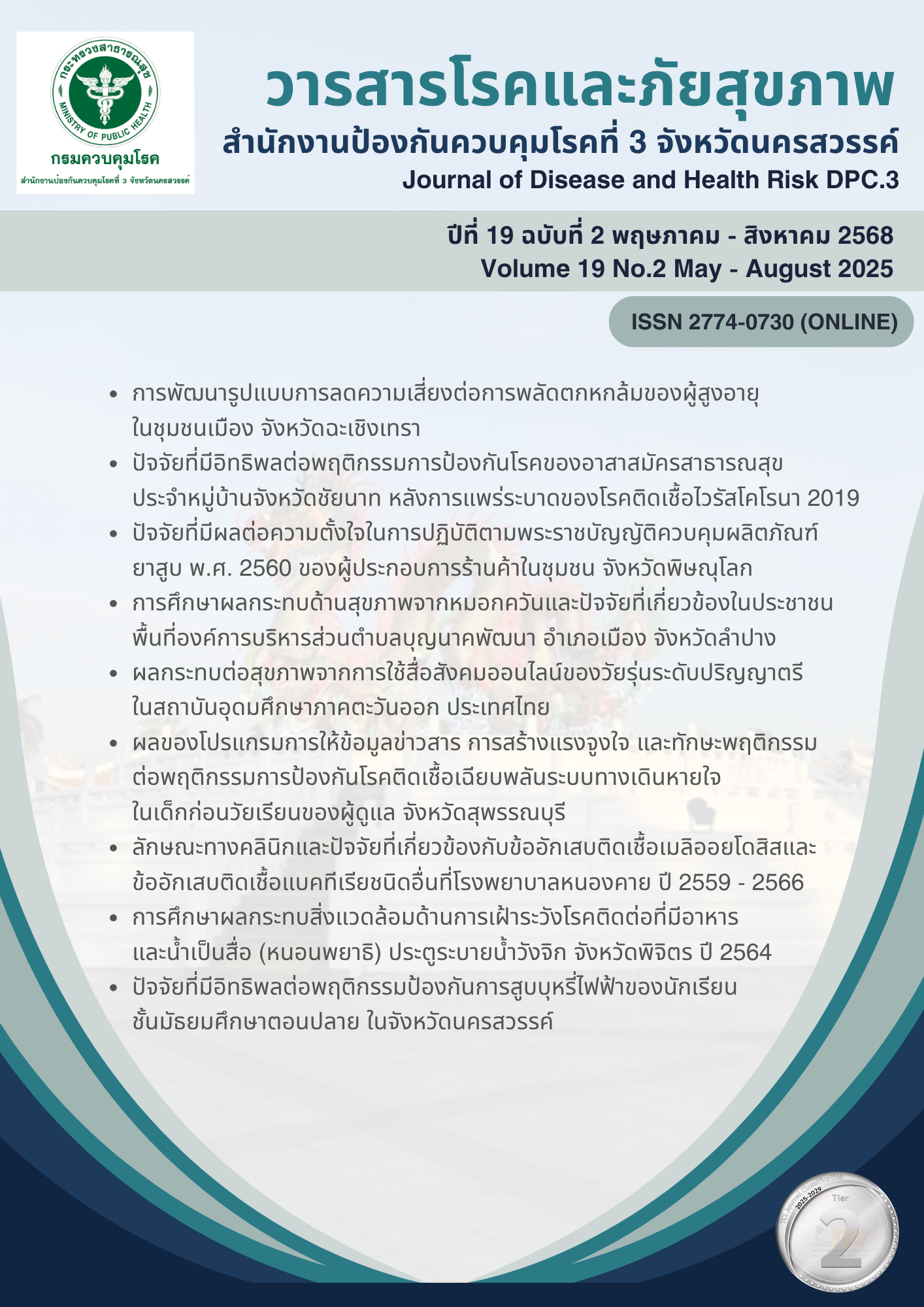
Development of a Fall Risk Reduction Model for Older Adults in Urban Communities, Chachoengsao Province
Keywords:
Falls, Older Adults, Risk Reduction, Urban CommunitiesAbstract
Falls are a significant health issue that adversely affects the well-being and quality of life of older adults, particularly in urban communities with unique risk factors. This action research aimed to develop a fall risk reduction model for older adults in urban communities of Chachoengsao Province. The study involved 160 older adults, selected through simple random sampling from 22 communities within the municipal area of Mueang Chachoengsao District. The research was conducted in three phases. Phase 1 involved assessing the fall risk situation among older adults using a fall prevention behavior questionnaire and a home environment assessment checklist. Phase 2 focused on developing a fall risk reduction model through the A-I-C process, in collaboration with relevant local stakeholders. Data collection tools included meeting records and follow-up survey forms. Phase 3 evaluated the effectiveness of the developed model using a fall prevention behavior questionnaire, a home safety assessment tool (Phase 1), and an outcome monitoring form. Data was analyzed using descriptive statistics, paired t-tests for pre- and post-intervention comparisons, and content analysis. The findings revealed that older adults exhibited increased fall risk behaviors, particularly not using handrails in bathrooms (78.8%) and failing to use stable shower chairs (72.5%). Additionally, most home environments were deemed unsuitable. The fall risk reduction model comprised three key initiatives: promoting community participation in fall prevention activities, conducting training and public awareness campaigns on fall risk reduction, and developing a community-level fall prevention and monitoring system. The evaluation showed a decline and stabilization in fall-related injuries and fatalities among urban older adults. Furthermore, the mean scores for fall prevention behaviors and home safety significantly improved at p-values of 0.001, respectively. This study suggests that future research should compare fall risks between urban and rural settings to develop a more comprehensive and sustainable model. Additionally, policy-level implementation is recommended to mitigate health impacts and enhance the quality of life for older adults in Thai society.
References
Foundation of Thai Gerontology Research and Development Institute (TGRI). The situation of the Thai elderly 2021. Bangkok: Amarin Printing and Publishing; 2021. (in Thai).
Chuanwan S, Tianlai K, Theungklin P. Living arrangements of older adults in urban areas of Thailand to support appropriate housing and care [Research Report]. Institute for Population and Social Research, Mahidol University; 2020. (in Thai).
Samkampang T, Nathapin K. Factors associated with accidents among older adults in Kham Pom Subdistrict, Khon Kaen Province. Journal of Office of Disease Prevention and Control 6 Khon Kaen. 2010;18(1): 61–9. (in Thai).
Tuphanich W, Chailap S, Chailap K. Problems and needs of older adults in urban areas. Vajira Medical Journal and Journal of Urban Medicine. 2019;63(Suppl): 83–92. (in Thai).
Supprasert W, Phromneewong T, Kaewrat W, Meesaard S, Suepjakla A, Udomyong A, et al. The relationship between multifactorial socio-ecological factors and fall risk among older adults in Ban Puek Subdistrict, Mueang District, Chonburi Province. Journal of Public Health and Health Sciences. 2021;4(2): 123–38. (in Thai).
Samatta S, Nathapin K. Factors associated with the accidental of elderly in Na-Fai Sub-district, Muang District, Chaiyaphum. Journal of Medicine and Public Health, Ubon Ratchathani University. 2021;4(2): 89–101. (in Thai).
Chaowno S, Khunkongmee P. Factors influencing fall risk among older adults in the responsibility area of Taksin Family Medicine Clinic, Mueang District, Tak Province. Public Health Journal. 2022;18(1): 31–44. (in Thai).
Damsimai S, Chimhad P, Khaenamkhaew D. The guideline for life quality development of the elderly. Mahachulagajasara Journal. 2022;13(1): 1–9. (in Thai).
Division of Injury Prevention, Department of Disease Control, Ministry of Public Health. Fall prevention in older adults. Department of Disease Control, Ministry of Public Health [Internet]. 2022 [cited 2025 Jan 5]. Available from: https://ddc.moph.go.th/dip/news.php?news=23843 (in Thai).
Registration Administration Bureau, Department of Provincial Administration. Population data. [Internet]. 2022 [cited 2023Mar 7]. Available from: https://shorturl.asia/TJbQ9. (in Thai).
Information and Communication Technology Center, Office of the Permanent Secretary, Ministry of Social Development and Human Security. Thai elderly population: Present and future. (n.d.). Bangkok: Ministry of Social Development and Human Security. (in Thai).
Ratchamee W, Choompaeng T, Suksangpanya L. Factors affecting falls in Health Region 6 [Final Report]. Chonburi: Health Center Region 6, Department of Health, Ministry of Public Health; 2022. (in Thai).
Health Data Center, Ministry of Public Health. Screening of older adults: 10 topics [Internet]. 2022. [cited 2023 Mar 7]. Available from: https://shorturl.asia/zAsWJ. (in Thai).
Local Registration Office, Chachoengsao Municipality. Data on elderly people in Chachoengsao Municipality. Chachoengsao; 2022. (in Thai).
Office of Disease Prevention and Control 6, Chonburi Province. Survey results on the health status of residents in urban housing estates. Chonburi: Office of Disease Prevention and Control 6, Chonburi Province; 2022. (in Thai).
Cohen JM, Uphoff NT. Rural development participation: Concept and measure for project design implementation and evaluation. Rural Development Committee, Center for International Studies. New York: Cornell University Press; 1981.
Daniel WW. Biostatistics: Basic concepts and methodology for the health sciences. 9th ed. New York: John Wiley & Sons; 2010.
Muangsiri K, Maharatpong N, Rodchakpai Y. Factors associated with fall prevention behaviors among older adults in Chonburi Province. Naresuan University Journal. 2017;25(4): 23–33.
Veera Niyomwan. Participatory and creative workshop AIC. Nonthaburi: Textbook Project, Department of Health, Ministry of Public Health; 1999.
Srisaard B. Basic research. 7th ed. Bangkok: Suweeriyasarn; 2002.
Bloom BS. Handbook on formative and summative evaluation of student learning. New York: McGraw-Hill; 1971.
Cronbach LJ. Coefficient Alpha and the internal structure of tests. Psychometrika. 1951;16: 297-334
Ottenbacher K, Ostir G, Peek M, Goodwin J, Markides K. Diabetes mellitus as a risk factor for hip fracture in Mexican American older adults. Journal of Gerontology. 2012;57A(10): 648–53.
Stevens JA, Phelan EA. Development of self-efficacy for preventing falls scale. Phys Ther. 2012;92(4):567–74.
Laokhompruttajarn J, Yatniyom P, Laokhompruttajarn T. The development of fall prevention model in elderly by participation of family, community and local in ABC 6-D area base Chaiyaphum Province. Regional Health Promotion Center 9 Journal. 2024;18(3): 851-60.
Chaowsin N, Chantanassot P, Pupithakkun J. Development of fall prevention model for aging based on community using sufficient economy [Research report]. Nakhon Pathom: Nakhon Pathom Rajabhat University; 2020. (in Thai).
Downloads
Published
How to Cite
Issue
Section
License
Copyright (c) 2025 Journal of Disease and Health Risk DPC.3

This work is licensed under a Creative Commons Attribution-NonCommercial-NoDerivatives 4.0 International License.
Copyright notice
Article published in the Journal of Disease and Health Risk DPC.3 Nakhon Sawan. It is considered a work of academic research and analysis as well as the personal opinion of the author. It is not the opinion of the Office of Disease Prevention and Control 3, Nakhon Sawan. Or the editorial team in any way Authors are responsible for their articles.
Privacy Policy
Name, address and e-mail address specified in the Journal of Disease and Health Risk DPC.3 Nakhon Sawan. It is used for identification purposes of the journal. And will not be used for any other purpose. Or to another person.