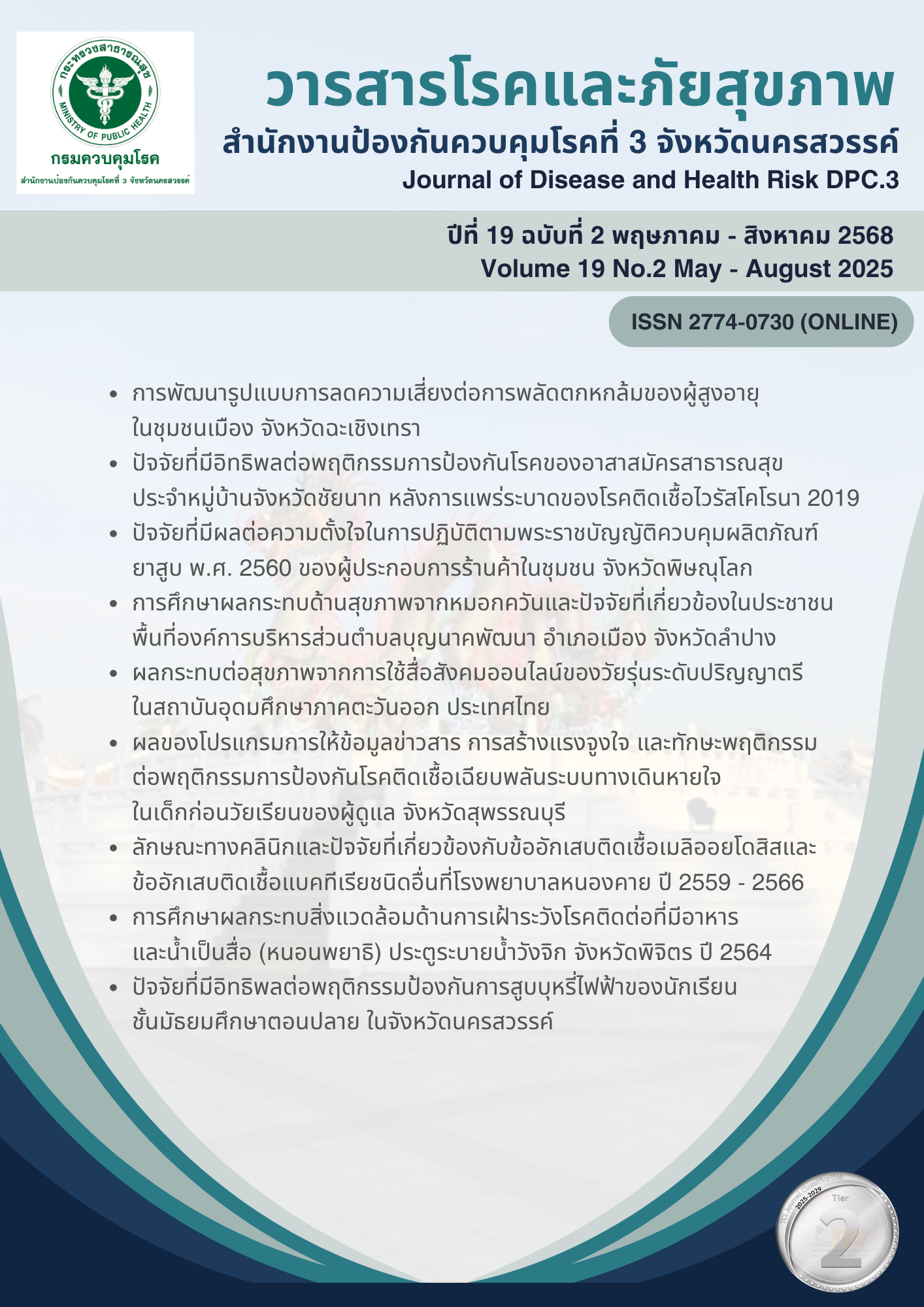
Health Impacts of Social Media Use Among University Undergraduates in the Eastern Region of Thailand
Keywords:
Social Media, Health Impact, AdolescentAbstract
Thai adolescents are higher social media users, and social media usage behavior is a significant factor related to health impacts. The objectives of this study were to examine health impacts, and factors related to health impacts from using social media among undergraduates in universities in the eastern region. The aim of this cross-sectional descriptive study. A multi-stage random sampling was used to recruit 379 adolescents from universities. Data was collected using an online questionnaire and analyzed with descriptive statistics to show frequency, percentage, mean, and standard deviation. Correlations were determined using chi-squared statistical methods and Pearson correlation coefficient tests, with a 95% confidence interval.
The results revealed that 99.8% of university students has access to social media, with 42.5% accessing social media more than 7 hours per day. Additionally, 49.7% reported a low level of health impact from social media use. Pearson correlation analysis indicated significant factors correlated with health impacts from social media use, as follows; attitude toward using social media (r=0.455, p<0.001), knowledge about the health impact of social media use (r=-0.214, p<0.001), access to social media more than had 7-8 hours per day (r=0.133, p=0.010), and the number of types of social media used (r=-0.105, p=0.041). The results showed that adolescents with Attitude, knowledge, and access to social media were significant correlated with health impacts from using social media. The findings suggested that should promote access to appropriate media, specifically regarding should promote attitude, and knowledge toward health impacts from using social media, and promote skill improving self-management for reducing health impacts from using social media.
References
Faculty of Education, Ramkhamhaeng University. Knowledge management guide: using technology to promote learning in a diverse approach [Internet]. 2019 [cited 2024 May 23]. Available from: http://www.edu.ru.ac.th/images/edu_KM/km-poster-2562-03.pdf (in Thai).
National Statistical Office, Ministry of Digital Economy and Society. The 2018 household survey on the use of information and communication technology (quarter4) [Internet]. 2018 [cited 2024 May 23]. Available from: https://www.nso.go.th/nsoweb/storage/survey_detail (in Thai).
Arumachutee T, Jongasayakul W. Video streaming application usage of generation X, generation Y and generation Z. Journal of Modern Learning Development. 2022;7:34-48. (in Thai).
Kemp S. Digital 2022: October global stat shot report [Internet]. 2022 [cited 2024 May 23]. Available from: https://datareportal.com/reports/digital-2022-thailand.
Senawong N. A study of behavior for using of social media of generation Z in the new normal era in Bangkok [Thesis]. Bangkok: Siam University; 2021. (in Thai).
Thomée S, Härenstam A, Hagberg M. Mobile phone use and stress, sleep disturbances, and symptoms of depression among young adults-a prospective cohort study. BMC Public Health. 2011;11: 1-11.
Hwang KH, Yoo YS, Cho OH. Smartphone overuse and upper extremity pain, anxiety, depression and interpersonal relationships among college students. Korea Content Assoc. 2012;12: 365-75.
Intolo P, Sirininlakul N, Saksanit N, Kongdontree P, Thuwatorn P. Pain and muscle activity of neck, shoulder, upper back and arm during smartphone use in women aged 18-25 years old. J Health Syst Res. 2016;10: 351-60. (in Thai).
Chuemongkon W, Inthitanon T, Wangsate J. Impact of smartphone and tablet use on health and academic performance of pharmacy students at Srinakharinwirot University. Srinagarind Med J. 2019;34: 90-8. (in Thai).
Suppharakornsaku Y. Phetchabun high school student’s behaviors in using online social networks and their impact. Humanity and Social Science Journal. 2017;8: 53-71. (in Thai).
Vannucci A, and Ohannessian CM. Social media use subgroups differentially predict psychosocial well-being during early adolescence. Journal of youth adolescence 2019;48: 1469-93.
Hou Y, Xiong D, Jiang T, Song L, and Wang Q. Social media addiction: Its impact, mediation, and intervention. Cyberpsychology: Journal of Psychosocial Research on Cyberspace. 2019; 13. doi:10.5817/CP2019-1-4.
Lau W. Effects of social media usage and social media multitasking on the academic performance of university students. Computers in Human Behavior. 2017;68: 286-91.
Thamduengsri S. Social network usage behaviors of Rajabhat Maha Sarakham University’s students [Thesis]. Maha Sarakham: Rajabhat Maha Sarakham University; 2019. (in Thai).
Krejcie RV, Morgan DW. Determining sample size for research activities. EPM 1970;30: 607-10.
Clark-Carter D. Percentiles. In: Everitt BS, Howell D, editors. Encyclopedia of Statistics in Behavioral Science. 3rd ed. Hoboken, NJ: Wiley; 2005. p.1539-40.
Ketverapong R. Online media usage behavior, media literacy and cyberbullying awareness of youth in Chiang Mai Province. Ganesha Journal. 2021;17: 143-60. (in Thai).
Klapper JT. The effects of mass communication. New York: The Free Press; 1960.
Chuekuna S, and Suwannaphant K. Factors associated social media networks usage impact among Sirindhorn College of Public Health students, Khon Kaen Province. Thai Health Science Journal and community public health. 2020;3: 70-82. (in Thai).
Sarawanawong J, Fyeted K, Ngernpoolsap D, Chantrdee W. Online social media usage behaviors of undergraduate students, Kasetsart University. Journal of Library and Information Science Srinakharinwirot University 2017;10: 16-31. (in Thai).
White CM. Social media, crisis communication, and emergency management: leveraging web 2.0 technologies. Boca Raton, FL: CRC Press; 2012.
Thamaduengsri S. Behaviors in accessing social media of Rajabhat Maha Sarakham University students. Journal of Social Science for Local Rajabhat Mahasarakham University. 2021;5: 142-50. (in Thai).
Wonginchan A, Tangpukdee J, Wonginchan S, Kearttiwongkru S, Khonggungong S. Association of online media use and holistic health problems of school-aged children in Thailand 4.0 era. Songklanagarind Journal of Nursing. 2022;42: 61-72. (in Thai)
Thummakul D, Pumtha-it T. Relationship between health literacy and health behavior of the elderly in Bang Phlat district, Bangkok. Journal of health science research 2021;15: 106-118.
Downloads
Published
How to Cite
Issue
Section
License
Copyright (c) 2025 Journal of Disease and Health Risk DPC.3

This work is licensed under a Creative Commons Attribution-NonCommercial-NoDerivatives 4.0 International License.
Copyright notice
Article published in the Journal of Disease and Health Risk DPC.3 Nakhon Sawan. It is considered a work of academic research and analysis as well as the personal opinion of the author. It is not the opinion of the Office of Disease Prevention and Control 3, Nakhon Sawan. Or the editorial team in any way Authors are responsible for their articles.
Privacy Policy
Name, address and e-mail address specified in the Journal of Disease and Health Risk DPC.3 Nakhon Sawan. It is used for identification purposes of the journal. And will not be used for any other purpose. Or to another person.