ผลของโปรแกรมความรอบรู้ด้านทันตสุขภาพขั้นพื้นฐานเพื่อส่งเสริมสุขภาพช่องปาก ของผู้ใหญ่ที่เป็นโรคเบาหวานชนิดที่ 2 ในพื้นที่เขตสุขภาพที่ 7
คำสำคัญ:
ความรอบรู้ด้านทันตสุขภาพ, โรคเบาหวานชนิดที่ 2, สุขภาพช่องปากบทคัดย่อ
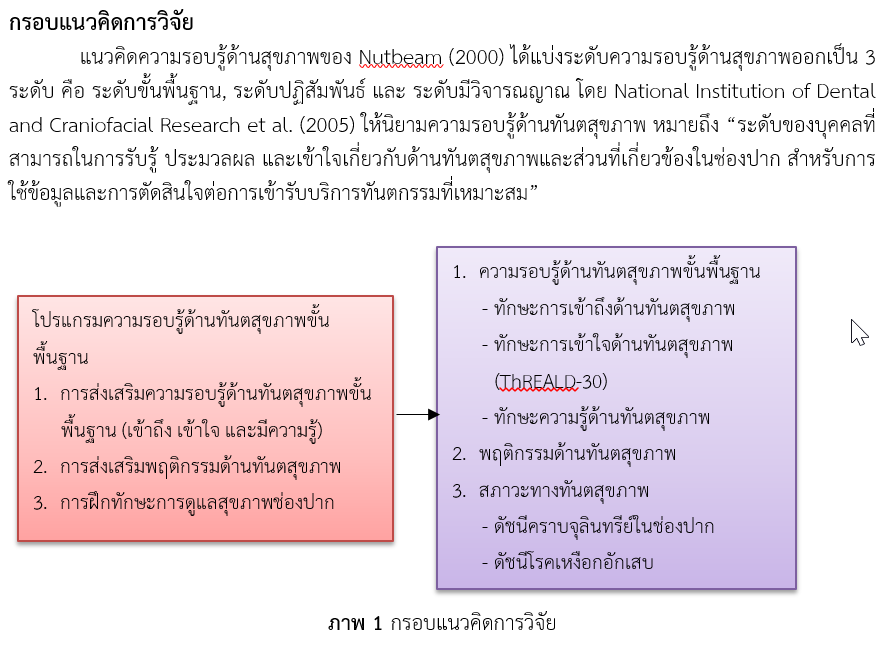
การศึกษากึ่งทดลองแบบสองกลุ่มครั้งนี้ มีวัตถุประสงค์เพื่อศึกษาผลของโปรแกรมความรอบรู้ด้านทันตสุขภาพขั้นพื้นฐานเพื่อส่งเสริมสุขภาพช่องปากของผู้ใหญ่ที่เป็นโรคเบาหวานชนิดที่ 2 ในพื้นที่เขตสุขภาพที่ 7 โดยแบ่งกลุ่มการศึกษาออกเป็น 2 กลุ่ม กลุ่มละ 40 คน ด้วยวิธีการสุ่มแบบหลายขั้นตอน ระยะการศึกษา 12 สัปดาห์ วัดก่อน-หลังการศึกษา และติดตามหลังการศึกษา 12 สัปดาห์ เก็บรวบรวมข้อมูลด้วยแบบสัมภาษณ์ แบบประเมินความรอบรู้ด้านทันตสุขภาพขั้นพื้นฐาน และแบบประเมินด้านทันตสุขภาพ วิเคราะห์ข้อมูลด้วยสถิติพรรณนาและสถิติอนุมานเพื่อเปรียบเทียบความแตกต่างระหว่างกลุ่ม (Independence t-test) และสรุปภาพรวม (Overall) ด้วยสถิติสมการประมาณค่าวางนัยทั่วไป (Generalized Estimating Equation; GEE) ผลการศึกษาพบว่า
ภายหลังการทดลองและการติดตามผล กลุ่มทดลองมีค่าเฉลี่ยคะแนนความรอบรู้ขั้นพื้นฐานเพิ่มขึ้น ในทักษะการเข้าถึง และความรู้ด้านทันตสุขภาพ มากกว่ากลุ่มเปรียบเทียบ อย่างมีนัยสำคัญทางสถิติ (p-value<0.05) ส่วนทักษะความเข้าใจด้านทันตสุขภาพของกลุ่มทดลองดีขึ้น และดีกว่ากลุ่มเปรียบเทียบ แต่ไม่พบความแตกต่างอย่างมีนัยสำคัญทางสถิติ (p-value>0.05) ทั้งนี้ ดัชนีคราบจุลินทรีย์และดัชนีโรคเหงือกอักเสบ ของกลุ่มทดลองดีขึ้น และดีกว่ากลุ่มเปรียบเทียบ อย่างมีนัยสำคัญทางสถิติ (p-value<0.05)
โปรแกรมความรอบรู้ด้านทันตสุขภาพขั้นพื้นฐานช่วยส่งเสริมให้ทันตสุขภาพของผู้ใหญ่ที่เป็นโรคเบาหวานชนิดที่ 2 ดีขึ้น สามารถนำไปประยุกต์ใช้สำหรับการศึกษาอื่นต่อไป
เอกสารอ้างอิง
กลุ่มยุทธศาสตร์และแผนงานสำนักโรคไม่ติดต่อ. (2559). รายงานประจำปี 2559. กรุงเทพฯ: สำนักงานกิจการ โรงพิมพ์องค์การสงเคราะห์ทหารผ่านศึก.
นาตยา แก้วพิภพ และพรรณี บัญชร หัตถกิจ. (2562). ผลของโปรแกรมการส่งเสริมความรอบรู้ด้านสุขภาพและการรับรู้ความสามารถตนเองเพื่อส่งเสริมพฤติกรรมการป้องกันการตั้งครรภ์. วารสารสุขศึกษา, 42(1), 1-12.
ปัณณี กิตติพงศ์พิทยา และคณะ. (2551). การประยุกต์ทฤษฎีการรับรู้ความสามารถตนเองเพื่อส่งเสริมการดูแลทันตสุขภาพในนักเรียนมัธยมศึกษาปีที่ 1 อำเภออรัญประเทศ จังหวัดสระแก้ว. วารสารสุขศึกษา, 31(108), 7-25.
ศักดิ์สิทธิ์ คำเกาะ, ชบาไพร สุวรรณชัยรบ, ศุภศิลป์ ดีรักษา, และรัชฎา ฉายจิต. (2563). ความสัมพันธ์ระหว่างความรอบรู้ด้านทันตสุขภาพกับการสูญเสียฟันของผู้ใหญ่ที่เป็นโรคเบาหวานชนิดที่ 2. วารสารโรงพยาบาลสกลนคร, 23(1), 63-73.
ศูนย์เทคโนโลยีสารสนเทศและการสื่อสาร กระทรวงสาธารณสุข. (2562). อัตราผู้ป่วยเบาหวานที่ขึ้นทะเบียน และมารับการรักษาในเขตพื้นที่รับผิดชอบ. สืบค้นเมื่อ 4 ตุลาคม 2562 จาก https://hdcservice.moph.go.th/hdc/reports/report.php?source=pformated/format1.php&cat_id=b2b59e64c4e6c92d4b1ec16a599d882b&id=e9fb648fe9f1858878714a410222eef1
สำนักทันตสาธารณสุข กรมอนามัย. (2561). รายงานผลการสำรวจสภาวะสุขภาพช่องปากระดับประเทศครั้งที่ 8 ประเทศไทย พ.ศ. 2560. กรุงเทพฯ: สำนักงานกิจการโรงพิมพ์องค์การสงเคราะห์ทหารผ่านศึก.
อรุณ จิรวัฒน์กุล. (2547). ชีวสถิติสำหรับงานวิจัยทางวิทยาศาสตร์สุขภาพ. ขอนแก่น: คลังนานาวิทยา.
อิสริยาภรณ์ สุรสีหเสนา. (2553). ผลของโปรแกรมการดูแลสุขภาพช่องปาก เพื่อปรับเปลี่ยนพฤติกรรมการดูแลสุขภาพช่องปากในผู้ป่วยเบาหวานหมู่บ้านโสก อำเภอคอนสวรรค์ จังหวัดชัยภูมิ. วิทยานิพนธ์ปริญญาสาธารณสุขศาสตรมหาบัณฑิต บัณฑิตวิทยาลัย มหาวิทยาลัยขอนแก่น.
Best, J. W. (1977). Research in Education3rd ed. Englewood Cliffs, New Jersey. Prentice-Hall.
Bloom, B. (1975). Taxonomy of Education Objective, Handbook 1: Cognitive Domain. New York: David Mckay.
Deeraksa, S., Leangubon, J., & Thaewpia, S. (2014). The Effectiveness of Oral Health Program by Learning with A Group Discussion for Oral Health Behaviors of Patients with Diabetes Mellitus in The Sanitarium Thakhuntho Sub District, Thakhuntho District, Kalasin Province. Thai Dental Nurse Journal, 25(2), 45-58.
Deeraksa, S., Chaichit, R., Muktabhant, B., & Udompanich, S. (2019). Reliability and Validity of the Thai Version of Rapid Estimate of adult literacy in dentistry. J Int Oral Health, 11(3), 132-6.
International Diabetes Federation. (2017). Diabetes Atlas, Eighth Edition. [n.p.]: International Diabetes Federation.
Kolb, D. A. (1984). Experiential Learning: Experience as the Source of Learning and Development. Englewood Cliffs New Jersey: Prentice-Hall.
Lee, J. Y., Divaris, K., Baker, A. D., Rozier, R. G., & Vann W. F. (2012). The Relationship of Oral Health Literacy and Self-Efficacy with Oral Health Status and Dental Neglect. Am J Public Health, 102(5), 923-929.
Lemeshow, S, & Levy, P. S. (1999). Sampling of Populations: Methods and Applications, 3rd ed. Wiley, New York: John Wiley and Sons.
Luo, H., Pan, W., Sloan, F., Feinglos, M., & Wu, B. (2015). Forty-Year Trends in Tooth Loss Among American Adults With and Without Diabetes Mellitus: An Age-Period-Cohort Analysis. Prev Chronic Dis, 12, E211.
National Institute of Dental and Craniofacial Research, National Institute of Health, U.S. Public Health Service, Department of Health and Human Services. (2005). The Invisible Barrier: Literacy and its Relationship with Oral Health. A Report of a Workgroup Sponsored by the National Institute of Dental and Craniofacial Research, National Institute of Health, U.S. Public Health Service, Department of Health and Human Services. J Public Health Dent Summer, 65(3), 174-182.
Nutneam, D. (2000). Health Literacy as a Public Goal: a Challenge for Contemporary Health Education and Communication Strategies Into the 21st Century. Health Promotion Int., 15(3), 259-67.
Silness, J., & Loe, H. (1967). Periodontal Disease in Pregnancy 3. Response to Local Treatment. Acta odonto Scan, 24, 747-749.
Vilella, K. D., Fraiz, F. C., Benelli, E. M., & Assuncao, L. R. (2017). Oral Health Literacy and Retention of Health Information Among Pregnant Women: A Randomized Controlled Trial. Oral Health Prev Dent, 15(1), 41-48.
ดาวน์โหลด
เผยแพร่แล้ว
ฉบับ
ประเภทบทความ
สัญญาอนุญาต
- บทความหรือข้อคิดเห็นใด ๆ ที่ปรากฏในวารสารสภาการสาธารณสุขชุมชน ที่เป็นวรรณกรรมของผู้เขียน บรรณาธิการ ไม่จำเป็นต้องเห็นด้วย
- บทความที่ได้รับการตีพิมพ์ถือเป็นลิขสิทธิ์ของ วารสารสภาการสาธารณสุขชุมชน


