
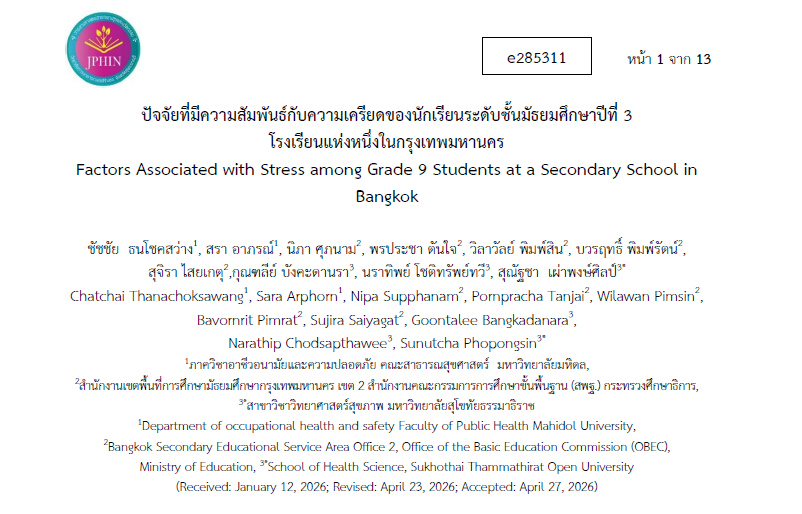
ปัจจัยที่มีความสัมพันธ์กับความเครียดของนักเรียนระดับชั้นมัธยมศึกษาปีที่ 3 โรงเรียนแห่งหนึ่งในกรุงเทพมหานคร
คำสำคัญ:
ความเครียด, พฤติกรรมเสี่ยงด้านจิตใจ, นักเรียนมัธยมศึกษาปีที่ 3, สุขภาพจิตวัยรุ่น, การจัดสรรเวลาบทคัดย่อ
การวิจัยครั้งนี้เป็นการวิจัยเชิงพรรณนาแบบภาคตัดขวาง มีวัตถุประสงค์เพื่อศึกษาระดับความเครียดและปัจจัยที่มีความสัมพันธ์กับความเครียดของนักเรียนระดับชั้นมัธยมศึกษาปีที่ 3 โรงเรียนแห่งหนึ่งในกรุงเทพมหานคร กลุ่มตัวอย่างคือ นักเรียนระดับชั้นมัธยมศึกษาปีที่ 3 จำนวน 421 คน คัดเลือกตัวอย่างด้วยวิธีการเจาะจง ตามเกณฑ์ที่กำหนด ได้แก่ เป็นนักเรียนที่กำลังศึกษาอยู่ในระดับชั้นมัธยมศึกษาปีที่ 3 ของโรงเรียนที่ศึกษา ได้รับความยินยอมจากผู้ปกครองและสมัครใจเข้าร่วมการวิจัย รวมถึงสามารถตอบแบบสอบถามได้ครบถ้วนสมบูรณ์ เครื่องมือที่ใช้ในการวิจัยประกอบด้วย แบบสอบถามข้อมูลทั่วไป และแบบวัดความเครียดของกรมสุขภาพจิต (ST-20) ผ่านทดสอบความเชื่อมั่นของเครื่องมือมีค่าสัมประสิทธิ์แอลฟาของครอนบาคเท่ากับ 0.70 วิเคราะห์ข้อมูลโดยใช้สถิติเชิงพรรณนา การวิเคราะห์ถดถอยพหุโลจิสติก กำหนดระดับนัยสำคัญทางสถิติที่ 0.05
ผลการศึกษาพบว่า นักเรียนส่วนใหญ่มีความเครียดอยู่ในระดับปกติ ร้อยละ 91.40 แต่มีกลุ่มเสี่ยงที่มีความเครียดในระดับสูงร้อยละ 8.60 ซึ่งจัดเป็นกลุ่มเสี่ยงที่ควรรีบปรึกษาจิตแพทย์ และปัจจัยที่มีความสัมพันธ์กับความเครียดของนักเรียนอย่างมีนัยสำคัญทางสถิติ ได้แก่ เพศหญิง (AOR = 2.23, 95% CI: 1.10, 4.54) ความสัมพันธ์กับเพื่อนที่ไม่ดี (AOR = 2.06, 95% CI: 1.06, 4.00) การจัดสรรเวลาของตนเองไม่ได้ (AOR = 2.27, 95% CI : 1.15, 4.48) การทะเลาะเบาะแว้งในครอบครัว (AOR = 2.03, 95% CI: 1.03, 4.00) และการมีปัญหาสุขภาพส่วนตัว (AOR = 2.14, 95% CI: 1.10, 4.16) ผลการศึกษาสะท้อนให้เห็นว่าปัญหาความเครียดและพฤติกรรมที่มีความเสี่ยงด้านจิตใจของนักเรียนเกิดจากปัจจัยหลายมิติ ทั้งด้านส่วนบุคคล ครอบครัว และสังคมโรงเรียน ดังนั้น โรงเรียนและหน่วยงานที่เกี่ยวข้องควรพัฒนาระบบคัดกรองและดูแลสุขภาพจิตนักเรียนอย่างเป็นระบบ ควบคู่กับการส่งเสริมทักษะการจัดการความเครียด การปรับตัวทางอารมณ์ และการสร้างความสัมพันธ์ที่ดี เพื่อป้องกันและลดความเสี่ยงต่อปัญหาสุขภาพจิตในกลุ่มวัยรุ่นอย่างยั่งยืน
เอกสารอ้างอิง
กรมสุขภาพจิต. (2565). รายงานสถานการณ์สุขภาพจิตเด็กและวัยรุ่นไทย. นนทบุรี:กระทรวงสาธารณสุข.
นิธิสนี รุจิรังสีเจริญ, นิดา ลิ้มสุวรรณ, ศิริไชย หงษ์สงวนศรี, และ บัญญัติ ยงย่วน. (2564). ปัจจัยที่สัมพันธ์กับระดับความเครียดของนักเรียนระดับมัธยมศึกษา สังกัดกรุงเทพมหานคร. วารสารสมาคมจิตแพทย์แห่งประเทศไทย, 66(1), 53–68.
Lazarus, R. S., & Folkman, S. (1984). Stress, appraisal, and coping. Springer.
Mark, E., & Anamwathana, P. (2025). Thailand's lost youth: Mental health crisis and the price of policy neglect. Fulcrum. https://fulcrum.sg/thailands-lost-youth-mental-health-crisis-and-the-price-of-policy-neglect/
Mickey, R.M., & Greenland, S. (1989). The Impact of confounder selection criteria on effect estimation. American Journal of Epidemiology, 129(1), 125-137. https://doi.org/10.1093/oxfordjournals.aje.a115101
Nayak, S. G., & Nair, S. (2019). Impact of procrastination and time-management on academic stress among undergraduate nursing students. International Journal of Caring Sciences, 12(3), 1484–1491. https://www.internationaljournalofcaringsciences.org/docs/18_nayak_original_12_3.pdf
Solomon, M. B., & Herman, J. P. (2009). Sex differences in psychopathology: Of gonads, adrenals and mental illness. Physiology & Behavior, 97(2), 250–258. https://doi.org/10.1016/j.physbeh.2009.02.033
Stuke, H., Schlack, R., Erhart, M., Kaman, A., Ravens-Sieberer, U., & Irrgang, C. (2025). Peer relationships are a direct cause of the adolescent mental health crisis: Interpretable machine learning analysis of 2 large cohort studies. JMIR Public Health and Surveillance, 11, Article e60125. https://doi.org/10.2196/60125
Thanachoksawang, C., Arphorn, S., Jarupat Maruo, S., Punneng, S., Ishimaru, T., & Bangkadanara, G. (2024). Psychological distress among high school students in Bangkok, Thailand. Health Psychology Research, 12, Article 120045. https://doi.org/10.52965/001c.120045
Wang, Y., & Tang, W. (2025). The association between parent-adolescent conflicts and depressive mood: A systematic review and meta-analysis. BMC Psychology, 13, Article1044. https://doi.org/10.1186/s40359-025-03021-3
World Health Organization. (2025). Mental health of adolescents [Fact sheet]. https://www.who.int/news-room/fact-sheets/detail/adolescent-mental-health
ดาวน์โหลด
เผยแพร่แล้ว
รูปแบบการอ้างอิง
ฉบับ
ประเภทบทความ
สัญญาอนุญาต
ลิขสิทธิ์ (c) 2026 วิทยาลัยการสาธารณสุขสิรินธร จังหวัดสุพรรณบุรี

อนุญาตภายใต้เงื่อนไข Creative Commons Attribution-NonCommercial-NoDerivatives 4.0 International License.
1. บทความหรือข้อคิดเห็นใด ๆ ที่ปรากฏในวารสารศาสตร์สาธารณสุขและนวัตกรรม ที่เป็นวรรณกรรมของผู้เขียน บรรณาธิการ ไม่จำเป็นต้องเห็นด้วย
2. บทความที่ได้รับการตีพิมพ์ถือเป็นลิขสิทธิ์ของ วารสารศาสตร์สาธารณสุขและนวัตกรรม



