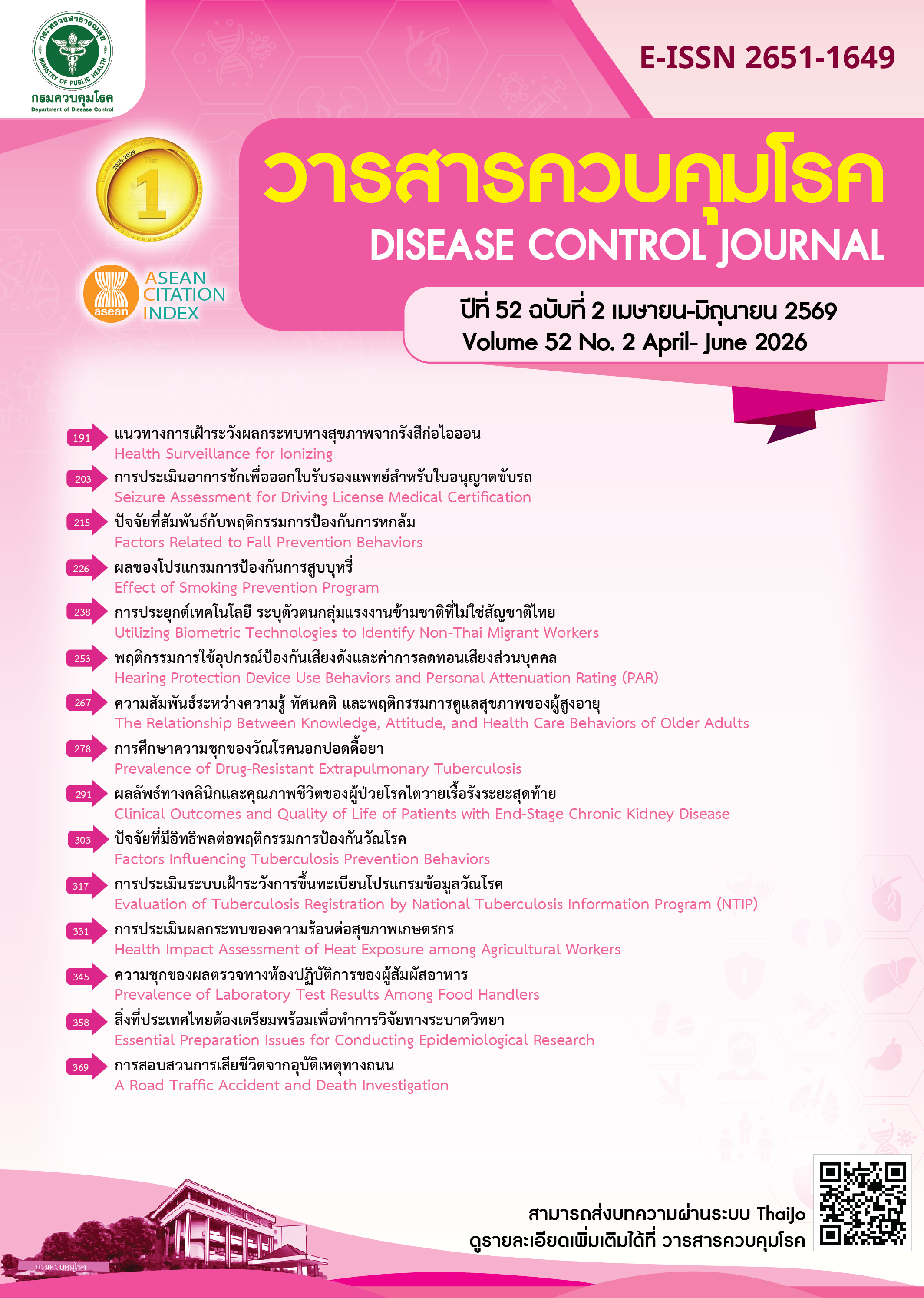
การประเมินผลกระทบของความร้อนต่อสุขภาพเกษตรกร อำเภอเมือง จังหวัดนครราชสีมา
DOI:
https://doi.org/10.14456/dcj.2026.27คำสำคัญ:
การสัมผัสความร้อน, เกษตรกรทำงานกลางแจ้ง, การตอบสนองทางสรีรวิทยา, ภาวะขาดน้ำ, ภาวะไตเรื้อรังบทคัดย่อ
การวิจัยครั้งนี้เป็นการศึกษาเชิงพรรณนาภาคตัดขวาง มีวัตถุประสงค์เพื่อ (1) ศึกษาค่าดัชนีความร้อนและภาระงานของเกษตรกรที่ทำงานกลางแจ้ง (2) ศึกษาความเสี่ยงของภาวะไตเรื้อรัง (3) เปรียบเทียบความแตกต่างของปัจจัยทางสรีรวิทยา และ (4) ศึกษาปัจจัยทางสรีรวิทยาที่ส่งผลต่อภาวะการขาดน้ำในเกษตรกรอำเภอเมือง จังหวัดนครราชสีมา โดยเก็บข้อมูลภาคสนามช่วงเดือนพฤษภาคมถึงมิถุนายน ช่วงเวลา 08.30-17.30 น. โดยใช้เครื่องวัดความร้อนในสภาพแวดล้อมการทำงาน (Wet Bulb Globe Temperature: WBGT) heat stress monitor) ตาม ISO 7243 พร้อมตรวจปัจจัยสรีรวิทยาโดยใช้เครื่องวัดอุณหภูมิ เครื่องวัดความดันโลหิต เครื่องชั่งน้ำหนักอ่านค่าดิจิทัล แถบตรวจปัสสาวะ ชุดตรวจหาไมโครอัลบูมินแบบตลับ และแบบสัมภาษณ์ครอบคลุมข้อมูลส่วนบุคคล ปัจจัยการทำงาน และการเปลี่ยนแปลงทางสรีรวิทยา มีกลุ่มตัวอย่าง 130 คน (เพศชาย 57 คน เพศหญิง 73 คน อายุเฉลี่ย 47.84±12.8 ปี) และวิเคราะห์ข้อมูลโดยใช้ Friedman test, Wilcoxon signed-rank test, Cochran Q test, McNemar test และ Multiple binary logistic regression ผลการวิจัยพบว่าค่าดัชนีความร้อนภายนอก (WBGTout) มีค่าสูงสุด 33.2°C และเกษตรกรทุกคน(100%) สัมผัสความร้อนเกินเกณฑ์มาตรฐานตามข้อเสนอแนะของ American Conference of Governmental Industrial Hygienist: ACGIH) เมื่อคำนวณ Clothing adjustment factor ร่วมด้วย ค่า Effective WBGT มีค่าสูงสุด 37.10 °C กลุ่มตัวอย่างมีภาวะขาดน้ำสูงถึงร้อยละ 73.8 และพบโปรตีนและเม็ดเลือดขาวในปัสสาวะมีผลผิดปกติร้อยละ 12.3 และ 16.2 ตามลำดับ และมีความเสี่ยงต่อภาวะไตเรื้อรังที่ไม่ทราบสาเหตุชัดเจนร้อยละ 16.3 เมื่อเปรียบเทียบน้ำหนักตัว อุณหภูมิแกนกลางของร่างกาย (หูซ้าย) อัตราการเต้นของหัวใจ พบว่าในช่วงก่อนแตกต่างจากช่วงระหว่าง และหลังการทำงาน อย่างมีนัยสำคัญทางสถิติ (p-value<0.05) สำหรับอุณหภูมิแกนกลางของร่างกาย (หูขวา) แตกต่างกันทุกช่วง เวลาที่เปรียบเทียบ (p-value<0.05) ปัจจัยเสี่ยงต่อการเกิดภาวะขาดน้ำของเกษตรกร คือ เพศชายมีโอกาสเกิดภาวะขาดน้ำมากกว่าเพศหญิง 2.86 เท่า (95% CI=1.036-7.874, p-value=0.043) ไม่พบว่า BMI และ อายุ ของเกษตรกรทำงานกลางแจ้งมีความสัมพันธ์กับภาวะขาดน้ำ จึงกล่าวได้ว่าเกษตรกรกลางแจ้งเผชิญภาวะความเค้นจากความร้อนสูง มีความเสี่ยงต่อการเกิดภาวะขาดน้ำและโรคไตเรื้อรังระยะเริ่มต้นหรือภาวะโรคไตเรื้อรังที่ไม่ทราบสาเหตุชัดเจนที่มักพบในกลุ่มเกษตรกรทำงานหนักกลางแจ้งในประเทศเขตร้อน จึงควรพัฒนามาตรการจัดการความร้อนและส่งเสริมการดื่มน้ำที่เหมาะสม
Downloads
เอกสารอ้างอิง
Thai Meteorological Department. Climate information [Internet]. Bangkok: TMD; 2024 [cited 2024 May 10]. Available from: https://www.tmd.go.th/climate/climateSubpage (in Thai)
National Statistical Office. Agricultural Census 2023: Northeastern Region. Bangkok: National Statistical Office; 2023 [Internet]. [cited 2023 Feb 1]. Available from: https://www.nso.go.th/public/e-book/Census_Survey/Agricultural-Census-Northeastern-2566/2/ (in Thai)
Health Impact Assessment Division. Heat. Topic: “Health Effects of Heat Exposure.” Health Impact Assessment Division, Ministry of Public Health [Internet]. [cited 2023 Feb 1]. Available from: https://hia.anamai.moph.go.th/web-upload/12xb1c83353535e43f224a05e184d8fd75a/202402/m_magazine/35644/4745/file_download/c4239838ba7712df487d2b896652145f.pdf (in Thai)
Chapman CL, Hess HW, Lucas RAI, Glaser J, Saran R, Bragg-Gresham J, et al. Occupational heat exposure and the risk of chronic kidney disease of nontraditional origin in the United States. Am J Physiol Regul Integr Comp Physiol. 2021;321(2):R141–51. doi: 10.1152/ajpregu.00103.2021
Wanigasuriya KP, Peiris-John RJ, Wickremasinghe RL. Chronic kidney disease of unknown aetiology in Sri Lanka: is cadmium a likely cause? BMC Nephrol. 2011;12:32. doi: 10.1186/1471-2369-12-32
Ioannou LG, Foster J, Morris NB, Piil JF, Havenith G, Mekjavic IB, et al. Occupational heat strain in outdoor workers: a comprehensive review and meta-analysis. Temperature (Austin). 2022;9(1):67–102. doi: 10.1080/23328940.2022.2030634
Sawka MN, Burke LM, Eichner ER, Maughan RJ, Montain SJ, Stachenfeld NS. American College of Sports Medicine position stand: exercise and fluid replacement. Med Sci Sports Exerc. 2007;39(2):377–90. doi: 10.1249/mss.0b013e31802ca597
International Organization for Standardization. ISO 7243:2017. Hot environments-estimation of the heat stress on working man, based on the WBGT-index. Geneva: ISO; 2017.
American Conference of Governmental Industrial Hygienists. TLVs and BEIs: threshold limit values for chemical substances and physical agents & biological exposure indices. Cincinnati: ACGIH; 2023.
Ahmedabad Municipal Corporation; Indian Institute of Public Health, Gandhinagar; Natural Resources Defense Council. Ahmedabad heat action plan 2015: guide to extreme heat planning in Ahmedabad, India [Internet]. Ahmedabad: AMC; 2015 [cited 2025 Aug 1]. Available from: https://iiphg.edu.in/images/pdfs/NRDC/HAP_2015.pdf
World Meteorological Organization, World Health Organization. Heatwaves and health: guidance on warning-system development. Geneva: WMO–WHO; 2015.
Fanger PO. Thermal comfort: analysis and applications in environmental engineering. New York: McGraw-Hill; 1970.
Gagge AP, Stolwijk JAJ, Nishi Y. An effective temperature scale based on a simple model of human physiological regulatory response. Memoirs of the Faculty of Engineering, Hokkaido University [Internet]. 1972 [cited 2025 Aug 1];13(Suppl):21-36. Available from: https://eprints.lib.hokudai.ac.jp/repo/huscap/all/37901/13Suppl_21-36.pdf
U.S. Department of Labor, Occupational Safety and Health Administration. OSHA Technical Manual – Section III, Chapter 4: Heat Stress. Available from: www.osha.gov/dts/osta/otm_iii/otm_iii_4.html
Ministry of Labour. Ministerial Regulation on the Standards for Administration and Management of Occupational Safety, Health, and Working Environment regarding Heat, Lighting, and Noise, B.E. 2559 (2016). Royal Thai Government Gazette. 2016;133(91A). (in Thai)
Srisawat N, Pisitkul T, Tungsanga S, Komolpis K, Peerapornratana S. Total solution for early screening of chronic kidney disease using albuminuria test kits in primary care: final research report. Bangkok: Health Systems Research Institute; 2022. (in Thai)
Department of Disease Control. Do you know your body mass index (BMI) and its classification? Topic: “BMI Assessment Criteria.” Online Journal of the Division of Non-Communicable Diseases [Internet]. [cited 2022 Jan 24]. Available from: https://ddc.moph.go.th/dncd/journal_detail.php?publish=12207 (in Thai)
International Organization for Standardization. ISO 9886:2004. Ergonomics evaluation of thermal strain by physiological measurements. Geneva: ISO; 2004.
Ben Khadda Z, Lahmamsi H, El Karmoudi Y, Ezrari S, El Hanafi L, Sqalli Houssaini T. Chronic Kidney Disease of Unknown Etiology: A Global Health Threat in Rural Agricultural Communities-Prevalence, Suspected Causes, Mechanisms, and Prevention Strategies. Pathophysiology. 2024;31(4):761-86. doi: 10.3390/pathophysiology31040052
Kenefick RW, Sawka MN. Hydration at the work site. J Am Coll Nutr. 2007;26(5 Suppl):597S–603S. doi: 10.1080/07315724.2007.10719665
Abbey BM, Heelan KA, Brown GA, Bartee RT. Validity of HydraTrend reagent strips for the assessment of hydration status. J Strength Cond Res. 2014;28(9):2634-9. doi: 10.1519/JSC.0000000000000430.
Ingsathit A, Thakkinstian A, Chaiprasert A, Sangthawan P, Gojaseni P, Kiattisunthorn K, et al. Prevalence and risk factors of chronic kidney disease in the Thai adult population: Thai SEEK study. Nephrol Dial Transplant. 2010;25(5):1567–75. doi: 10.1093/ndt/gfp669
Hill NR, Fatoba ST, Oke JL, Hirst JA, O’Callaghan CA, Lasserson DS, et al. Global prevalence of chronic kidney disease: a systematic review and meta-analysis. PLoS One. 2016;11(7):e0158765. doi: 10.1371/journal.pone.0158765
Notley SR, Lamarche DT, Meade RD, Flouris AD, Kenny GP. Revisiting the influence of individual factors on heat exchange during exercise in dry heat using direct calorimetry. Experimental Physiology. 2019;104(7):1038–50. doi: 10.1113/EP087666
Tseng MF, Chou CL, Chung CH, Chen YK, Chien WC, Feng CH, et al. Risk of chronic kidney disease in patients with heat injury: a nationwide longitudinal cohort study in Taiwan. PLoS One. 2020;15(7):e0235607. doi: 10.1371/journal.pone.0235607
Francescato MP, Venuto I, Buoite Stella AB, Stel G, Mallardi F, Cauci S. Sex differences in hydration status among adolescent elite soccer players. J Human Sport Exerc [Internet]. 2019 [cited 2025 Aug 1];14(2):265–80. Available from: https://air.uniud.it/handle/11390/1140947
ดาวน์โหลด
เผยแพร่แล้ว
รูปแบบการอ้างอิง
ฉบับ
ประเภทบทความ
สัญญาอนุญาต
ลิขสิทธิ์ (c) 2026 วารสารควบคุมโรค

อนุญาตภายใต้เงื่อนไข Creative Commons Attribution-NonCommercial-NoDerivatives 4.0 International License.
บทความที่ลงพิมพ์ในวารสารควบคุมโรค ถือว่าเป็นผลงานทางวิชาการหรือการวิจัย และวิเคราะห์ตลอดจนเป็นความเห็นส่วนตัวของผู้เขียน ไม่ใช่ความเห็นของกรมควบคุมโรค ประเทศไทย หรือกองบรรณาธิการแต่ประการใด ผู้เขียนจำต้องรับผิดชอบต่อบทความของตน