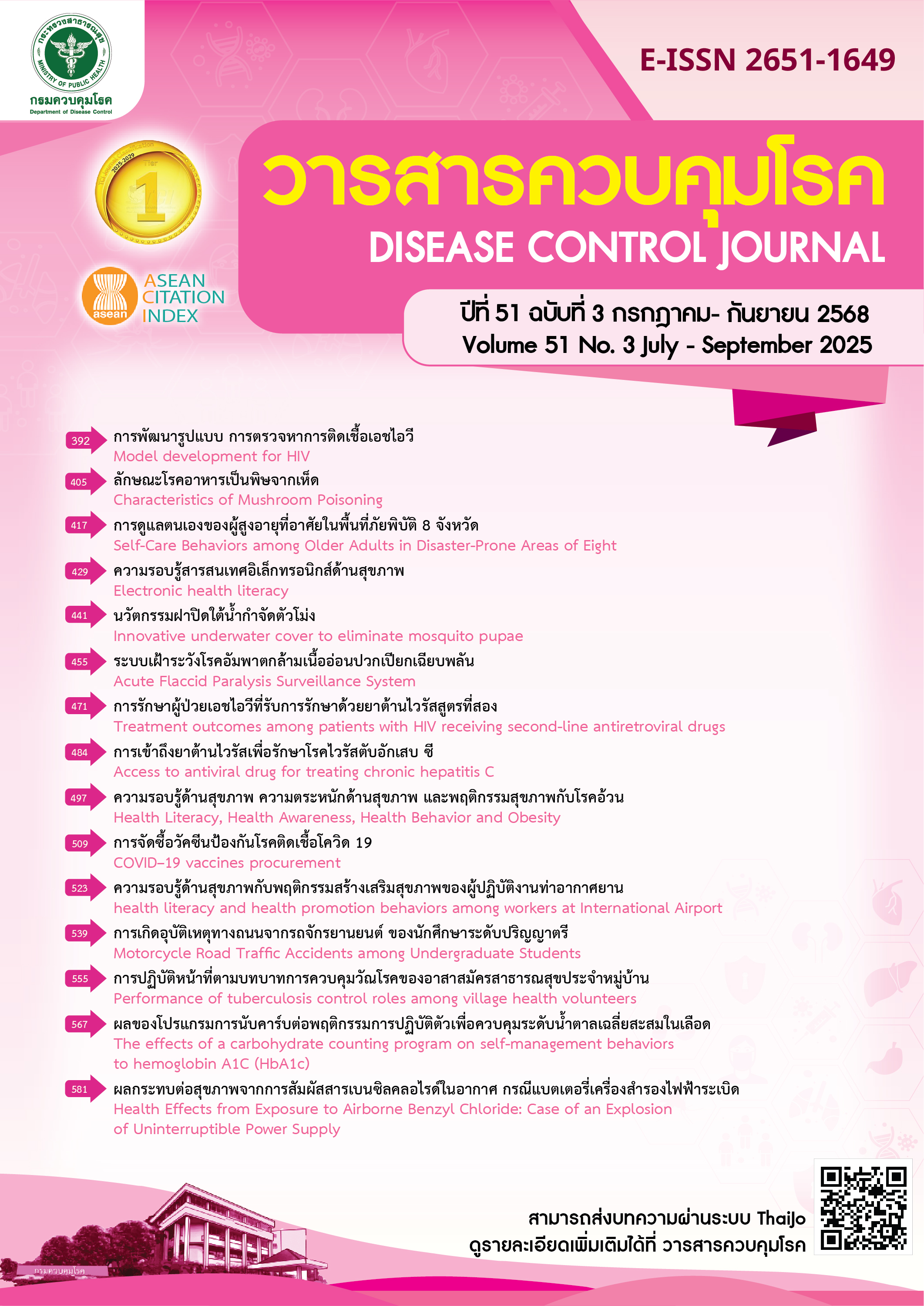
A pilot project to increase access to antiviral drug for treating chronic hepatitis C in 2022-2023
DOI:
https://doi.org/10.14456/dcj.2025.39Keywords:
Viral hepatitis C, Access, Antivirals drug for hepatitis CAbstract
Chronic hepatitis C is a major cause of liver cirrhosis and liver cancer. In previous implementations, access to screening services has remained limited due to the exclusion of such services from the national benefit package. Furthermore, notable barriers persist that hinder patients’ ability to access appropriate treatment, the Division of AIDS and STIs (DAS) initiated a pilot project to increase access to antiviral drug for treating chronic hepatitis C in 2022. The objective of this initiative is to improve access to hepatitis C virus (HCV) screening and treatment within pilot provincial settings. The project implemented a service delivery model in which trained general practitioners provide both diagnosis and immediate treatment across 3 pilot provinces. DAS provided reagents for hepatitis C viral load testing and antiviral drugs for those with a positive Anti-HCV result. Patients underwent confirmatory testing with HCV Viral Load. Those without complications received antiviral treatment for 12 weeks at community hospitals and monitored their treatment outcomes, administered by trained general practitioners. Local staff collected data from report forms and recorded treatment information in a reporting program and analyzed the data using descriptive statistics. The project results showed that 19,708 individuals in the target population underwent anti-HCV screening, with 2.2 % (425 individuals) testing positive for Anti-HCV. Among these, 96.2% underwent HCV viral load testing, with 87.5 % (358 individuals) testing positive. Of these, 98.6% (353 individuals) patients received treatment at community hospitals (CPH). Five individuals did not receive antiviral therapy: two patients with cirrhosis were referred to medical specialists, while three patients declined treatment due to work-related relocation. A total of 292 patients (82.7%) completed the 12-week antiviral treatment and follow-up, where 278 patients (95.2%) achieved a sustained virological response (SVR), indicating a complete cure. The implementation demonstrated that the target population had access to screening and received immediate and accurate treatment from trained general practitioners. In community hospitals, these physicians were able to manage and prescribe medications for patients without complications, thereby improving the timeliness and accessibility of care. Therefore, this operational model should be expanded to cover all provinces by providing training for doctors in community hospitals and establishing a consultation system with gastroenterologists in referral hospitals. Additionally, the system for recording screening and treatment data should be developed to link data with service units. Laboratory testing for hepatitis C should be integrated into the regular testing system to reduce referral costs from local service units. Finally, guidelines for managing hepatitis C should be developed to enhance understanding and efficiency among provincial staff.
Downloads
References
World Health Organization. Guidance for country validation of viral hepatitis elimination and path to elimination [Internet]. Geneva. World Health Organization; 2023 [cited 2024 Aug 26]. Available from: https://iris.who.int/bitstream/handle/10665/373186/9789240078635eng.pdf?sequence=1
World Health Organization. Interim guidance for country validation of viral hepatitis elimination [Internet]. Geneva. World Health Organization; 2021 [cited 2024 Aug 27]. Available from: https://iris.who.int/bitstream/handle/10665/341652/9789240028395-eng.pdf?sequence=1
Wasitthankasem R, Posuwan N, Vichaiwattana P, Theamboonlers A, Klinfueng S, Vuthitanachot V, et al. Decreasing hepatitis C virus infection in Thailand in the past decade: evidence from the 2014 national survey. PLoS One. 201611(2):e0149362.
Lertpiriyasuwat C, Jiamsiri S, Dithapan W, Nuchtean T, Srisawat K, Wanthong R, et al. Viral hepatitis B and C screening by collaboration of local administrative organization, 2022-2023. Dis Control J. 2024;50:589-99. (in Thai)
Chitapanarux T, Phornphutkul K. Risk factors for the development of hepatocellular carcinoma in Thailand. J Clin Transl Hepatol. 2015;3(3):182-8.
International agency for research on cancer, World Health Organization. Thailand cancer statistics 2022 [Internet]. [cited 2024 Aug 29]. Available from: https://gco.iarc.who.int/media/globocan/factsheets/populations/764-thailand-fact-sheet.pdf
Pilasant S, Leelahavarong P, Kulpokin D. A synthesis of policy recommendations on budgeting of implementing sofosbuvir/velpatasvir as a pan-genotypic regimen for the treatment of chronic hepatitis C in Thailand [Internet]. Nonthaburi. Health Systems Research Institute; 2020 [cited 2024 Aug 30]. Available from: https://www.hitap.net/wp-content/uploads/2021/12/SOF-VEL-Report.pdf
Mongkolwaj K, The development of self-health management system for hepatitis C infection patients during waiting for the treatment process at Lomsak hospital. Phetchabun Medical Journal. 2022;3:1-18. (in Thai)
Liakina V, Valantinas J. Anti-HCV prevalence in the general population of Lithuania. Med Sci Monit. 2012;18(3):28-35.
Piangpratch P. The development of self-health management system for hepatitis C infection patients during waiting for the treatment process at Lomsak hospital. Chaiyaphum Journal.2024;44 (2):13-26. (in Thai)
Viejo L, Herola A, Lloret I, Ruano F, Paulino I, Ivorra C, et al. Screening of hepatitis C virus infection in adult general population in Spain. European Journal of Gastroenterology & Hepatology. 2018;30(9):1077-81.
Numpraphrut P. Effectiveness of Sofosbuvir-Velpatasvir Regimen in The Treatment of Patients with Chronic Hepatitis C Infection in Vachiraphuket Hospital. Maharat Nakhon Si Thammarat Medical Journal. 2024;8:149-61. (in Thai)
Pin-Nan Cheng, Lein-Ray Mo, Chun-Ting Chen, Chi-Yi Chen, Chung-Feng Huang, Hsing-Tao Kuo, et al. Sofosbuvir/Velpatasvir for Hepatitis C Virus Infection: Real-World Effectiveness and Safety from a Nationwide Registry in Taiwan. Infect Dis Ther. 2022;11:485-500.
Chaimongkol N, Kanjanarat P, Thongsawat S, Thetket K, Saewtrakool C. Effectiveness and Safety of Sofosbuvir/Velpatasvir and Barriers to Accessing Sofosbuvir/Velpatasvir among Patients with Hepatitis C Virus Infection: A Descriptive Study.Thai Journal pharmacy practice. 2024;16:1139-53. (in Thai)
Sangngean T. Chronic hepatitis C treatment outcome in Somdejpraputhayodfajulaloak Maharaj Fort Hospital from 2007-2014. Mahasarakham Hospital Journal. 2015;12:41-54. (in Thai)
Downloads
Published
How to Cite
Issue
Section
License
Copyright (c) 2025 Disease Control Journal

This work is licensed under a Creative Commons Attribution-NonCommercial-NoDerivatives 4.0 International License.
Articles published in the Disease Control Journal are considered as academic work, research or analysis of the personal opinion of the authors, not the opinion of the Thailand Department of Disease Control or editorial team. The authors must be responsible for their articles.