
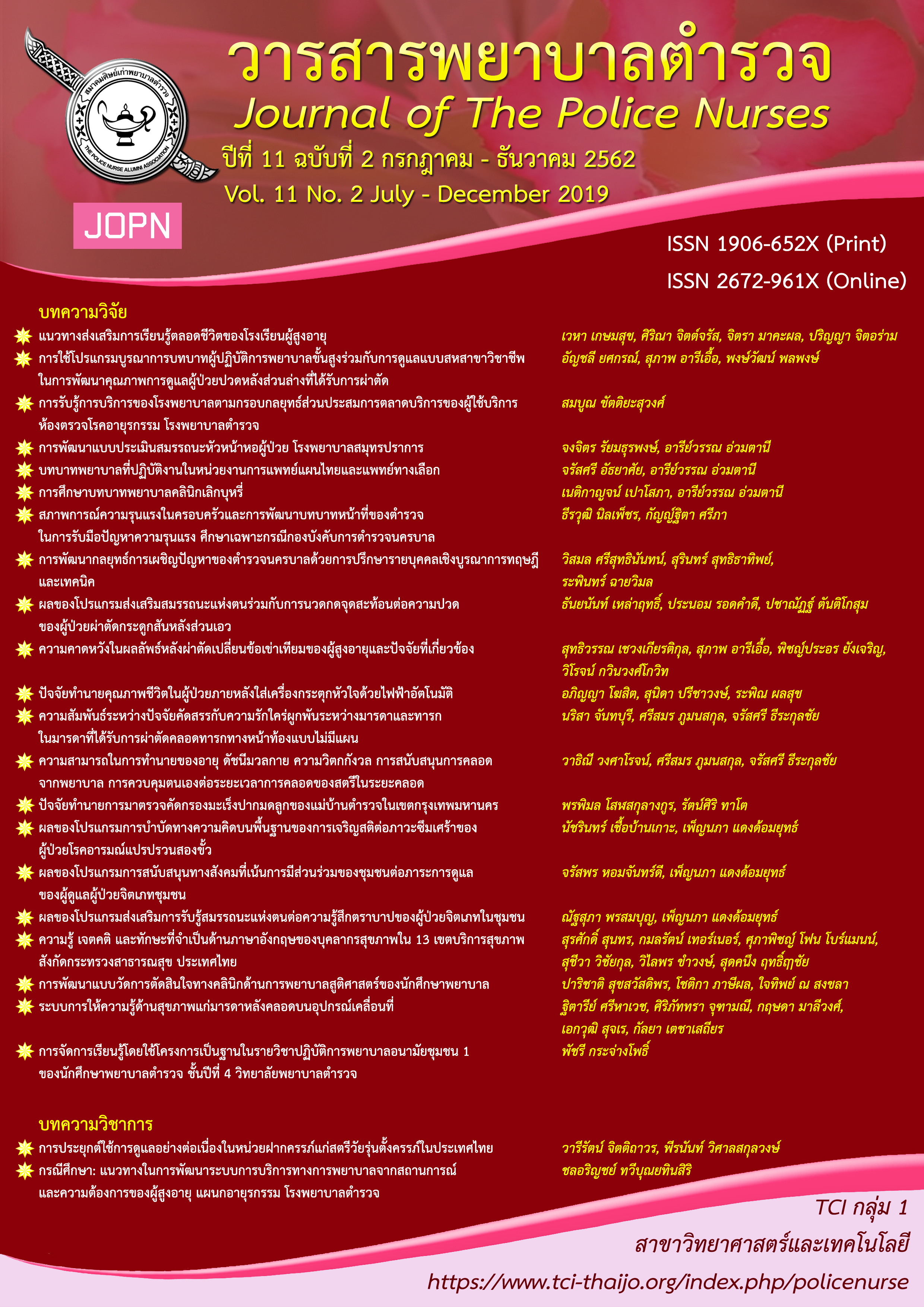
ความสามารถในการทำนายของอายุ ดัชนีมวลกาย ความวิตกกังวล การสนับสนุนการคลอดจากพยาบาล การควบคุมตนเองต่อระยะเวลาการคลอดของสตรีในระยะคลอด
คำสำคัญ:
ระยะเวลาการคลอด, อายุ, ดัชนีมวลกาย, ความวิตกกังวล, การสนับสนุนการคลอดจากพยาบาล, การควบคุมตนเองบทคัดย่อ
การวิจัยครั้งนี้เป็นการวิจัยเชิงทำนายเพื่อศึกษาความสามารถในการร่วมกันทำนายของอายุ ดัชนีมวลกาย ความวิตกกังวล การสนับสนุนการคลอดจากพยาบาล และการควบคุมตนเองต่อระยะเวลาการคลอดของสตรีในระยะคลอด ตัวอย่างเป็นผู้คลอดที่คลอดปกติทางช่องคลอดที่มาคลอดและพักฟื้นในหอผู้ป่วยสูติกรรมหลังคลอด และหอผู้ป่วยพิเศษสูติ-นรีเวช โรงพยาบาลรามาธิบดี กรุงเทพมหานคร ระหว่างเดือน กันยายน ถึง ธันวาคม พ.ศ. 2559 เลือกตัวอย่างแบบเจาะจง (purposive selection) จำนวน 100 ราย เก็บข้อมูลโดยใช้แบบสอบถามข้อมูลส่วนบุคคลและข้อมูลการคลอด แบบสอบถามความวิตกกังวลในระยะคลอด แบบสอบถามพฤติกรรมการสนับสนุนการคลอดจากพยาบาล และแบบสอบถามการควบคุมตนเองของผู้คลอดในระยะคลอด วิเคราะห์ข้อมูลโดยใช้สถิติเชิงบรรยายและการวิเคราะห์ถดถอยพหุคูณแบบขั้นตอน
ผลการวิจัยพบว่ามีเพียงอายุที่สามารถทำนายระยะที่ 1 ของการคลอดได้ร้อยละ 4 (R2 = .04, F(1, 98) = 3.98, p = .04) และมีข้อเสนอแนะว่าพยาบาลควรประเมินปัจจัยทางด้านอายุของผู้คลอดเพื่อช่วยในการวางแผนการพยาบาลในการลดระยะเวลาการคลอดให้เหมาะสม และจากการศึกษาปัจจัยที่ส่งผลต่อระยะเวลาการคลอดพบว่ายังมีผลการศึกษาที่ทั้งสนับสนุนและขัดแย้งกัน จึงอาจมีการศึกษาซ้ำเพื่อช่วยให้สตรีในระยะรอคลอดมีระยะเวลาการคลอดที่เหมาะสม
Downloads
เอกสารอ้างอิง
Boonpongmanee, C., Chunuan, S., & Somsap, Y. (2005). Effects of empowerment and continuous support on psychological factors, pain coping behaviors, and birth outcomes. Songklanagarind Medical Journal, 23(1), 37-47. doi:10.1002/146 51858.CD003766.pub4
Cohen, J. (1988). Statistical power analysis for the behavior sciences (2nd ed.). Hillsdale, NJ: Lawrence Erlbaum.
Costa, D., Dritsa, M., Larouch, J., & Brender, W. (2000). Psychosocial predictors of labor delivery complications and infant birth weight: A prospective multivariate study. Journal of Psychosomatic Obstetrics & Gynaecology, 21(3), 137-148. doi:10.3109/01674820009075621
Cunningham, F. G., Leveno, K. J., Bloom, S. L., Spong, C. Y., Dashe, J. S., Hoffman, B. L., . . . Sheffield, J. S. (2014). Williams obstetrics (24th ed.). New York, NY: McGraw-Hill.
Gorrie, T. M., McKinney, E. S., & Murray, S. S. (1994). Foundations of maternal-newborn nursing. Philadelphia, PA: W. B. Saunders.
Hodnett, E. D., & Osborn, W. (1989). Effects of continuous intrapartum professional support on childbirth outcomes. Research in Nursing & Health, 12, 289-297. https://doi.org/10.1002/nur.4770120504
Hodnett, E. D., Gates, S., Hofmeyr, G. J., & Sakala, C. (2013). Continuous support for women during childbirth. Cochrane Database of Systematic Reviews, 7, 1-85. doi:10.1002/14651858.CD003766.pub5
Klaus, M., Kennell, J., Berkowitz, G., & Klaus, P. (1992). Maternal assistance and support in labor: Father, nurse, midwife, or doula. Clinical Consultations in Obstetrics and Gynecology, 4(4), 211-217.
Lederman, R. P. (1978). The relationship of maternal anxiety, plasma catecholamine and plasma cortisol to progress in labour. American Journal of Obstetrics & Gynecology, 25, 495 - 500. doi:10.1016/0002-9378(78)90742-1
London, N. K., Ladewig, P. W., Ball, J. W., & McGillis Bindler, R. C. (2003). Maternal newborn & child nursing family - centered care. Upper Saddle River, NJ: Prentice hall.
Lowdermilk, D. L., & Perry, S. H. (2004). Maternity and women’s health care (8th ed.). St. Louis, MO: Mosby.
Lowe, N. K. (2002). The nature of labour pain. American Journal of Obstetrics & Gynecology, 186, S16-S24. https://doi.org/10.1016/S0002-9378(02)701 79-8
Montgomery, K. S. (2003). Nursing care of pregnant adolescents. Journal of Obstetric Gynecologic & Neonatal Nursing, 32(2), 249-257. https://doi.org/ 10.1177/0884217503252191
Namey, E. E., & Lyerly, A. D. (2010). The meaning of “control” for childbearing women in the US. Social Science and Medicine, 71(4), 769-776. doi:10.1016/j.socscimed.2010.05.024
O’Hare, J., & Fallon, A. (2011). Women’s experience of control in labour and childbirth. British Journal of Midwifery, 19(3), 164-169. https://doi.org/10. 12968/bjom.2011.19.3.164
Phumonsakul, S., Suksanguan, P., & Khanobdee, C. (2016). Development of the labor support scale for intrapartum nurse. Ramathibodi Nursing Journal, 22(3), 247-262.
Promrak, P. (2004). The effect of integrated pain management program on labor pain, duration of first stage of labor, and childbirth experience in primiparous mother (Master of nursing science program, maternal and newborn nursing). Faculty of Medicine Ramathibodi Hospital, Mahidol University, Bangkok, Phayathai.
Sauls, D. J. (2002). Effect of labor support on mothers, babies, and birth outcomes. Journal of Obstetric, Gynecologic & Neonatal Nursing, 31(6), 733-741. doi:10.1177/0884217502239209
Spielberger, C. D., Lushene, R. E., & McAdoo, W. G. (1977). Theory and measurement of anxiety states. Handbook of modern personality theory, pp. 239-253.
Tuntanokij, J. (2005). The effects of childbirth training program for pregnant women and supporters on pain level, pain coping behaviors, laboring period and childbirth experience (Master of nursing science program, maternal and newborn nursing). Faculty of Medicine Ramathibodi Hospital, Mahidol University, Bangkok, Phayathai.
Wong, L. D., Perry, S. E., Hockenberry, M. J., Lowdermilk, D. D., & Wilson, D. (2002). Maternal child nursing care (3rd ed.). Philadelphia, PA: Mosby Elsevier.
World Health Organization. (2004). Appropriate body-mass index for Asian population and its implications for policy and intervention strategies. Lancet, 363(9403), 157-163. doi:10.1016/S0140-6736(03)15268-3
ดาวน์โหลด
เผยแพร่แล้ว
รูปแบบการอ้างอิง
ฉบับ
ประเภทบทความ
สัญญาอนุญาต
ผลงานที่ได้ตีพิมพ์แล้วจะเป็นลิขสิทธิ์ของวารสารพยาบาลตำรวจ